
Choosing the right fulfillment model determines your success in Africa’s cross-border e-commerce market. Merchants must balance cost efficiency, delivery speed, customs compliance, and scalability when entering African markets or expanding internationally. This guide explains the main fulfillment types available and provides decision criteria to help you select the optimal approach for your business needs and growth stage.
Table of Contents
- How To Choose The Right E-Commerce Fulfillment Model For Cross-Border Africa Trade
- Direct Shipping Fulfillment Model
- Warehousing Fulfillment Model
- Dropshipping Fulfillment Model
- Hybrid Fulfillment Models
- Compliance And The Importer Of Record Role
- Multi-Courier Networks And Marketplace Integration
- Summary Comparison And Situational Recommendations
- Discover Moreshores Cross-Border Fulfillment Solutions
Key takeaways
| Point | Details |
|---|---|
| Evaluate cost, speed, and compliance | Balance delivery timelines, shipping expenses, and regulatory requirements when choosing fulfillment models |
| Direct shipping works for market testing | Low upfront costs but slower delivery makes this ideal for small sellers validating demand |
| Warehousing accelerates growth | Regional inventory storage enables 1-3 day delivery and higher repeat purchases for scaling brands |
| Hybrid models optimize operations | Combining warehousing and direct shipping reduces costs while maintaining fast delivery for popular products |
| IoR and courier networks are critical | Importer of record services and multi-carrier partnerships streamline customs clearance and delivery reliability |
How to choose the right e-commerce fulfillment model for cross-border Africa trade
Selecting your fulfillment approach requires analyzing several critical factors specific to Africa’s e-commerce landscape. Delivery speed directly impacts customer satisfaction and retention rates, particularly in competitive markets where consumers expect Amazon-level service. The faster you deliver, the more likely customers return for subsequent purchases.
Customs and regulatory complexity varies dramatically across African nations. Some markets have streamlined processes while others require extensive documentation and compliance expertise. Balancing cost, speed, and compliance is essential in cross-border trade decisions, especially when navigating diverse regulatory environments.
Capital requirements and inventory risk represent major considerations. Warehousing demands upfront investment in stock and storage, creating financial exposure if products don’t sell. Direct shipping and dropshipping minimize this risk but sacrifice speed and control.
Scalability needs evolve as your business grows. A fulfillment model supporting 50 monthly orders may collapse under 5,000 orders. Choose systems that accommodate volume expansion without requiring complete operational overhauls.
The importer of record role cannot be overlooked. Someone must legally accept responsibility for customs clearance, duties, VAT, and regulatory compliance. Many merchants underestimate this complexity until shipments get stuck at borders.
Pro Tip: Start by mapping your top 20% products by revenue. These items deserve premium fulfillment models with faster delivery, while less popular SKUs can use cost-focused approaches.
Direct shipping fulfillment model
Direct shipping sends orders from your origin warehouse straight to African customers without intermediate storage. This straightforward approach eliminates local inventory requirements entirely.
Typical delivery times range 7 to 21 days depending on destination country, customs efficiency, and carrier selection. South Africa generally sees faster clearance than West African nations due to more developed logistics infrastructure.
Cost structure includes higher per-order shipping fees, typically $15 to $30 per package for express services. Direct shipping avoids inventory costs but has higher shipping fees and longer timelines. You pay only when orders arrive, protecting cash flow during slow periods.
This model suits small sellers testing new African markets with limited budgets. You validate demand without committing thousands to inventory sitting in foreign warehouses. The low barrier to entry enables quick market experiments.
Limitations include slower delivery that disappoints customers accustomed to fast shipping. You also sacrifice control over the last-mile experience. Customs delays can extend timelines unpredictably, damaging your brand reputation despite being outside your control.
- Zero upfront inventory investment required
- Pay only for actual sales and shipments
- Simple operations without warehouse management
- Longer delivery times reduce customer satisfaction
- Higher per-unit shipping costs eat profit margins
- Limited ability to manage delivery experience
Warehousing fulfillment model
Warehousing pre-positions inventory in regional facilities near your African customer base. Products ship locally after orders arrive, dramatically compressing delivery windows.

Delivery timelines compress to 1-3 days in most major African cities when using regional warehouses. This speed matches customer expectations set by local marketplaces and international giants operating in Africa.
Upfront capital requirements include purchasing inventory, shipping bulk quantities internationally, and paying monthly warehouse storage fees. Inventory risk increases since products might not sell as projected, tying up working capital.
Per-order shipping costs drop significantly to $5 to $12 when delivering domestically from local warehouses. Volume discounts with regional carriers further reduce expenses as your shipment count grows.
Customer loyalty and repeat purchases improve substantially with faster delivery. Research shows warehousing boosts repeat purchase rates by up to 30% compared to slow international shipping, creating compounding revenue growth.
- Fast 1-3 day delivery meets customer expectations
- Lower per-order shipping costs improve unit economics
- Better control over packaging and delivery experience
- Enables same-day or next-day delivery in major cities
- Requires significant upfront inventory investment
- Inventory risk if products don’t sell as forecast
- Monthly warehouse fees add fixed operational costs
Stat: Fast delivery from regional warehouses can boost repeat purchases by 30%, turning one-time buyers into loyal customers who return quarterly.
Dropshipping fulfillment model
Dropshipping eliminates inventory ownership entirely. Suppliers ship products directly to customers only after you receive and forward orders, minimizing your financial exposure.
No inventory holding requirement makes this extremely capital-efficient. You can list hundreds of SKUs without buying a single unit upfront, testing product-market fit with minimal risk.
International delivery times typically span 14 to 28 days when dropshipping to Africa, combining supplier processing time with international transit. This extended timeline frustrates customers expecting faster service.
Dropshipping cuts upfront inventory costs by 90% but has longer delivery times and higher return rates up to 8%. Returns cost more in both money and customer satisfaction when products must travel internationally twice.
This model works well for small sellers with limited capital exploring diverse product categories. You discover which items resonate with African customers before committing serious investment.
Operational challenges include quality control difficulties since you never inspect products. Supplier reliability varies dramatically, with some consistently delivering while others create frequent headaches. Communication barriers complicate problem resolution.
- Minimal upfront capital investment required
- Test unlimited products without inventory risk
- Easily add or remove SKUs from your catalog
- Supplier handles storage, packing, and initial shipping
- Very slow delivery times damage customer satisfaction
- Higher return rates increase costs and complaints
- Limited quality control over products shipped
- Dependence on supplier reliability and communication
Pro Tip: Use dropshipping exclusively for product validation, then transition successful SKUs to warehousing once you’ve confirmed strong demand and reliable margins.
Hybrid fulfillment models
Hybrid approaches combine warehousing and direct shipping strategically, optimizing for both speed and cost efficiency across your product catalog.
Fast-moving SKUs live in regional African warehouses for quick delivery. These popular items justify the inventory investment through high turnover and customer satisfaction benefits. Analyze sales velocity quarterly to identify which products deserve premium placement.
Low-demand items and heavy products ship directly from origin. This avoids tying up capital in slow-moving inventory while managing bulky items that incur high storage costs. The occasional slow delivery on niche products becomes acceptable to customers.
Cost structure balances investments intelligently. Hybrid models offer 30-50% faster delivery than pure direct shipping with 90% on-time reliability. Inventory costs drop 20 to 40% compared to warehousing everything.
Delivery speed and reliability improve for the majority of orders while controlling expenses. Most customers receive fast shipping on popular items, creating positive brand perception despite slower delivery on specialty purchases.
Medium and large businesses with varied product lines benefit most from hybrid models. You need sufficient order volume and SKU diversity to justify the operational complexity of managing multiple fulfillment paths.
Steps to implement hybrid fulfillment:
- Analyze 6 months of sales data to identify top 20% of SKUs by revenue
- Calculate inventory turnover rates and gross margins for each product
- Stock high-velocity, high-margin items in African warehouses
- Route low-volume and bulky items through direct shipping
- Review and rebalance quarterly as demand patterns shift
| Model Component | Cost Impact | Speed Benefit | Best For |
|---|---|---|---|
| Warehoused SKUs | Higher inventory cost | 1-3 day delivery | Popular, lightweight products |
| Direct shipped SKUs | Lower inventory cost | 7-21 day delivery | Niche, heavy, or seasonal items |
| Combined approach | 20-40% lower than full warehouse | 30-50% faster than all direct | Medium to large catalogs |
Pro Tip: Reserve 15% of warehouse capacity for seasonal promotions and new product launches, preventing stockouts during peak demand periods.
Compliance and the importer of record role
The importer of record accepts legal responsibility for bringing goods into a country, handling all customs clearance, duties, VAT, and regulatory compliance requirements.
Compliance complexity across African markets varies enormously. Nigeria has different documentation requirements than Kenya, which differs from South Africa. Each nation maintains unique tariff schedules, prohibited item lists, and certification mandates.
IoR services reduce customs clearance delays by up to 70% and handle complex African VAT and duties. Professional IoR providers maintain country-specific expertise and relationships with customs authorities, expediting shipments that would otherwise sit in bureaucratic limbo.
Customs clearance delays can extend weeks without proper documentation and representation. An experienced IoR knows exactly which forms, certificates, and declarations satisfy each country’s requirements, preventing rejections.
Risk mitigation proves critical for protecting your business. Incorrect customs declarations can trigger fines, shipment seizures, or even import privilege revocation. The IoR assumes this liability, shielding your company from regulatory penalties.
Smooth cross-border logistics depend entirely on compliance expertise. No fulfillment model succeeds if products can’t clear customs efficiently and legally.
- Legal entity responsible for import compliance
- Manages duties, VAT, and tax payments
- Ensures proper product classifications and declarations
- Handles country-specific regulatory requirements
- Reduces customs clearance delays significantly
- Protects merchants from compliance penalties
Multi-courier networks and marketplace integration
Leveraging multiple courier partners optimizes cost, speed, and reliability across diverse African geographies and delivery scenarios.
Carrier diversification prevents single points of failure. When one courier experiences delays or service disruptions in a region, you route orders through alternatives without customer impact. This redundancy protects your delivery promises.
Multi-courier networks reduce shipping costs by 10-25% through competitive rate shopping. You select the most cost-effective option for each shipment based on destination, weight, and speed requirements.
Reliability improves with courier diversity. Different carriers excel in different regions. One might dominate South African logistics while another serves West Africa better. Using both ensures optimal performance everywhere.
Automated marketplace integration connects your fulfillment systems directly with platforms like Amazon, Jumia, Takealot, and Shopify storefronts. Orders flow automatically without manual data entry, eliminating human errors and delays.
Fulfillment accuracy increases dramatically with automation. Marketplace integration cuts errors by 50%, preventing wrong items, incorrect addresses, and delayed shipments that damage seller ratings and customer trust.
Scalability becomes achievable when technology handles order routing, inventory updates, and tracking synchronization across channels. You grow from 100 to 10,000 monthly orders without proportionally expanding staff.
- Optimize carrier selection for each shipment
- Reduce dependence on single courier provider
- Improve delivery reliability and speed
- Lower shipping costs through rate competition
- Automate order flow from marketplaces
- Minimize fulfillment errors and delays
- Scale operations efficiently with technology
Summary comparison and situational recommendations
Each fulfillment model serves specific business scenarios and growth stages. Understanding where you fit enables smarter decisions aligned with your current resources and future goals.
| Fulfillment Model | Typical Cost Per Order | Delivery Speed | Inventory Risk | Best Fit Scenario |
|---|---|---|---|---|
| Direct Shipping | $15-$30 | 7-21 days | None | Small sellers testing markets |
| Warehousing | $5-$12 | 1-3 days | High | Established brands with steady demand |
| Dropshipping | $10-$25 | 14-28 days | None | Limited capital, diverse SKU testing |
| Hybrid | $8-$18 | 2-7 days | Medium | Medium to large businesses |
Small merchants with under $10,000 monthly revenue should start with direct shipping or dropshipping. Test market demand without risking significant capital. Accept slower delivery as a tradeoff for financial safety during your validation phase.
Growing businesses reaching $25,000 to $100,000 monthly should transition popular SKUs to warehousing. Your proven products justify inventory investment. Faster delivery converts more browsers to buyers and increases customer lifetime value.
Established merchants exceeding $100,000 monthly revenue need hybrid models. Warehouse your top performers while direct shipping specialty items. This balanced approach optimizes both cost efficiency and customer experience.
Importer of record services remain essential regardless of fulfillment model chosen. Cross-border enablement through professional IoR partnerships ensures regulatory compliance and customs efficiency across all African markets.
Multi-courier networks benefit every business size. Even small sellers gain from carrier options, while large operations require diversity for reliability and cost optimization.
- Assess your monthly revenue and available capital first
- Choose fulfillment models matching your financial capacity
- Prioritize compliance through professional IoR services
- Plan migration paths as your business scales
- Invest in marketplace integration early for scalability
Discover MoreShores cross-border fulfillment solutions
Navigating Africa’s cross-border e-commerce landscape requires specialized expertise and infrastructure. MoreShores provides end-to-end solutions that simplify your expansion journey.
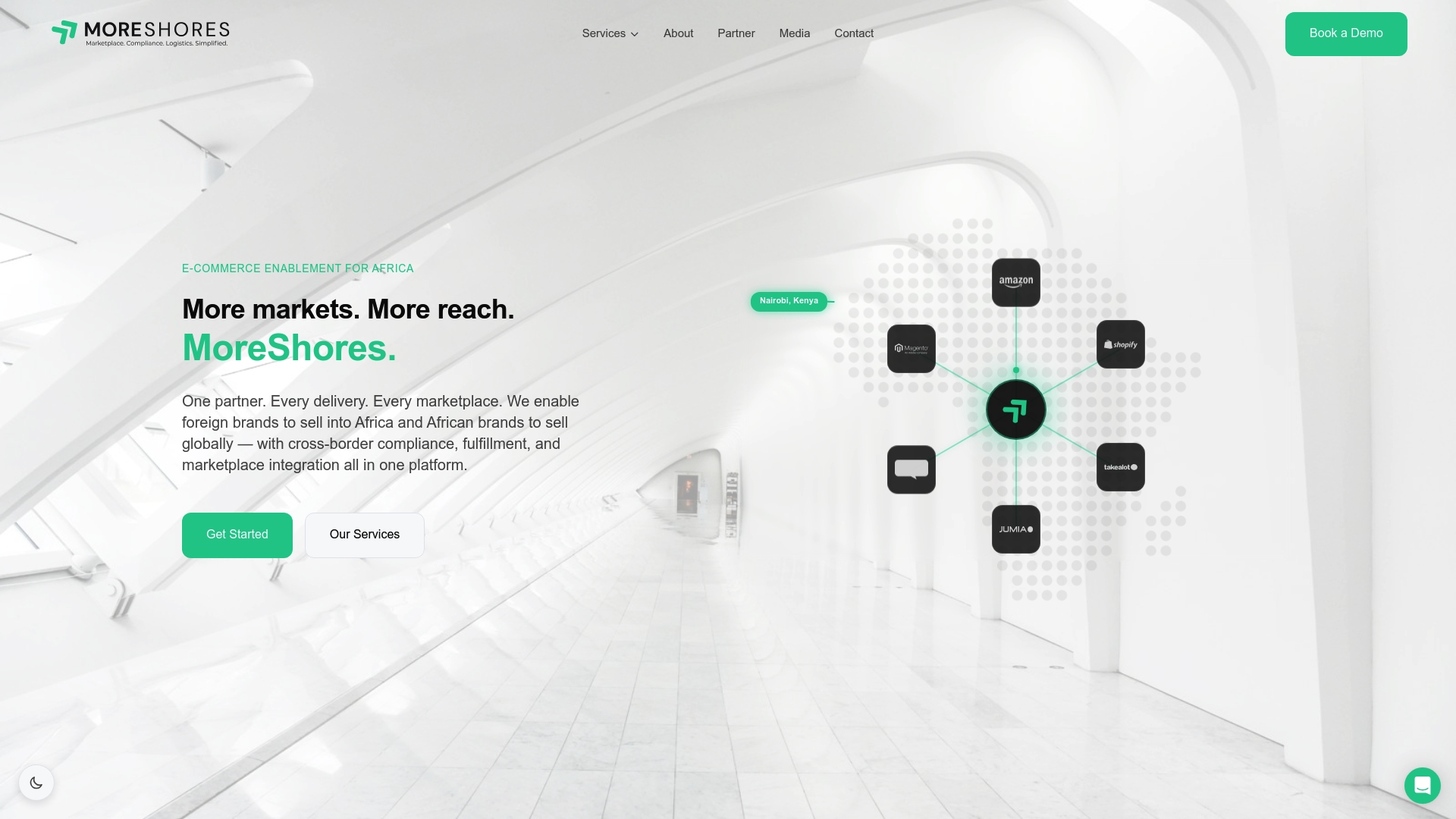
Our fulfillment and logistics services include warehousing, inventory management, and multi-courier delivery networks optimized for African markets. We handle the operational complexity while you focus on growing sales.
Cross-border enablement through our importer of record services ensures seamless customs clearance, duty management, and regulatory compliance across diverse African nations. We eliminate the barriers that stop most merchants.
Marketplace integration connects your products with leading platforms including Takealot, Amazon SA, Jumia, and Kilimall, plus Shopify and WooCommerce storefronts. Reach more customers with less effort.
FAQ
What is the typical delivery time for direct shipping to African markets?
Delivery times range from 7 to 21 days depending on destination country and customs efficiency. South Africa typically sees faster clearance than West African nations. Customs processing and distance from origin warehouse drive timeline variations.
How does an importer of record simplify customs clearance in Africa?
The IoR legally manages all import compliance, duties, VAT, and regulatory documentation across diverse African trade regulations. This professional expertise reduces customs delays by up to 70% and eliminates risk of fines or shipment rejections that merchants face when handling compliance themselves.
When should I consider hybrid fulfillment models for my business?
Hybrid models suit medium and large businesses with varied product catalogs needing balanced cost and speed. If you want faster delivery on popular items while controlling inventory costs on slower SKUs, hybrid approaches optimize both metrics simultaneously.
How much capital do I need to start warehousing inventory in Africa?
Initial investment typically ranges $5,000 to $25,000 depending on product costs and planned inventory levels. Calculate 3 months of expected sales volume at wholesale cost, plus shipping to warehouse and storage fees. Start with your top 10 SKUs to minimize risk.
Can I switch fulfillment models as my business grows?
Absolutely. Most successful merchants start with direct shipping or dropshipping, then migrate proven products to warehousing as revenue grows. Hybrid models emerge naturally as you identify which SKUs justify premium fulfillment investment based on sales velocity and margins.