Digital commerce infrastructure essentials for e-commerce success

TL;DR:
- Most of the work in e-commerce infrastructure involves processing payments, managing inventory, and ensuring reliable order fulfillment. Building flexible, scalable systems—whether monolithic or composable—is essential for growth, especially when entering diverse markets like Africa. Investing strategically in operational infrastructure enables brands to optimize customer retention, reduce costs, and capitalize on rapid regional market expansion.
Most business owners think launching an online store is the hard part. It is not. The real work happens behind the scenes, in the infrastructure that processes payments, manages inventory, routes orders, and ensures your customers get what they ordered, when they expect it. Core components include platforms, payment gateways, inventory systems, fulfillment integrations, CDNs, security tools, and analytics, and together they form the operational backbone of every successful e-commerce operation. If you are scaling into African markets or managing cross-border trade, understanding this infrastructure is not optional. It is the foundation your growth depends on.
Table of Contents
- Defining digital commerce infrastructure
- Core components and modern architecture
- Africa’s e-commerce boom: Challenges and realities
- Building resilient, scalable commerce systems
- A new reality: Infrastructure is a growth driver, not a back-office cost
- How MoreShores enables your cross-border e-commerce vision
- Frequently asked questions
Key Takeaways
| Point | Details |
|---|---|
| Holistic foundation | Digital commerce infrastructure goes beyond a web store, powering every aspect from payments to logistics and analytics. |
| Composable is agile | Modern, composable systems enable rapid adaptation and growth compared to legacy monolithic systems. |
| Africa’s unique drivers | Africa’s e-commerce growth is fueled by regulatory change and local logistics, but faces infrastructure gaps. |
| Resilience is vital | Robust infrastructure design reduces risk, handles complexity, and boosts performance for cross-border trade. |
| Strategic investment | Treating infrastructure as a growth driver—especially fulfillment and ops—delivers long-term business gains. |
Defining digital commerce infrastructure
With the stage set, let’s break down what actually makes up digital commerce infrastructure and how each part supports your business end-to-end.
Digital commerce infrastructure is the complete set of foundational technologies, tools, and services that support your entire online commerce operation. It is not just the storefront your customers see. It is everything that runs underneath, from the moment a customer clicks “buy” to the moment that product lands at their door.
Think of it as four interconnected pillars:
- Transaction processing: Payment gateways, fraud detection, currency handling, and order management systems that make sure money moves correctly and securely.
- Customer experience: Your e-commerce platform, website front-end, product catalog, content delivery network (CDN), and mobile performance tools that control what buyers see and how fast they see it.
- Backend operations: Inventory management, warehousing systems, shipping and fulfillment integrations, returns processing, and logistics routing that keep physical goods moving.
- Analytics and intelligence: Monitoring dashboards, customer data platforms, conversion tracking, and demand forecasting tools that tell you what is working and what is not.
Every pillar depends on the others. A fast, well-designed storefront means nothing if your inventory data is inaccurate. Excellent fulfillment falls apart if your payment gateway fails at checkout.
Here is a quick reference to the core components and the role each plays:
| Component | Primary function | Example tools |
|---|---|---|
| E-commerce platform | Storefront, catalog, checkout | Shopify, Magento, WooCommerce |
| Payment gateway | Transaction processing, fraud prevention | Stripe, PayFast, Flutterwave |
| Inventory management | Stock tracking, order syncing | TradeGecko, Cin7, NetSuite |
| Fulfillment integration | Shipping, routing, last-mile delivery | ShipBob, Aramex, DHL |
| CDN | Performance, page speed, global reach | Cloudflare, AWS CloudFront |
| Security tools | WAF, PCI DSS compliance, data protection | Cloudflare WAF, Akamai |
| Analytics and monitoring | Performance tracking, conversion data | Google Analytics, Datadog |
When you work with platform integration partners who understand all four pillars, you reduce the risk of gaps between systems that quietly bleed revenue.
Core components and modern architecture
Now that you know the pillars, it is essential to see how these pieces are actually assembled, and why architecture choice impacts everything from deployment speed to long-term agility.
There are two broad approaches to building a commerce technology stack: monolithic and composable (often called MACH architecture, which stands for Microservices, API-first, Cloud-native, and Headless).
Monolithic systems bundle everything into a single, tightly integrated platform. The front-end, back-end, checkout, catalog, and order management all live inside one codebase. This approach is simpler to set up and often cheaper to start with. But it has real limitations as you grow.

Composable systems take the opposite approach. Each function, storefront, payments, logistics, search, is a separate, specialized service connected through APIs. Modern methodologies emphasize composable or MACH architectures for flexibility, scalability, and best-of-breed integrations over monolithic systems.
Here is a direct comparison to help you decide:
| Factor | Monolithic | Composable (MACH) |
|---|---|---|
| Setup speed | Fast | Slower initial build |
| Scalability | Limited | High |
| Feature deployment | Slow, risky updates | Rapid, independent deployment |
| Vendor flexibility | Low (locked in) | High (swap components freely) |
| Integration complexity | Low | High (needs strong API management) |
| Best suited for | Early-stage, simple catalogs | Scaling, multi-market, complex ops |
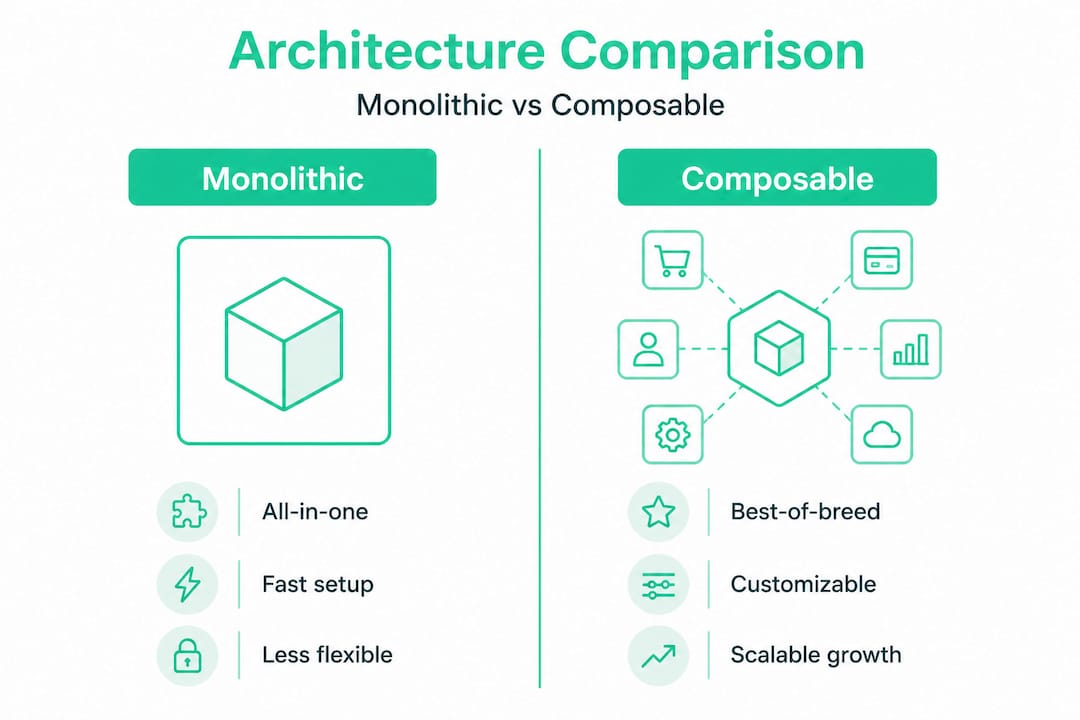
Monolithic systems limit innovation and scalability, while composable systems allow rapid feature deployment and vendor swaps, but increase integration complexity and vendor management needs. This trade-off matters a lot when you are entering multiple African markets simultaneously or managing cross-border catalog syncing.
Here is a practical approach to evaluating your architecture options:
- Audit your current stack. Identify which systems are tightly coupled and where bottlenecks slow down updates or integrations.
- Prioritize pain points. Focus first on the layer causing the most revenue loss, whether that is checkout abandonment, slow page loads, or fulfillment errors.
- Migrate incrementally. You do not need to replace everything at once. Swap out one component at a time, starting with the highest-impact area.
- Invest in API management. Composable systems only deliver their promise when your APIs are well-documented, monitored, and governed.
- Plan for regional complexity. If you are selling into Africa, factor in local payment methods, tax rules, and logistics integrations from the start.
Pro Tip: Before committing to a full composable migration, test one front-end component, like search or checkout, as a standalone service. This gives you real performance data before you invest in a broader rebuild.
Choosing the right marketplace integration approach and pairing it with solid fulfillment solutions is far easier when your architecture can flex to accommodate new regions, platforms, and partners without a full system overhaul.
Africa’s e-commerce boom: Challenges and realities
Understanding architecture is one part of the puzzle. Let’s zoom in on Africa, where both explosive growth and demanding market conditions shape infrastructure choices.
Africa is not a future opportunity. It is a current one. Africa’s e-commerce market is projected to reach $113 billion by 2029, with the African Continental Free Trade Area (AfCFTA) Digital Trade Protocol actively enabling cross-border commerce through digital identity frameworks, harmonized payments, and cybersecurity standards.
That is a significant number. But it comes with real operational complexity that your infrastructure needs to be built to handle.
Key growth drivers:
- Rising smartphone penetration across Sub-Saharan Africa, with mobile commerce accounting for the majority of online transactions in many markets.
- AfCFTA reducing trade barriers across 54 countries, opening intra-African trade routes that were previously fragmented.
- Growing middle-class consumer segments in Nigeria, Kenya, South Africa, Ghana, and Egypt with increasing appetite for international brands.
- Digital payment adoption accelerating through platforms like M-Pesa, Flutterwave, Paystack, and Ozow.
Key infrastructure challenges:
- Logistics gaps: Last-mile delivery in many African cities remains expensive and unreliable, particularly outside major urban centers. Rural coverage is a serious constraint.
- Foreign exchange (FX) costs: Currency volatility and high FX conversion costs add friction to cross-border transactions, especially for brands pricing in USD or EUR.
- Infrastructure deficits: Power instability, inconsistent broadband, and limited local data center capacity affect platform performance in certain markets.
- Regulatory fragmentation: Each country has its own customs procedures, import duties, VAT structures, and product compliance requirements, and navigating all of these manually is not scalable.
- Payment diversity: There is no single dominant payment method across Africa. You need to support mobile money, bank transfers, cards, and cash-on-delivery depending on the market.
Pro Tip: When entering a new African market, do not assume your South Africa infrastructure will scale directly to Nigeria or Kenya. Each market has distinct last-mile logistics networks, payment preferences, and regulatory requirements. Build modular infrastructure that can be configured per region rather than deployed as a single template.
Africa ecommerce solutions that work in practice are those built with these realities embedded from the start, not added on as an afterthought. Strong Africa fulfillment partners with local knowledge of customs processes and courier networks are often the difference between a smooth launch and a costly delay.
Building resilient, scalable commerce systems
With Africa’s market realities in mind, here is how you can craft digital commerce infrastructure that thrives, whether you are scaling fast or building for resilience.
The most common failure points in cross-border commerce operations are not random. They are predictable. Edge cases like payment failures, inventory inaccuracies, order cancellations, complex promotions, international tax calculations, peak load spikes, and data residency requirements are all manageable when your architecture uses event-driven design, circuit breakers, and feature flags.
Let’s break down what each of these means in practice:
- Event-driven architecture means your systems react to real-time events rather than relying on batch processing. When a payment fails, the system immediately triggers a retry logic or customer notification rather than waiting for a scheduled sync.
- Circuit breakers prevent cascading failures. If your logistics API is slow during a peak sale, the circuit breaker isolates that issue so the rest of your checkout flow keeps running.
- Feature flags let you deploy new functionality to a subset of users or markets first, reducing the risk of a bad rollout affecting your entire customer base during a high-traffic period.
On the performance side, the data is compelling. Edge functions reduce cart time-to-first-byte (TTFB) by 120 to 300 milliseconds, lift conversion rates by 3 to 8 percent, and cut origin server CPU load by 30 to 60 percent. Using composable accelerators also delivers 40 to 70 percent faster pilot deployments. These are not marginal gains. A 3 to 8 percent conversion lift at scale translates directly into significant revenue.
“Treat commerce as a layered engine: experience, transaction, operations, and intelligence. Under-investing in operations, particularly fulfillment, loses repeat business despite front-end gains.”
This quote captures something most teams learn the hard way. You can have a stunning storefront and a seamless checkout flow, but if your fulfillment layer is unreliable, customers will not come back. Repeat purchase rate is one of the strongest indicators of long-term e-commerce health, and it is built in the operations layer, not the experience layer.
Here is a practical checklist for building resilient systems:
- Implement real-time inventory syncing across all sales channels to prevent overselling.
- Use automated tax calculation tools that handle VAT, customs duties, and import levies by destination country.
- Set up alerting for payment gateway degradation before it affects your conversion rate.
- Build peak load testing into your release cycle, not just before major promotional events.
- Ensure your data storage and processing practices meet local data residency requirements for each market you operate in.
Investing in cross-border commerce strategies that bake resilience into the architecture upfront is far less costly than retrofitting it after a major incident. Work through a practical onboarding roadmap to map your current stack against these resilience requirements before you scale into new markets.
A new reality: Infrastructure is a growth driver, not a back-office cost
Let’s take a step back for a reality check, because how you view your digital commerce infrastructure could be your biggest competitive edge or roadblock.
Most organizations treat infrastructure as a cost center. They budget for it reluctantly, review it only when something breaks, and optimize it only after customers complain. This mindset is the single biggest barrier to sustainable growth in cross-border e-commerce.
Here is the contrarian view we hold, based on what we see with brands successfully scaling into and out of Africa: infrastructure investment is the best revenue investment you can make. Not marketing spend. Not storefront redesigns. Infrastructure.
Why? Because the front-end experience is table stakes. Customers now expect fast pages, clean checkout flows, and attractive product imagery. Those are the baseline. What separates brands that grow profitably from those that plateau is the quality of their operational infrastructure. Inventory accuracy. Fulfillment speed. Order tracking. Post-purchase communication. These are the moments that create loyal customers.
There is a common trap we see over and over. Brands invest heavily in top-of-funnel marketing and user experience, driving strong first-purchase numbers. Then they neglect the backend, and return rates spike, reviews turn negative, and customer lifetime value stays flat. The front-end brought customers in. The broken backend drove them away.
The smarter framing is this: every dollar invested in fulfillment reliability, inventory accuracy, and logistics partnerships generates compounding returns through higher repeat purchase rates and lower customer acquisition costs over time.
For brands scaling into African markets specifically, this principle is even more critical. The Africa e-commerce strategy that works is one where operational infrastructure is treated as a strategic enabler from day one, not a problem to solve later. Build it right at the start, even if it feels like over-engineering for your current volume. Your future self will be grateful.
Make infrastructure choices based on your expected revenue and your target markets over the next three years, not just your current cost constraints. That is how you build for growth rather than just for today.
How MoreShores enables your cross-border e-commerce vision
If you want to translate these principles into fast, sustainable e-commerce wins, here is how MoreShores can help you lead in Africa and beyond.
MoreShores is built specifically to solve the infrastructure gaps that hold cross-border brands back. From acting as Importer of Record for customs clearance, duties, and VAT compliance, to managing warehousing, inventory, and multi-courier fulfillment, the platform covers every operational layer described in this guide.

Through our cross-border enablement platform, you get a single infrastructure layer that handles the complexity of entering African markets without rebuilding your entire stack. Our marketplace integration services connect your catalog to Takealot, Amazon SA, Jumia, Kilimall, and more, while syncing seamlessly with your Shopify or WooCommerce storefront. Africa-focused e-commerce solutions from MoreShores are designed for brands that want to move fast, stay compliant, and grow profitably across the continent. Ready to get started? Let’s talk.
Frequently asked questions
What are the essential components of a digital commerce infrastructure?
Core components include e-commerce platforms, payment gateways, inventory management, shipping and fulfillment systems, product catalogs, content delivery networks, security tools, and monitoring and analytics systems.
Why is composable infrastructure preferred over monolithic systems?
Composable MACH architecture offers greater flexibility, faster feature deployment, and easier integration of best-of-breed tools, though it requires stronger API management and vendor coordination compared to monolithic systems.
How big is Africa’s e-commerce market and what drives its growth?
Africa’s e-commerce market is projected to reach $113 billion by 2029, driven by AfCFTA trade integration, rising smartphone adoption, and the expansion of regional digital payment platforms.
How can infrastructure design improve cross-border e-commerce performance?
Event-driven architecture and edge optimization reduce latency, prevent cascading failures during peak traffic, and handle complex cross-border challenges like tax calculation, payment failures, and data compliance.
What should African brands prioritize when designing their digital infrastructure?
African brands should prioritize local payment partners, AfCFTA-compliant trade protocols, regional logistics hubs, and modular architecture that can be configured market by market rather than deployed as a single global template.