Role of customs regulations in 2026: Your Africa e-commerce guide
TL;DR:
- Customs regulations in Africa and the EU are evolving rapidly in 2026, directly impacting e-commerce margins and compliance strategies. Building robust documentation, obtaining trusted trader status, and leveraging AI-driven risk engines are essential for smooth cross-border trade and operational efficiency. Partnering with experienced logistics providers like MoreShores can help navigate these complexities and capitalize on new trade frameworks.
If you are shipping goods across borders into Africa right now, the role of customs regulations in 2026 is no longer a back-office concern. It is a direct line item affecting your margins. The EU’s removal of the low-value parcel duty exemption, AfCFTA’s rules of origin requirements, and AI-driven enforcement across South Africa, Nigeria, and Kenya are changing the cost structure and risk profile of every international shipment. For e-commerce logistics managers and compliance officers entering African markets, understanding these shifts is not optional. This guide breaks down what changed, what it costs you, and what you can do about it.
Table of Contents
- Overview of global customs regulatory changes affecting e-commerce in 2026
- Key customs reforms under AfCFTA and regional African trade frameworks
- Digital transformation and AI adoption in African customs for enhanced compliance
- Operational impact and compliance strategies for e-commerce logistics in African markets
- A fresh perspective: Why embracing customs regulations as strategic enablers matters
- How MoreShores supports your e-commerce customs compliance and logistics in Africa
- Frequently asked questions
Key Takeaways
| Point | Details |
|---|---|
| EU Customs overhaul | The 2026 EU Customs reform introduces a centralized data-driven model replacing declarations and imposes new duties on low-value parcels. |
| AfCFTA tariff elimination | Most African tariffs are phased out under AfCFTA if products meet strict rules of origin requiring local value addition. |
| AI enhances customs enforcement | AI-driven risk engines in Africa accelerate compliance checks, rewarding trusted traders with faster clearance. |
| Digital customs platforms | Single windows and integrated digital systems reduce clearance times and improve cross-border logistics efficiency. |
| Strategic compliance advantage | Proactive customs compliance and data integration can turn regulations from obstacles into competitive strengths. |
Overview of global customs regulatory changes affecting e-commerce in 2026
The biggest story in global customs right now is the EU Customs Reform. Starting July 2026, the EU replaces its traditional declaration-based model with a centralized EU Customs Data Hub, a data-driven system designed to centralize risk analysis, improve enforcement, and remove inefficiencies built into the old paper-trail model.
Here is what matters most for e-commerce operations shipping into or through the EU:
- Low-value exemption eliminated. The €22 duty-free threshold is gone. Every parcel valued under €150 now attracts a flat €3 customs duty per item category, on top of existing VAT. This directly compresses margins on high-volume, low-price shipments.
- Platforms become liable importers. Marketplaces and distance sellers are now formally designated as the importer of record. That means your platform carries compliance obligations and penalty exposure.
- Penalties for non-compliance range from 1% to 6% of total import value, with stricter enforcement under the new EU Customs Authority.
- Trust and Check trader status rewards compliant businesses with procedural simplifications, fewer inspections, and faster release times. Getting this status takes work, but the operational payoff is real.
- Centralized risk analysis means customs authorities share data across member states, so inconsistencies in your documentation are more likely to be flagged than before.
“The EU Customs reform replaces the declaration-based system with a data-driven model via the EU Customs Data Hub, removing the low-value import duty exemption and imposing a flat €3 duty per item under €150.”
Why does this matter if you are focused on African markets? Because most international brands entering Africa also ship into EU markets, and the compliance culture your team builds for EU trade will determine how well you adapt to Africa’s own evolving customs landscape. Your cross-border enablement model needs to account for both sets of rules simultaneously.
Pro Tip: Apply for Authorized Economic Operator (AEO) or Trust and Check status now, before volume grows. The approval process can take 6 to 12 months, and the benefits, including expedited clearance and fewer physical inspections, compound over time.
Key customs reforms under AfCFTA and regional African trade frameworks
The African Continental Free Trade Area is one of the most consequential trade agreements operating in 2026, but its benefits are conditional. You cannot simply ship goods between African countries and claim preferential rates. The compliance burden sits squarely on you.
Here is what the AfCFTA framework actually requires:
- Tariff elimination applies to 90% of tariff lines over a 5-to-10-year phase-in period, but only if products meet rules of origin with a minimum 30-40% local value addition or a change in HS tariff heading.
- Certificates of Origin must be issued by designated national authorities in the exporting country. Self-certification is not accepted in most African jurisdictions, and a missing or incorrect certificate means you pay the full Most Favored Nation (MFN) duty rate.
- The East African Community set a June 2026 deadline to eliminate non-tariff barriers across member states. Progress has been uneven, but the direction is clear.
- A digital regional Customs Bond is launching to replace multiple national guarantee instruments. For logistics managers running multi-country African distribution, this reduces the cash flow pressure of posting separate bonds in each country.
- Infrastructure gaps remain a real challenge. Not every customs post in sub-Saharan Africa has the system connectivity to process digital documents in real time. You need contingency workflows for paper-based verification.
| Factor | AfCFTA preferential rate | MFN (standard) rate |
|---|---|---|
| Certificate of Origin | Required | Not required |
| Local value addition | 30-40% minimum | No requirement |
| HS code change | Required if value addition not met | No requirement |
| Applicable duty | 0-10% (phased) | 15-35% typical |
| Risk of misclassification | High penalty exposure | Standard penalty |
Pro Tip: Build a value-chain documentation file for each SKU you import into Africa. Track where materials are sourced, where they are processed, and what percentage of the finished product value is added locally. Customs inspectors under AfCFTA are increasingly requesting this evidence, and a gap in your records can invalidate your preferential claim retroactively.
You can find additional support for navigating regional frameworks, including EAC reforms and customs bond transitions, through experienced cross-border partners with on-the-ground relationships.
Digital transformation and AI adoption in African customs for enhanced compliance
African customs authorities are not standing still. South Africa’s SARS Modernisation 3.0 and Egypt’s Nafeza platform are two of the most visible examples of a continent-wide shift toward AI-driven risk engines that flag non-compliance faster and more accurately than human review ever could.
What this means in practice:
- Pre-approved trusted traders are routed through expedited lanes with reduced physical inspection rates. Companies that invest in compliance documentation earn real speed advantages.
- AI-flagged discrepancies in declared value, HS codes, or origin documentation trigger holds and additional scrutiny. The cost of a single flagged shipment in demurrage and inspection fees can quickly exceed the original duty saving.
- Nigeria’s Single Window platform is targeting a significant reduction in cargo dwell time by end-2026, moving toward real-time submission of manifests, import licenses, and phytosanitary or quality certificates.
- Kenya Revenue Authority’s iCustoms system integrates with port management software to generate risk scores for incoming cargo. Shipments from known compliant traders receive lower scores and faster clearance.
- Data interoperability is becoming a hard requirement. If your ERP cannot push accurate customs data to national single-window platforms automatically, you are creating manual gaps that AI systems are specifically designed to catch.
“African customs like South Africa’s SARS Modernisation 3.0 and Egypt’s Nafeza aim for AI-driven risk engines by 2026, improving inspections for trusted traders and enabling earlier detection of non-compliance.”
Pro Tip: Audit your HS code library at least quarterly. AI systems cross-reference declared codes against product descriptions, images, and prior shipment records. An outdated or approximate code that cleared easily two years ago may now trigger an automatic hold.
For e-commerce brands, AI-driven customs compliance is increasingly the differentiator between brands that scale quickly in Africa and those that stall in clearance queues.

Operational impact and compliance strategies for e-commerce logistics in African markets
Understanding the rules is one thing. Building the operational workflows to follow them consistently at volume is another. Here is a practical framework for logistics managers navigating customs regulations impact in 2026.
Platform and seller liability
Under the new EU framework, platforms and sellers become liable importers with penalties ranging from 1% to 6% for non-compliance. African customs authorities are moving in the same direction, using AI verification to hold sellers accountable for declaration accuracy. You cannot outsource accountability to your freight forwarder and walk away.
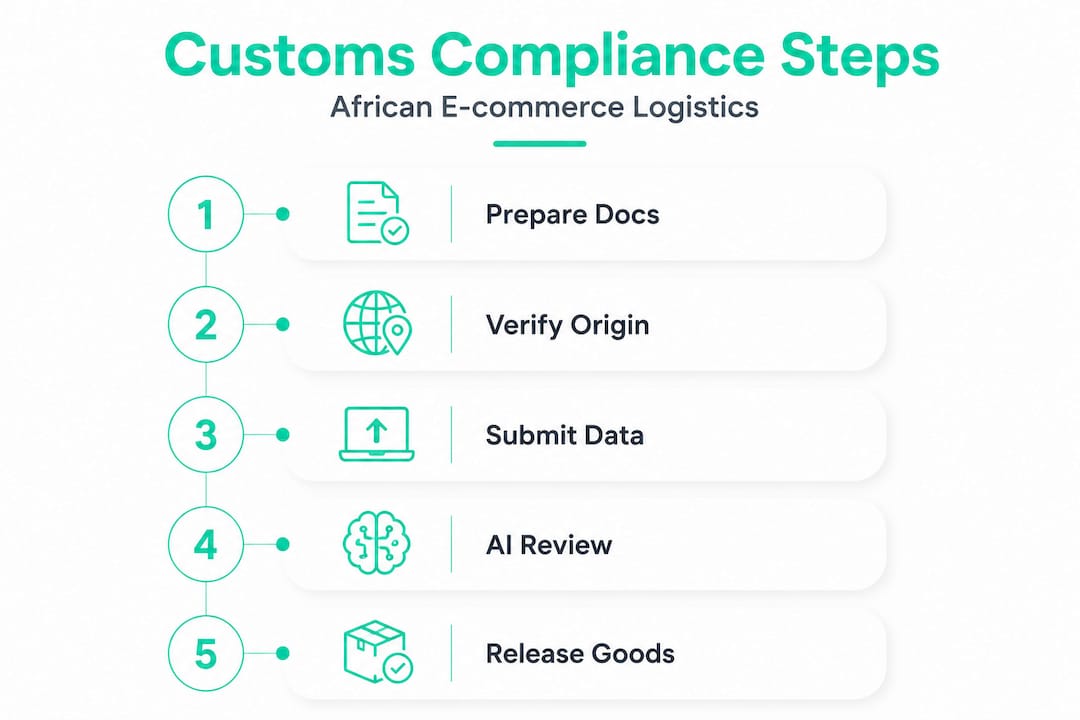
Step-by-step process for Certificate of Origin in Africa
- Identify the correct issuing authority in your export country, usually the national chamber of commerce or a designated government body.
- Submit your commercial invoice, packing list, and evidence of local value addition to the issuing authority.
- Receive your Certificate of Origin, typically valid for 12 months. Confirm the HS code on the certificate matches your shipping documentation exactly.
- Attach the certificate to your customs entry at the point of import. Keep a digital copy integrated into your ERP for audit trails.
- Verify that the importing country’s customs authority accepts electronic certificates if you are submitting digitally.
| Regulatory framework | Duty exemption threshold | Compliance liability | Key documentation |
|---|---|---|---|
| EU Customs Reform (2026) | None (€3 flat duty under €150) | Platform and seller | Customs Data Hub submission |
| AfCFTA | Phased elimination | Exporter and importer | Certificate of Origin |
| South Africa (SARS) | Standard tariff schedule | Importer of Record | SARS eFiling, customs entry |
| Nigeria | Standard tariff schedule | Importer | Single Window submission |
Risk mitigation that actually works
- Map every SKU to a verified HS code and document your classification rationale.
- Integrate your order management system with customs declaration platforms where available.
- Set internal thresholds: if declared value differs from actual transaction value by more than 5%, flag for manual review before submission.
Pro Tip: Use marketplace compliance integration tools to automatically sync product data, declared values, and origin documentation across your sales channels. Discrepancies between what your marketplace lists and what your customs declaration states are a growing trigger for AI-flagged audits.
For brands managing physical stock in Africa, logistics and customs compliance processes should be aligned before your first container ships, not after your first customs hold.
A fresh perspective: Why embracing customs regulations as strategic enablers matters
Most e-commerce teams treat customs compliance as a cost of doing business, something to minimize and hand off. That framing is expensive.
The EU Customs Reform shifts focus from trade facilitation to enforcement, creating more uniform controls that initially cause disruption but ultimately reduce fraud and level the playing field. Brands that invest in compliance infrastructure now will operate at a lower cost per shipment than those scrambling to retrofit their processes in 2027.
The same logic applies in Africa. Trusted trader programs, AEO status, and AfCFTA preferential rates are not just paperwork. They are operational advantages. A brand that clears South African customs in 24 hours because it holds trusted trader status will move inventory faster, reduce warehousing costs, and offer customers shorter delivery windows than a competitor still clearing in 4 to 7 days.
The harder truth is that uniform enforcement also means fewer places to hide. Under-declaration, misclassification, and opportunistic routing through low-enforcement corridors are all becoming higher-risk strategies as AI systems share data across borders. The compliance investment you make now is also a hedge against penalty exposure that could exceed the short-term savings from sloppy documentation.
Your cross-border strategy should treat customs data quality as a competitive asset. Brands that know their supply chain at the SKU level, who can prove value addition, origin, and correct classification at a moment’s notice, are the ones that will grow fastest in African markets over the next three years.
How MoreShores supports your e-commerce customs compliance and logistics in Africa
Navigating the evolving customs regulations in 2026 across multiple African markets requires more than a good freight forwarder. It requires an end-to-end partner who understands compliance, marketplace dynamics, and fulfillment in the same conversation.

MoreShores acts as your Importer of Record across African markets, handling duties, VAT, and regulatory compliance so you are not exposed to the liability risks described in this guide. Our cross-border enablement services are built specifically for international brands entering African e-commerce, with workflows designed around AfCFTA origin requirements, SARS modernization, and digital single-window platforms. We connect your inventory to marketplace platforms including Takealot, Amazon SA, Jumia, and Kilimall, with documentation and compliance processes aligned to each market’s customs requirements. Our e-commerce solutions also integrate directly with Shopify and WooCommerce, giving you real-time visibility across your African distribution. If you are ready to enter African markets without carrying the customs risk yourself, MoreShores is the partner you need.
Frequently asked questions
What are the key changes in the EU customs regulations affecting low-value parcels in 2026?
From July 1, 2026, EU parcels under €150 lose their customs duty exemption and now incur a flat €3 duty per item category plus existing VAT, with platforms and sellers designated as liable importers subject to penalties for non-compliance.
How does AfCFTA affect tariffs and customs duties for goods shipped within Africa?
AfCFTA eliminates tariffs on 90% of tariff lines over 5 to 10 years, but only when products meet rules of origin requirements including a minimum 30-40% local value addition or a qualifying change in HS tariff heading.
What role does AI technology play in African customs enforcement in 2026?
AI-driven risk engines enable earlier detection of non-compliance and reduce inspection rates for trusted traders, raising the overall bar for data accuracy and requiring e-commerce brands to maintain clean, integrated documentation across all shipments.
What are best practices for e-commerce logistics managers to ensure customs compliance in Africa?
Obtaining proper Certificates of Origin and documenting value chains accurately is essential for AfCFTA preferential rates, while maintaining correct HS codes, integrating data systems with national customs platforms, and managing importer-of-record liabilities proactively will protect you from growing AI-triggered penalties.