
E-commerce brands expanding into African markets face a maze of customs regulations, fragmented logistics networks, and complex compliance requirements that can derail even the most promising growth strategies. Delays at borders, unexpected costs, and marketplace integration failures create operational headaches that drain resources and frustrate customers. This comprehensive guide walks you through the essential fulfillment steps for cross-border success in 2026, from infrastructure preparation through execution and continuous improvement, helping you navigate Africa’s unique challenges while building resilient, scalable operations.
Table of Contents
- Understanding Cross-Border Fulfillment Challenges In Africa
- Preparing Your Cross-Border Fulfillment Infrastructure
- Executing The Fulfillment Step By Step Process
- Verifying Fulfillment Success And Continuous Improvement
- Moreshores Cross-Border Fulfillment Solutions
- Frequently Asked Questions About Cross-Border Fulfillment
Key takeaways
| Point | Details |
|---|---|
| Systematic approach | Following structured fulfillment steps ensures streamlined cross-border operations and reduces costly delays in African markets. |
| Strategic automation | Automating customs documentation and selecting aligned ILSPs can cut processing times by up to 40% while improving reliability. |
| Operational depth | Marketplace integrations require operational fluency beyond technical connections to maintain inventory accuracy and customer satisfaction. |
| Continuous optimization | Regular performance monitoring and ILSP partnership adjustments drive long-term success in dynamic African e-commerce environments. |
Understanding cross-border fulfillment challenges in Africa
Cross-border e-commerce in Africa is growing rapidly, creating unprecedented opportunities for brands willing to navigate its complexities. Yet this explosive growth brings significant operational challenges that can overwhelm unprepared businesses. Understanding these obstacles is the first step toward building effective fulfillment strategies.
Customs regulations vary dramatically across African nations, creating a patchwork of requirements that changes at every border. Each country maintains distinct documentation standards, tariff structures, and clearance procedures that can cause unexpected delays and cost overruns. Brands often underestimate the time required for customs processing, leading to frustrated customers and damaged reputations.
Successful cross-border fulfillment in Africa requires deep understanding of local regulations, customs procedures, and payment systems that differ substantially from Western markets. Payment infrastructure remains fragmented, with mobile money dominating some regions while traditional banking prevails in others. This variation forces brands to maintain multiple payment processing relationships and reconciliation processes.
Logistics networks in Africa present unique challenges:
- Infrastructure gaps in rural areas limit last-mile delivery options and increase costs
- Carrier reliability varies significantly between urban centers and remote regions
- Tracking systems may lack real-time visibility across all transportation modes
- Reverse logistics for returns often requires separate planning and partnerships
- Seasonal weather patterns can disrupt transportation routes during rainy periods
Regulatory knowledge becomes essential when operating across multiple African markets. Import licenses, product certifications, and tax registration requirements differ by country and product category. Brands entering these markets need local expertise or e-commerce solutions for Africa that handle compliance proactively, preventing shipment holds and regulatory penalties that damage profitability.
Preparing your cross-border fulfillment infrastructure
Building a robust fulfillment foundation requires careful planning before processing your first cross-border order. Your preparation phase determines whether operations run smoothly or encounter constant friction that erodes margins and customer trust.
Selecting the right Integrated Logistics Service Provider (ILSP) represents your most critical infrastructure decision. ILSP selection significantly affects logistics performance and customer satisfaction in cross-border e-commerce enterprises. Evaluate potential partners across multiple dimensions rather than focusing solely on price.
Key ILSP evaluation criteria:
- Logistics quality: On-time delivery rates, damage rates, and tracking accuracy across African markets
- Technology integration: API capabilities, real-time visibility systems, and marketplace connectivity
- Geographic coverage: Direct service to your target markets versus subcontracted partnerships
- Compliance expertise: Knowledge of local regulations, customs automation, and documentation support
- Scalability: Capacity to handle volume fluctuations and expansion into new markets
Customs documentation automation delivers transformative efficiency gains. Automating customs documentation can reduce processing times by up to 40%, cutting the bottleneck that often causes the longest delays in cross-border fulfillment. Modern systems pre-populate forms, validate data against regulatory requirements, and submit documentation electronically to customs authorities.

Pro Tip: Align ILSP selection with your strategic business priorities rather than optimizing for lowest cost alone, as partnership quality directly impacts customer retention and operational resilience over time.
Your compliance checklist should cover these essential elements:
| Compliance Area | Required Actions |
|---|---|
| Tax registration | VAT/GST registration in destination countries, duty calculation systems |
| Import licenses | Product-specific permits, business registration documents |
| Product compliance | Safety certifications, labeling requirements, restricted goods verification |
| Payment processing | Multi-currency support, local payment method integration, fraud prevention |
| Data protection | GDPR compliance for EU customers, local data privacy regulations |
Technology integration extends beyond basic API connections. Your brand onboarding process should establish real-time inventory synchronization across all sales channels, preventing overselling and stockouts. Implement order management systems that route fulfillment requests to optimal warehouses based on inventory location, shipping costs, and delivery speed requirements.
Cross-border enablement services should provide unified visibility across your entire supply chain, from inbound international shipments through final delivery to customers. This transparency enables proactive problem-solving when delays occur and provides accurate delivery estimates that set appropriate customer expectations.
Executing the fulfillment step by step process
Effective fulfillment execution requires disciplined processes that account for cross-border complexities while maintaining speed and accuracy. Each step builds on the previous one, creating a seamless flow from order receipt to customer delivery.
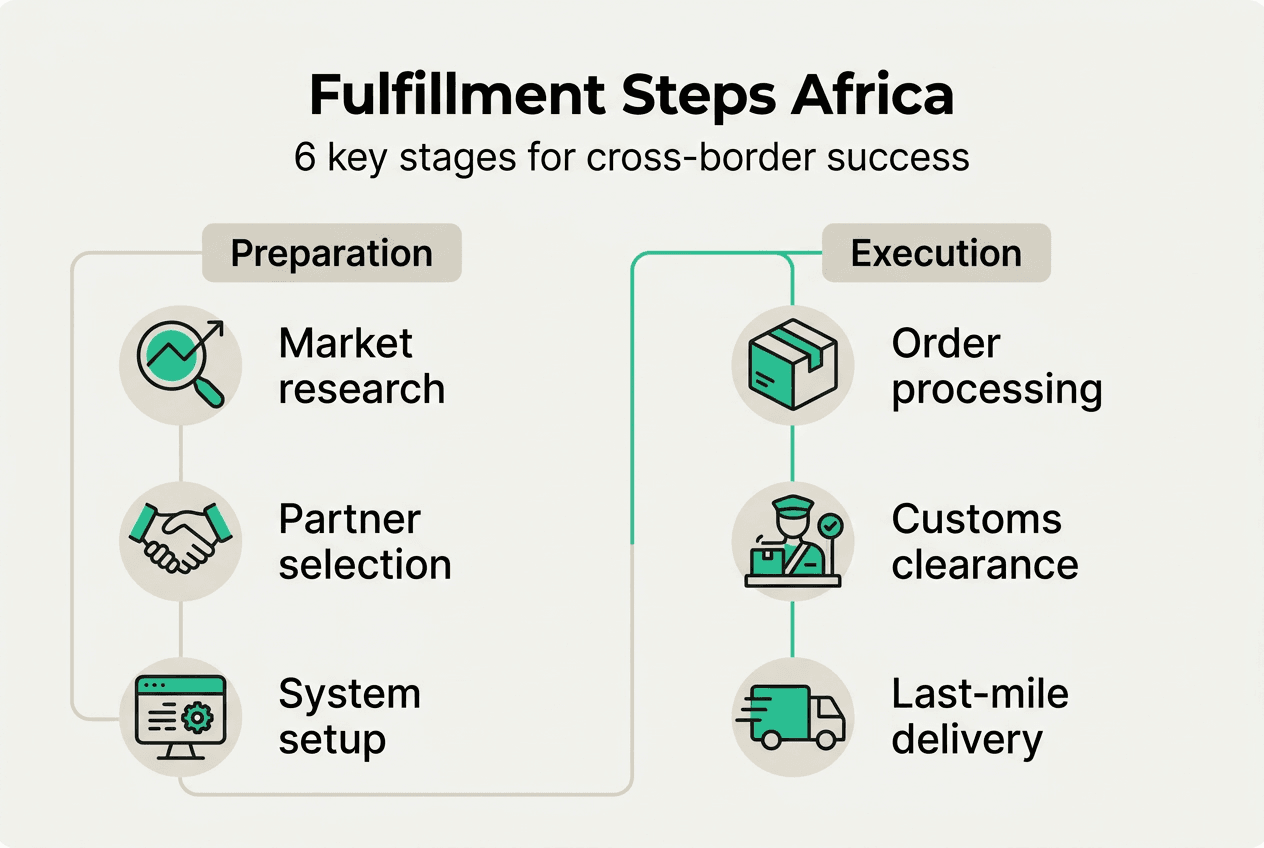
Step 1: Order confirmation and validation with marketplace synchronization
When an order arrives, your system must immediately validate inventory availability, shipping address accuracy, and payment authorization. Marketplace integrations demand operational fluency rather than surface-level connectivity, ensuring inventory counts update across all channels simultaneously. This prevents the common problem of selling products that are actually out of stock, which damages seller ratings and customer trust.
Step 2: Inventory picking, packing, and labeling with destination-specific requirements
Warehouse teams must follow country-specific packing standards that vary across African markets. Some destinations require specific label formats, customs declarations attached to packages, or special handling for temperature-sensitive products. Efficient picking routes minimize warehouse travel time, while quality control checkpoints catch errors before shipment.
Step 3: Customs documentation automation and shipment dispatch
Automated systems generate accurate commercial invoices, certificates of origin, and customs declarations based on product classifications and destination requirements. Electronic submission to customs authorities accelerates clearance, while proper documentation reduces the risk of inspections that cause delays.
Step 4: Transport management using cost-effective routes and special line services
Cost-effective special line services supported by CBEC integrated logistics service providers have gained popularity among cross-border e-commerce firms seeking to balance speed and cost. These services optimize routing by consolidating shipments, negotiating bulk carrier rates, and selecting transportation modes based on urgency and package characteristics.
| Fulfillment Stage | Average Timeline | Key Success Factors | | — | — | | Order processing | 2-4 hours | Automated validation, inventory accuracy | | Warehouse operations | 12-24 hours | Efficient picking routes, quality controls | | Customs clearance | 1-3 days | Complete documentation, pre-clearance when possible | | International transit | 3-7 days | Optimal routing, carrier reliability | | Last-mile delivery | 1-2 days | Local partner quality, address accuracy |
Step 5: Real-time tracking updates and proactive communication with customers
Customers expect visibility throughout the delivery journey. Your system should send automated updates at key milestones: order confirmation, shipment dispatch, customs clearance, out for delivery, and final delivery confirmation. Proactive communication about delays prevents customer service inquiries and maintains trust even when problems occur.
Step 6: Local last-mile delivery and returns handling within African markets
Last-mile delivery in Africa often requires partnerships with local couriers who understand regional infrastructure and customer preferences. Some markets prefer delivery to pickup points rather than home addresses, while others expect SMS coordination before delivery attempts. Marketplace integration services should support these local variations while maintaining consistent customer experiences.
Pro Tip: Maintain close collaboration with ILSPs to navigate unexpected delays or regulatory changes efficiently, as their local expertise often provides solutions that aren’t apparent from documentation alone.
Returns management requires separate planning in cross-border contexts. Establish clear return policies that account for international shipping costs, customs procedures for returned goods, and inspection processes. Fulfillment and logistics services should include return authorization systems, prepaid return labels where feasible, and quality assessment workflows that determine whether products can be restocked or must be liquidated.
Verifying fulfillment success and continuous improvement
Measuring performance and adapting your approach separates thriving cross-border operations from those that stagnate or fail. Systematic verification identifies problems early and drives continuous improvement across your fulfillment ecosystem.
Key fulfillment metrics reveal operational health:
- Delivery time accuracy: Percentage of orders delivered within promised timeframes
- Cost per shipment: Total fulfillment costs divided by order volume, tracked by destination
- Customer satisfaction scores: Post-delivery surveys and marketplace ratings
- Customs clearance rates: Percentage of shipments clearing without holds or inspections
- Return rates: Returns as a percentage of total orders, analyzed by reason code
- Inventory accuracy: Physical inventory matching system records across all warehouse locations
Feedback loops transform raw data into actionable insights. Weekly reviews of fulfillment metrics should identify patterns: Are certain destinations experiencing consistent delays? Do specific product categories have higher return rates? Is one ILSP underperforming compared to alternatives? These patterns guide targeted improvements rather than broad, unfocused changes.
Cross-border e-commerce logistics reconstruction significantly impacts consumer continuance intention on platforms, making digital logistics improvements essential for long-term success. Customers who experience smooth fulfillment become repeat buyers and brand advocates, while those facing problems often abandon platforms entirely.
Adjusting ILSP partnerships based on performance maintains competitive advantage. Your initial ILSP selection won’t remain optimal forever as business volumes change, new markets open, and partner capabilities evolve. Conduct quarterly business reviews with logistics partners to assess performance against service level agreements and discuss capacity planning for anticipated growth.
“Infrastructure flexibility and the ability to adapt logistics strategies quickly separate successful cross-border e-commerce operations from those that struggle with rigid, outdated approaches. The African market demands operational agility.”
Digital logistics enhancements drive platform loyalty by improving the entire customer experience. Invest in technologies that provide accurate delivery estimates, enable customer delivery preferences, and offer flexible options like scheduled deliveries or alternative pickup locations. These capabilities differentiate your brand in competitive markets where product selection alone no longer guarantees success.
Continuous improvement initiatives should focus on high-impact opportunities:
- Negotiate volume-based rate reductions with carriers as shipment volumes increase
- Implement predictive analytics to forecast demand and optimize inventory positioning
- Expand warehouse networks closer to major customer concentrations
- Develop contingency plans for common disruption scenarios like port strikes or weather events
- Train customer service teams on fulfillment processes so they can resolve issues quickly
Partner with MoreShores to access performance benchmarking data that compares your metrics against industry standards and identifies improvement opportunities. Regular performance reviews with MoreShores cross-border enablement teams ensure your fulfillment strategy evolves alongside market conditions and customer expectations.
MoreShores cross-border fulfillment solutions
Navigating Africa’s complex cross-border landscape requires expertise, technology, and established partnerships that take years to build independently. MoreShores eliminates these barriers by providing integrated fulfillment infrastructure specifically designed for brands targeting African and international markets.
Our cross-border enablement services handle the entire fulfillment chain, from customs clearance as Importer of Record through final delivery via our multi-courier network. We automate documentation, manage regulatory compliance, and optimize routing to reduce costs while improving delivery speed. Brands gain immediate access to fulfillment capabilities that would otherwise require substantial capital investment and operational expertise.
Strategic e-commerce logistics platform partnership opportunities align our services with your growth objectives. We scale with your business, expanding into new markets and adjusting capacity as volumes fluctuate seasonally. Our marketplace integration services synchronize inventory and orders across Takealot, Amazon SA, Jumia, Kilimall, Shopify, and WooCommerce, providing unified visibility and control. Explore how MoreShores transforms cross-border complexity into competitive advantage for ambitious e-commerce brands.
Frequently asked questions about cross-border fulfillment
What are the main phases of cross-border fulfillment?
Cross-border fulfillment consists of three main phases: preparation, execution, and verification. Preparation involves selecting logistics partners, establishing compliance frameworks, and integrating technology systems. Execution covers order processing, customs clearance, transportation, and delivery. Verification includes performance monitoring, feedback analysis, and continuous improvement initiatives.
Why is ILSP selection so critical for cross-border success?
ILSP selection determines your logistics quality, cost structure, and ability to scale across African markets. The right partner provides local regulatory expertise, established carrier relationships, and technology integration that streamlines operations. Poor ILSP selection leads to delivery delays, compliance issues, and customer dissatisfaction that damages your brand reputation and marketplace ratings.
How does customs automation improve fulfillment efficiency?
Customs automation reduces processing times by up to 40% by pre-populating documentation, validating data against regulatory requirements, and submitting forms electronically. This eliminates manual data entry errors that cause clearance delays and reduces the administrative burden on your team. Automated systems also maintain audit trails that simplify compliance verification during regulatory reviews.
What makes marketplace integration more than just technical connectivity?
Marketplace integration requires operational fluency that synchronizes inventory in real time, routes orders to optimal fulfillment locations, and updates tracking information accurately. Technical API connections alone don’t prevent overselling, coordinate warehouse operations, or provide the customer communication necessary for positive experiences. True integration aligns your entire fulfillment process with marketplace requirements and customer expectations.
How often should I review and adjust my fulfillment strategy?
Conduct comprehensive quarterly reviews of fulfillment performance, ILSP partnerships, and cost structures. Monitor key metrics weekly to identify emerging issues quickly. Adjust your strategy whenever you enter new markets, experience significant volume changes, or encounter persistent performance problems. African markets evolve rapidly, requiring agile fulfillment approaches that adapt to changing conditions rather than rigid processes that become obsolete.