
Africa’s cross-border e-commerce market is growing at a 20% annual rate, outpacing many global regions. Yet beneath this explosive growth lies a complex web of logistics challenges, compliance hurdles, and marketplace fragmentation that can derail unprepared brands. This guide cuts through the noise to reveal the essential strategies international brands and African businesses need to master logistics, navigate regulatory complexity, and leverage multi-marketplace approaches to succeed in Africa’s booming digital economy in 2026.
Table of Contents
- Introduction To Cross-Border E-Commerce In Africa
- Logistics Challenges And Innovations In African Cross-Border Trade
- Understanding Compliance: Vat, Duties, And Importer Of Record Services
- Marketplace Integration: Expanding Reach In Africa And Globally
- Common Misconceptions In Cross-Border African E-Commerce
- Practical Strategies For Brands Entering Or Expanding In African Cross-Border E-Commerce
- Conclusion: Leveraging Trends To Build A Competitive Cross-Border Strategy
- Unlock Your Cross-Border Potential With Moreshores
Key takeaways
| Point | Details |
|---|---|
| Market growth drivers | Africa’s e-commerce expansion is fueled by mobile penetration exceeding 80% in major markets and regional trade agreements like AfCFTA. |
| Compliance impact | Nearly 40% of cross-border shipment delays stem from regulatory paperwork errors, not logistics infrastructure. |
| Marketplace strategy advantage | Brands using multi-marketplace integration see 15-20% higher sales conversion compared to single-platform approaches. |
| Importer of Record benefits | IoR services reduce customs clearance times by 40% and compliance costs by 25% across African markets. |
| Technology solutions | Blockchain tracking and AI route optimization cut delivery times by up to 25% in fragmented courier networks. |
Introduction to cross-border e-commerce in Africa
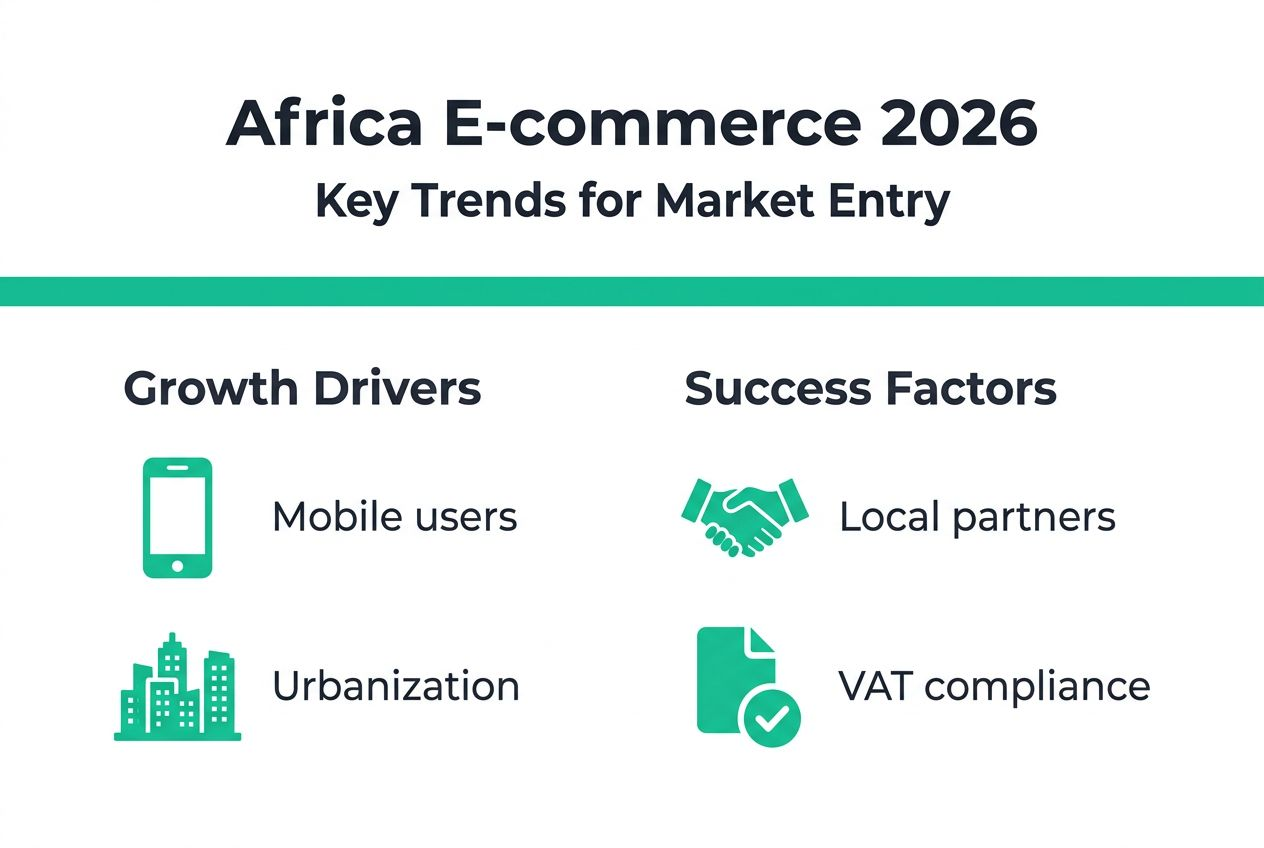
Africa’s e-commerce landscape in 2026 represents one of the world’s most compelling growth opportunities. The continent’s digital commerce sector is expanding at a 20% CAGR, driven by unprecedented mobile internet penetration that now reaches over 500 million users. Unlike mature markets where growth plateaus, African markets are just hitting their stride.
Several powerful forces converge to accelerate this transformation. Mobile devices have become the primary gateway to online shopping, with smartphone adoption growing faster than traditional desktop access ever did. The African Continental Free Trade Area (AfCFTA) is dismantling decades of trade barriers, creating a unified market of 1.3 billion consumers. Youth demographics skew heavily digital, with median ages under 20 in many countries creating a generation of mobile-first shoppers.
Yet Africa’s e-commerce environment differs fundamentally from Western or Asian markets:
- Regulatory frameworks vary dramatically between neighboring countries, requiring market-specific compliance strategies
- Payment infrastructure combines mobile money dominance with emerging digital wallet adoption
- Last-mile delivery challenges persist in urban centers and rural areas alike
- Currency volatility and cross-border payment complexity add layers of financial risk
- Consumer trust barriers require localized customer service and return policies
For international brands eyeing African expansion and local businesses scaling regionally, understanding these unique characteristics separates successful market entry from costly missteps. The opportunity is massive, but the path forward demands specialized cross-border e-commerce enablement expertise that accounts for Africa’s distinct operational realities.
Logistics challenges and innovations in African cross-border trade
Logistics remains the most visible pain point in African cross-border e-commerce, though not always for the reasons brands expect. Fragmented courier networks cause 30-50% longer delivery times compared to consolidated markets, but innovative technology solutions are rapidly closing this gap.
Traditional logistics infrastructure struggles with Africa’s geographic diversity. A shipment might pass through three countries, each with different courier partners, customs procedures, and tracking systems. This fragmentation creates visibility gaps where packages disappear into bureaucratic black holes for days or weeks.
Emerging technologies are transforming this landscape:
- Blockchain-based tracking systems provide immutable shipment records accessible to all stakeholders, eliminating the “where is my package” problem that erodes customer trust
- AI-powered route optimization analyzes historical delivery data, traffic patterns, and border crossing times to reduce delays by 25% through smarter path selection
- Multi-courier networks distribute risk across partners, improving delivery accuracy by 18% when one provider faces disruptions
- Real-time customs status APIs alert sellers to documentation issues before they cause costly holds
- Predictive analytics forecast peak demand periods, enabling proactive inventory positioning
Pro Tip: Partner with e-commerce logistics platforms that maintain relationships with multiple regional couriers rather than relying on a single provider. When political unrest, weather events, or operational issues affect one courier, your shipments automatically reroute through alternatives without manual intervention.
The innovation extending beyond pure technology includes strategic warehouse placement. Brands achieving the fastest delivery times position inventory in regional hubs serving multiple countries, rather than shipping everything from a single central location. This distributed model, combined with cross-border enablement services, cuts average delivery windows from 14-21 days to 5-7 days in major urban markets.
Advanced logistics services providers now offer predictive restocking algorithms that analyze marketplace sales velocity across regions, automatically triggering inventory transfers before stockouts occur. This proactive approach prevents the revenue loss associated with out-of-stock listings in high-demand periods.
Understanding compliance: VAT, duties, and importer of record services
While logistics challenges are visible and measurable, compliance complexity operates as the hidden iceberg sinking unprepared cross-border ventures. Compliance issues cause 40% of shipment delays in African cross-border e-commerce, dwarfing infrastructure-related holdups.
The compliance landscape varies dramatically across African markets. VAT rates range from 5% to 18% depending on the country and product category. Import duties add another 5% to 35% based on harmonized tariff codes, country of origin, and trade agreements. A laptop shipped to Kenya faces different treatment than the same device entering Nigeria or South Africa.
Documentation requirements multiply this complexity. Each country demands specific customs forms, certificates of origin, product safety certifications, and invoicing formats. A single missing document or misclassified tariff code triggers inspection holds that can last weeks. Brands attempting to navigate this maze in-house often discover their first shipment sitting in customs limbo, accruing storage fees while lawyers and customs brokers scramble to rectify paperwork errors.
Importer of Record (IoR) services eliminate this risk by assuming legal responsibility for customs clearance:
- IoR providers accelerate clearance by 40% through pre-established customs relationships and streamlined documentation processes
- Compliance costs drop 25% as IoR services leverage economies of scale and expertise that individual sellers cannot match
- Legal liability transfers from the seller to the IoR provider, protecting brands from penalties for inadvertent violations
- VAT and duty payments flow through the IoR’s established accounts, simplifying cross-border cash flow management
- Regulatory changes are monitored continuously, with documentation updated automatically to maintain compliance
Pro Tip: When evaluating cross-border enablement partners, prioritize providers offering IoR services bundled with logistics rather than sourcing them separately. Integrated platforms share data seamlessly between customs clearance and fulfillment teams, eliminating the coordination delays that plague multi-vendor approaches.
VAT planning deserves special attention for pricing strategy. Some markets allow VAT recovery on business purchases, while others treat it as a sunk cost. Understanding these nuances enables accurate pricing that maintains margin while remaining competitive. Brands that partner with experienced e-commerce logistics platforms gain access to country-specific tax modeling tools that project total landed costs before committing to market entry.
Marketplace integration: expanding reach in Africa and globally
Marketplace selection and integration strategy directly impacts revenue potential in African cross-border e-commerce. Multi-marketplace integration improves sales conversion rates by 15-20% compared to single-platform strategies, but success requires understanding each marketplace’s unique characteristics.
Key African marketplaces serve distinct customer segments. Jumia dominates across 11 African countries with strong fashion and electronics categories. Amazon South Africa attracts premium buyers seeking international brands with reliable delivery. Kilimall focuses on East African markets with competitive pricing on consumer goods. Takealot leads South Africa’s general merchandise segment.

The strategic choice between concentrated and diversified marketplace approaches depends on your product category and resources:
| Strategy | Advantages | Challenges |
|---|---|---|
| Single marketplace focus | Simplified operations, concentrated marketing spend, easier inventory management | Revenue concentration risk, limited customer reach, vulnerability to policy changes |
| Multi-marketplace integration | Broader audience exposure, revenue diversification, competitive pricing insights | Complex inventory synchronization, higher operational overhead, marketplace fee variations |
| Phased expansion | Controlled learning curve, incremental investment, proof of concept before scaling | Slower market penetration, delayed revenue potential, competitors may gain early advantages |
Integration technology has evolved to make multi-marketplace management feasible even for mid-sized sellers:
- Centralized inventory systems sync stock levels across platforms in real time, preventing overselling
- Unified order management consolidates fulfillment regardless of which marketplace generated the sale
- Automated pricing rules adjust for marketplace fees and local competition while protecting margins
- Performance analytics aggregate data across platforms, revealing which marketplaces drive the best ROI for specific product categories
- Customer service tools route inquiries to the appropriate team regardless of originating marketplace
Successful brands following the brand onboarding guide typically start with one or two marketplaces matching their core product strengths, then expand methodically based on performance data. Electronics sellers often begin with Amazon South Africa for its premium positioning, while fashion brands may prioritize Jumia’s broader regional footprint.
Marketplace integration platforms have reduced the technical barrier to multi-channel selling. What once required custom API development and ongoing maintenance now deploys through pre-built connectors. For brands seeking comprehensive e-commerce solutions, integrated platforms handling everything from customs clearance to marketplace listing eliminate coordination headaches between separate service providers.
Pro Tip: Monitor marketplace-specific conversion rates rather than just gross sales. A platform driving high traffic but low conversion may indicate pricing misalignment or poor product-market fit, suggesting either adjustment or reallocation of marketing spend to better-performing channels.
Common misconceptions in cross-border African e-commerce
Several persistent myths about African cross-border e-commerce lead brands astray, wasting resources on the wrong priorities. Addressing these misconceptions upfront prevents costly strategic errors.
The most damaging misconception positions logistics costs as the primary barrier to African e-commerce profitability. While shipping expenses certainly impact margins, compliance delays and customs holds create far greater financial drag. A shipment sitting in customs for two weeks accrues storage fees, ties up working capital, and often results in customer cancellations. Regulatory expertise delivers higher ROI than marginal shipping cost reductions.
Another common error assumes VAT and tariff structures follow consistent patterns across African markets. In reality, neighboring countries often implement radically different tax regimes. South Africa’s 15% VAT differs from Kenya’s 16% and Nigeria’s 7.5%. Import duties vary even more dramatically based on product classification, country of origin, and active trade agreements. Brands applying a one-size-fits-all approach to pricing discover their margins evaporate in high-duty markets or they price themselves out of competition in low-duty jurisdictions.
Key myths to abandon:
- Customs delays result primarily from inefficient couriers rather than incomplete documentation and regulatory compliance gaps
- All African markets share similar consumer preferences and shopping behaviors, when in fact preferences vary as much as between European countries
- Marketplace success requires massive upfront inventory investment, though consignment and dropship models often prove more capital-efficient for market testing
- Local language requirements are universal, while English and French serve as commercial languages across most major markets
- Mobile payment complexity prevents smooth transactions, despite mobile money achieving higher penetration than credit cards in many regions
The misconception that Importer of Record services only benefit large enterprise sellers particularly limits SME success. In practice, IoR services deliver proportionally greater value to smaller sellers who lack the legal and logistics infrastructure to navigate customs complexity independently. The 40% reduction in clearance time and 25% decrease in compliance costs often means the difference between profitability and failure for emerging brands.
Understanding these realities allows brands to allocate resources effectively, prioritizing regulatory expertise and multi-marketplace strategies over superficial cost-cutting that undermines long-term success.
Practical strategies for brands entering or expanding in African cross-border e-commerce
Translating market insights into action requires a systematic approach balancing ambition with operational reality. These five strategic steps provide a proven framework for successful African market entry and expansion in 2026.
-
Assess target markets through regulatory and logistical lenses before making product decisions. Start by mapping VAT rates, import duties, and documentation requirements for your product category across potential markets. Identify countries where your products face favorable tariff treatment through existing trade agreements. Evaluate courier network density and average delivery times in target cities. This research prevents the common mistake of selecting markets based solely on population size or GDP, only to discover prohibitive import barriers or impossible logistics.
-
Engage Importer of Record services from day one rather than attempting DIY customs clearance. The learning curve for African customs compliance is steep and expensive. Cross-border enablement providers with established IoR capabilities absorb this complexity, allowing you to focus on product-market fit and customer acquisition. The 40% reduction in clearance time directly translates to improved customer satisfaction and reduced working capital requirements.
-
Implement multi-marketplace integration strategically, starting with two platforms that complement rather than compete. If targeting premium buyers, pair Amazon South Africa with a regional specialist like Takealot. For mass-market penetration, combine Jumia’s pan-African reach with Kilimall’s East African strength. Marketplace integration platforms enable this multi-channel approach without proportional increases in operational overhead.
-
Adopt blockchain tracking and AI optimization technologies through logistics partners rather than building proprietary systems. The capital and expertise required for in-house development rarely justifies the investment for brands under $10 million in annual revenue. Fulfillment and logistics solutions providers offering these technologies as standard features deliver enterprise capabilities at SME price points.
-
Establish quarterly regulatory review cycles to monitor VAT and duty changes across your active markets. African countries frequently adjust tax policies, sometimes with limited advance notice. Automated alerts from compliance partners catch these changes before they impact your pricing or documentation, preventing costly shipment holds.
Pro Tip: Build contingency margin into your initial pricing to absorb unexpected compliance costs during the learning phase. Plan for 3-5% higher landed costs than your IoR provider estimates, then optimize pricing downward as you gain operational experience. This conservative approach prevents the cash flow crises that often occur when brands price too aggressively and discover hidden costs after inventory is committed.
Success in African cross-border e-commerce rewards preparation over improvisation. Brands that invest time in systematic market assessment, partner with experienced enablement providers, and maintain operational flexibility consistently outperform those chasing first-mover advantages with inadequate preparation.
Conclusion: leveraging trends to build a competitive cross-border strategy
Africa’s cross-border e-commerce transformation in 2026 creates unprecedented opportunities for international brands and regional businesses willing to master the interconnected challenges of logistics, compliance, and marketplace strategy. The 20% CAGR driving market expansion shows no signs of slowing, but capturing this growth requires more than enthusiasm.
Successful market entry depends on recognizing that compliance complexity, not logistics costs, represents the primary barrier to profitability. Importer of Record services, multi-marketplace integration, and technology-enabled logistics form the three pillars supporting sustainable African e-commerce operations. Brands attempting to navigate these challenges independently face steep learning curves and costly mistakes that erode the first-mover advantages they seek.
Integrated cross-border e-commerce enablement platforms collapse the complexity that once required coordinating multiple specialized vendors. When customs clearance, warehousing, fulfillment, and marketplace management flow through a single provider, the operational friction that derails expansion initiatives disappears. The question is no longer whether to enter African markets, but how quickly you can deploy the right partnerships to capture the opportunity before competitors establish dominant positions.
Unlock your cross-border potential with MoreShores
Navigating African cross-border e-commerce complexity demands expertise that most brands lack in-house. MoreShores eliminates the guesswork by providing integrated solutions handling every aspect of market entry and scaling.

Our cross-border enablement services include full Importer of Record capabilities, reducing customs clearance times by 40% while cutting compliance costs by 25%. Seamless marketplace integration services connect your products to Jumia, Amazon South Africa, Kilimall, and Takealot through a single platform, eliminating the operational overhead of managing multiple channels separately. Advanced fulfillment and logistics infrastructure leverages blockchain tracking and AI route optimization to deliver the speed and reliability African customers demand. Partner with MoreShores to transform African market complexity into competitive advantage, accelerating your path from planning to profitability.
FAQ
What are the biggest logistics challenges in African cross-border e-commerce?
Fragmented courier networks create the most significant logistics hurdles, extending delivery times by 30-50% compared to markets with consolidated infrastructure. Infrastructure gaps in rural areas compound these challenges. However, multi-courier partnerships and AI-powered route optimization are reducing these delays by up to 25%, making reliable delivery increasingly achievable across the continent.
How do Importer of Record services streamline compliance?
Importer of Record providers assume legal responsibility for customs clearance, handling all documentation, VAT payments, and duty calculations on your behalf. This expertise reduces clearance times by 40% and compliance costs by 25% by eliminating the errors that trigger shipment holds. IoR services transform customs from a barrier into a seamless operational step, allowing brands to focus on sales and customer service.
Which marketplaces should brands prioritize for African expansion?
Prioritize multi-marketplace strategies combining platforms with complementary strengths rather than concentrating on a single channel. Jumia offers the broadest pan-African reach, Amazon South Africa attracts premium buyers, and Kilimall dominates East African markets. Starting with two platforms that match your product category and target demographic, then expanding based on performance data, typically delivers the best risk-adjusted returns.
What technology innovations improve African cross-border logistics?
Blockchain-based tracking systems provide unprecedented shipment visibility, eliminating the opacity that erodes customer trust when packages move through multiple countries and carriers. AI route optimization analyzes millions of data points to select the fastest, most reliable delivery paths, reducing delays by 25%. These technologies, once available only to enterprise sellers, now come standard with leading fulfillment platforms, democratizing access to world-class logistics capabilities.