B2B e-commerce in Africa: 5 steps to market entry

TL;DR:
- Africa’s fragmented logistics and regulatory environment require careful market assessment and local partnerships.
- Leveraging AfCFTA reduces tariffs and harmonizes regulations, easing cross-border trade challenges.
- Asset-light logistics, local fintech, and compliance infrastructure are key to successful market entry.
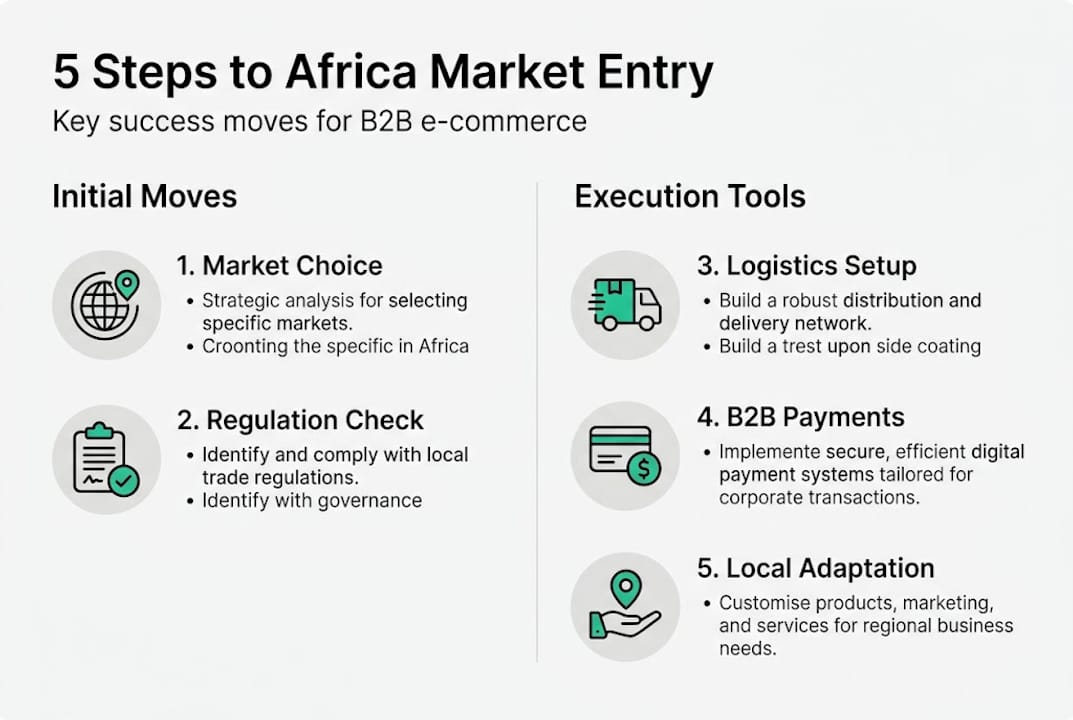
Entering African markets sounds like a clear growth opportunity until you hit the reality of fragmented logistics networks, multi-layered regulatory requirements, and payment systems that don’t talk to each other. Many B2B e-commerce managers at international brands find that their standard global playbook simply doesn’t translate. Customs clearance timelines stretch unpredictably, last-mile delivery costs eat into margins, and cross-border settlement fees add friction at every step. This guide walks you through five practical steps to assess readiness, navigate regulations, build resilient logistics, streamline payments, and adapt locally so you can move from ambition to profitable execution across Africa.
Table of Contents
- Assess readiness and choose entry markets
- Navigate regulations and maximize AfCFTA advantages
- Build resilient logistics: Automation, partners, and last-mile challenges
- Streamline B2B payments and local market adaptation
- What most global market playbooks miss about Africa
- Ready to unlock Africa? Power your move with MoreShores
- Frequently asked questions
Key Takeaways
| Point | Details |
|---|---|
| Start with hub markets | Entering African e-commerce through established hubs like South Africa and Nigeria minimizes risk and complexity. |
| Leverage AfCFTA advantages | AfCFTA provides tariff reductions and regulatory harmonization to simplify cross-border entry. |
| Adopt asset-light logistics | Partner with local players and use automation to manage costs and solve last-mile delivery challenges. |
| Use fintech for payments | Platforms like PAPSS and stablecoins cut settlement costs and streamline transactions. |
| Localize and adapt | Market pilots, public-private partnerships, and marketplace integration support sustainable, tailored entry. |
Assess readiness and choose entry markets
Before you commit capital or inventory, you need an honest picture of where your organization stands. Market entry into Africa is not a single move. It’s a sequence of decisions, and starting with the wrong market or an underprepared team is one of the most common reasons international brands stall.
Use this readiness checklist before selecting a market:
- Supply chain flexibility: Can your sourcing and fulfillment adapt to longer lead times and variable port clearance speeds?
- Compliance capacity: Do you have internal or external support for product certifications, import duties, and VAT registration in a new jurisdiction?
- Working capital buffer: African market entry often requires 60 to 90 days of runway before revenue stabilizes.
- Local market knowledge: Do you have a partner, distributor, or advisor with on-the-ground experience?
- Technology integration: Are your systems compatible with local marketplace platforms and payment gateways?
Once you’ve confirmed readiness, choose your entry market carefully. African hub market logistics data shows that South Africa, Nigeria, Kenya, and Egypt consistently rank highest for Logistics Performance Index scores and B2B ecosystem maturity, making them the most viable starting points for international brands.
| Market | Logistics strength | B2B ecosystem maturity | Key advantage |
|---|---|---|---|
| South Africa | High | High | Established retail and fintech infrastructure |
| Nigeria | Medium-High | High | Largest consumer market by population |
| Kenya | Medium | Medium-High | Strong mobile money and startup ecosystem |
| Egypt | Medium | Medium | Gateway to North Africa and Middle East |
Understanding marketplace integration in Africa is equally important, since each market has dominant platforms that require specific onboarding steps and compliance documentation. Review the B2B brand onboarding process early so you know what’s required before you commit to a market.
Pro Tip: Start with one or two hub markets rather than attempting a pan-African launch. Prove your model, refine your operations, and then scale regionally with real data behind your decisions.
Navigate regulations and maximize AfCFTA advantages
After market assessment and selection, regulatory navigation is the next essential step. Africa’s regulatory environment varies significantly by country, but the African Continental Free Trade Area (AfCFTA), which came into force in 2021, is actively reshaping the landscape for B2B e-commerce.

AfCFTA’s impact on B2B e-commerce includes tariff reductions across member states, regulatory harmonization, and a developing digital trade protocol that can meaningfully lower the cost and complexity of cross-border entry.
Here’s how to leverage AfCFTA step by step:
- Confirm your product’s tariff classification under the Harmonized System code and check whether it qualifies for preferential rates between your origin country and target African market.
- Verify rules of origin requirements to ensure your goods meet the local content or transformation thresholds required to claim AfCFTA tariff benefits.
- Register with the relevant national revenue authority in your target market for VAT and import duty compliance before your first shipment.
- Monitor the AfCFTA digital trade protocol for updates on e-commerce-specific provisions, including data flows and electronic contracts, which are still being finalized across member states.
- Engage public-private partnerships (PPPs) where available. Several African governments have established trade facilitation desks that help international brands navigate customs procedures faster.
Common regulatory mistakes include misclassifying products, undervaluing shipments on customs declarations, and failing to register for VAT before sales begin. These errors trigger delays, fines, and sometimes seizure of goods.
“Brands that invest early in compliance infrastructure, rather than treating it as an afterthought, consistently experience faster time-to-market and fewer costly shipment holds.”
Pro Tip: Work with a partner that offers cross-border enablement services and acts as your Importer of Record. This shifts the compliance burden off your team and reduces the risk of regulatory missteps that delay your launch.
Building cross-border partnerships with locally established operators also accelerates regulatory clearance, since they bring existing relationships with customs authorities and trade bodies.
Build resilient logistics: Automation, partners, and last-mile challenges
With regulations checked, next comes building a resilient supply chain to ensure you actually deliver. Africa’s logistics landscape is improving, but it remains fragmented. The Africa e-commerce logistics market is valued at USD 1.3 billion, with major players like DHL and Jumia Logistics operating alongside a growing number of local startups focused on automation and last-mile delivery.
Choosing the right logistics model is one of the most consequential decisions you’ll make:
| Model | Key pros | Key cons | Best for |
|---|---|---|---|
| Asset-light | Lower fixed costs, scalable, flexible | Less control over delivery quality | Early-stage or testing phase |
| Asset-heavy | Higher control, consistent service levels | High capital outlay, slow to adapt | Established, high-volume operations |
For most international brands entering Africa, the asset-light model is the smarter starting point. OmniRetail’s approach demonstrates how partnering with local platforms and embedding financial services into the supply chain enables profitability even in thin-margin FMCG categories.
Key logistics partners worth evaluating:
- DHL Express Africa: Strong for cross-border air freight and time-sensitive shipments
- Jumia Logistics: Integrated with Jumia marketplace, solid last-mile coverage in West and East Africa
- OmniRetail: Focused on B2B distribution to informal retailers across Nigeria
- Local last-mile startups: Country-specific operators often outperform global carriers in rural or peri-urban delivery
Automation is increasingly relevant for last-mile efficiency. Route optimization software, automated warehouse picking, and real-time tracking tools reduce both delivery times and operational costs. Review your fulfillment and logistics strategies to identify where automation can replace manual processes.
Pro Tip: Avoid locking capital into fixed warehouse assets before you understand actual demand patterns. Use third-party fulfillment centers initially, then scale your footprint based on real order volume data. Explore e-commerce logistics solutions that offer flexible warehousing without long-term commitments.
Streamline B2B payments and local market adaptation
Once logistics are planned, it’s essential to move money efficiently and build market relevance. Cross-border B2B payments in Africa have historically been slow, expensive, and opaque. That is changing, but you need to choose the right tools.
Step-by-step payment toolkit for African B2B e-commerce:
- PAPSS (Pan-African Payment and Settlement System): Enables intra-African payments in local currencies, reducing reliance on USD or EUR intermediaries and cutting settlement costs significantly.
- Stablecoins: USD-pegged stablecoins are gaining traction for B2B settlement, particularly in markets with volatile local currencies. They offer speed and cost advantages over traditional wire transfers.
- Embedded finance platforms: Platforms that integrate credit, insurance, and payment tools directly into the B2B transaction flow reduce friction and improve cash flow for both buyer and seller.
- Local mobile money integration: In markets like Kenya and Ghana, mobile money platforms such as M-Pesa handle significant B2B transaction volumes and should not be overlooked.
Cross-border payment solutions using fintech tools like PAPSS and stablecoins can cut settlement costs under AfCFTA, making your pricing more competitive and your cash cycle faster. Explore fintech for B2B payments to understand which tools integrate with your existing systems.
Localization matters as much as payment infrastructure. Running a pilot in one city or region before a national rollout lets you test pricing, product mix, and delivery models without overcommitting resources. Partnering with established marketplaces gives you immediate access to existing customer bases and local trust.
One important risk to flag: in less developed African markets, import-only market risk is real. Without local infrastructure investment and genuine value creation, international brands can find themselves locked out of sustainable growth as governments prioritize domestic producers.
Statistic callout: Digital payment adoption in Africa is growing at double-digit rates annually, and brands that integrate local payment methods from day one report significantly higher conversion rates than those relying solely on international card networks.
What most global market playbooks miss about Africa
Here’s the uncomfortable truth: most global market entry frameworks were built for markets with stable infrastructure, predictable regulatory enforcement, and mature financial systems. Africa requires a different mental model.
Textbook thinking assumes that if you solve distribution, you win. Africa’s B2B e-commerce shakeout shows that pure distribution is rarely profitable. The brands and platforms that are building sustainable businesses have pivoted toward embedded finance and supply chain services, not just moving goods from A to B.
AfCFTA generates real optimism, and rightly so. But strategic opportunities under AfCFTA come alongside genuine risks: market concentration in a few hub cities, governance gaps in enforcement, and growing cybersecurity threats that most international brands underestimate.
What we’ve seen working at MoreShores is that brands succeeding in African e-commerce realities treat compliance and financial services as core product features, not overhead. They build relationships with local operators before they need them. And they resist the urge to replicate their home-market model without adaptation. Africa rewards patience, local knowledge, and operational flexibility far more than it rewards speed or scale alone.
Ready to unlock Africa? Power your move with MoreShores
Putting these strategies into practice requires more than a plan. It requires infrastructure, local expertise, and partners who understand the operational realities on the ground.
MoreShores connects your business to Africa’s leading platforms, including Takealot, Jumia, Amazon SA, and Kilimall, while handling the full compliance stack as your Importer of Record. From cross-border enablement and customs clearance to fulfillment services and marketplace listing, we manage the complexity so you can focus on growth. Our comprehensive e-commerce solutions are built specifically for international brands entering African markets, giving you a scalable, compliant, and cost-efficient path to your first sale and beyond.
Frequently asked questions
What is the best African market to enter first for B2B e-commerce?
South Africa, Nigeria, Kenya, and Egypt are the top starting points due to their strong logistics infrastructure, established B2B ecosystems, and relatively mature regulatory frameworks compared to other African markets.
How does AfCFTA help with African market entry?
AfCFTA reduces tariffs, harmonizes regulations, and supports digital trade protocols, which together lower the cost and administrative burden of cross-border B2B e-commerce across member states.
What are asset-light logistics and why are they important in Africa?
Asset-light logistics means partnering with local providers and using automation rather than owning physical infrastructure, which keeps fixed costs low and allows you to scale based on actual demand rather than projected volume.
Which payment solutions cut B2B costs in Africa?
Fintechs like PAPSS and stablecoins reduce settlement costs and speed up cross-border transactions, making them the most practical tools for international brands managing multi-currency B2B payments across African markets.
What’s the key pitfall for international brands entering smaller African countries?
Without local infrastructure investment, brands risk becoming import-only market operators with no path to sustainable growth, making local adaptation and public-private partnerships essential from the start.