
Africa is not one market. It is 54 distinct countries, each with its own regulations, currencies, consumer behaviors, and infrastructure realities. Yet many international brands still approach the continent as a single opportunity, applying the same playbook they used in Southeast Asia or Latin America. That approach fails more often than it succeeds. Tailored strategies are essential because the regulatory, cultural, economic, and infrastructure differences between African countries are as significant as the differences between Germany and Vietnam. This guide gives you a practical, evidence-driven framework for entering African markets with confidence.
Table of Contents
- Defining African market entry
- Key market entry strategies: Models and frameworks
- Critical compliance and regulatory requirements
- Case studies: What works, what fails in Africa
- Risks, edge cases, and common pitfalls to avoid
- Your African market entry checklist: From idea to execution
- Explore your path with MoreShores
- Frequently asked questions
Key Takeaways
| Point | Details |
|---|---|
| Africa is not one market | Each African country requires its own market entry strategy, tailored to unique regulations and cultures. |
| Start with gateway markets | Nigeria, Kenya, and South Africa offer the most effective launchpads for broader regional expansion. |
| Compliance drives success | Navigating local licensing, data laws, and payments is essential for legal and operational success. |
| Local partnerships reduce risk | Forming trusted local alliances helps you overcome regulatory, infrastructure, and market barriers. |
| Continuous adaptation is vital | Monitor, iterate, and adapt your approach for long-term success in Africa’s dynamic environments. |
Defining African market entry
Now that you know one size does not fit all, let’s break down what market entry truly entails.
African market entry means expanding operations into one or more of Africa’s 54 diverse countries through approaches tailored to each country’s unique conditions. It is not simply shipping products to a new continent. It involves legal registration, regulatory compliance, local partnerships, payment infrastructure, and logistics networks that vary dramatically from one country to the next.
Who pursues African market entry? International consumer brands, e-commerce merchants, logistics providers, fintech companies, and institutional investors all have a stake. Each enters for different reasons and faces different barriers. A fashion brand entering Nigeria faces different challenges than a logistics firm entering Ethiopia.
The key differences between Africa and other emerging regions come down to fragmentation. In Southeast Asia, regional trade frameworks and shared digital infrastructure make multi-country expansion more predictable. In Africa, you are often dealing with 54 separate regulatory environments, multiple currency regimes, and infrastructure gaps that vary block by block in some cities.
- Regulatory diversity: Each country has its own business registration, licensing, and tax framework.
- Infrastructure gaps: Power reliability, road networks, and last-mile delivery vary enormously.
- Cultural and language factors: Africa has over 2,000 languages and deeply localized consumer preferences.
- Payment fragmentation: Mobile money dominates in East Africa; card payments are more common in South Africa.
Pro Tip: Review our brand onboarding guide before selecting your first African market. Understanding your operational requirements upfront saves months of costly course corrections later.
A glocal strategy, meaning global scale with hyper-local execution, is not optional in Africa. It is the baseline requirement for sustainable growth.
Key market entry strategies: Models and frameworks
Understanding the definition sets the stage for evaluating which market entry approaches actually work in Africa.
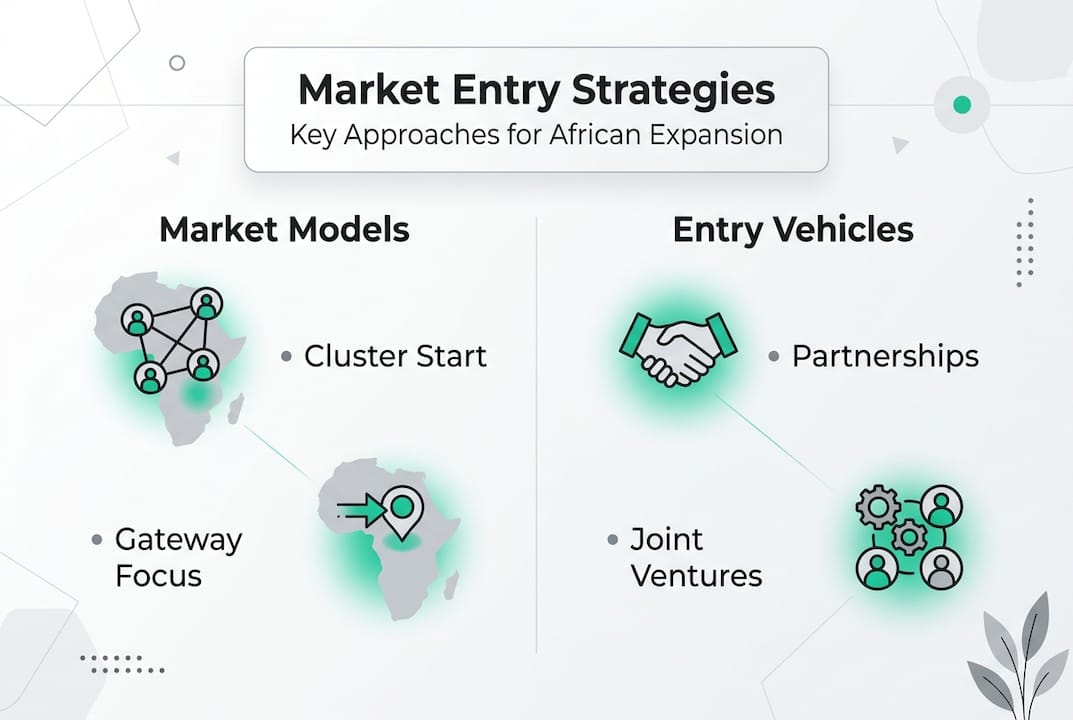
Cluster strategies, gateway market targeting, and entry modes like partnerships, joint ventures, and holding entities are the core mechanics international brands use to enter Africa. Each model carries different risk profiles and resource requirements.

Cluster strategy means starting with two or three high-potential markets, typically Nigeria, Kenya, and South Africa, and using those as regional hubs before expanding into neighboring countries. This approach balances speed with risk management.
Country-by-country strategy means going deep in one market before moving to the next. It is slower but produces stronger local brand equity and compliance foundations.
Entry vehicles include local partnerships, joint ventures, wholly owned subsidiaries, and holding entities registered in favorable jurisdictions like Mauritius.
| Entry model | Risk level | Resource requirement | Best for |
|---|---|---|---|
| Local partnership | Low to medium | Low | First-time entrants |
| Joint venture | Medium | Medium | Regulated industries |
| Wholly owned subsidiary | High | High | Long-term, high-volume brands |
| Holding entity (Mauritius) | Medium | Medium | Multi-country expansion |
Here is a practical sequence for selecting your entry model:
- Define your revenue targets and timeline for profitability.
- Map the regulatory requirements for your product category in target countries.
- Assess your internal capacity for compliance management.
- Evaluate local partner options and their track records.
- Choose the entry vehicle that matches your risk tolerance and resource availability.
- Review your marketplace integration options to understand how your products will reach consumers.
Critical compliance and regulatory requirements
Choosing your approach is just the start. Meeting compliance requirements is critical for operational success.
Country-specific licensing, data protection, payment localization, ad pre-approval, and import compliance are the five pillars of e-commerce regulatory compliance in Africa. Miss any one of them and you risk fines, shipment holds, or forced market exit.
Here is a snapshot of major licensing regimes:
- Nigeria: Business registration with the Corporate Affairs Commission costs approximately $36. E-commerce operators also need FCCPC compliance for consumer protection.
- South Africa: Companies must register with the CIPC and comply with POPIA for data privacy. Import duties and VAT at 15% apply to most goods.
- Kenya: Business registration through the eCitizen portal is straightforward, but sector-specific licenses add complexity for fintech and health products.
| Country | Key license | Typical fee | Compliance timeline |
|---|---|---|---|
| Nigeria | CAC registration | ~$36 | 2 to 4 weeks |
| South Africa | CIPC registration | ~$30 | 1 to 2 weeks |
| Kenya | Business registration | ~$15 | 1 to 3 weeks |
| Tanzania | BRELA registration | ~$50 | 3 to 6 weeks |
Data privacy laws are non-negotiable. Nigeria’s NDPR and South Africa’s POPIA both require explicit consent for data collection, local data storage in some cases, and breach notification protocols. Advertising pre-approval is required for certain product categories including pharmaceuticals, financial services, and food products.
Pro Tip: Localize your payment flows and data infrastructure before launch, not after. Integrating mobile money options like M-Pesa in Kenya or Flutterwave in Nigeria from day one reduces friction and keeps you aligned with local e-commerce compliance strategies. For market-specific registration details, business registration in Tanzania is a useful reference for East African expansion.
Case studies: What works, what fails in Africa
With the regulatory landscape mapped, let’s see what real companies have learned the hard way.
TECNO dominated African smartphones through hyper-localization, building devices with long battery life for markets with unreliable power, offering local language interfaces, and pricing aggressively for middle-income consumers. Meanwhile, five South African retail chains exited Nigeria due to forex restrictions and infrastructure challenges they had not adequately planned for.
“The brands that win in Africa are not the biggest. They are the most adaptable.”
Coca-Cola’s local bottler model succeeded because it distributed risk, embedded local knowledge, and created community economic stakes in the brand’s success. Shoprite’s direct retail model in Nigeria struggled with the same forex and logistics issues that broke other foreign retailers.
Key lessons from these real-world cases:
- Local adaptation is not optional. Product, pricing, and distribution must reflect local realities.
- Forex risk planning is essential. Currency devaluation can erase margins overnight without hedging strategies.
- Partnerships distribute risk. Local partners bring regulatory knowledge, relationships, and operational networks you cannot build quickly.
- Take the long view. Brands that commit to 5 to 10 year horizons consistently outperform those chasing short-term GMV.
Africa’s e-commerce market is projected to reach significant scale through 2030, driven by mobile internet penetration and a growing middle class. Review real-world onboarding lessons to understand how successful brands structure their African entry from day one.
Risks, edge cases, and common pitfalls to avoid
Learning from others’ wins and losses, it’s time to focus on practical risk management for your own entry.
Forex volatility, infrastructure gaps, counterfeiting, corruption, regulatory unpredictability, and cyber threats are the primary risk categories every international brand must plan for before entering African markets. Ignoring any one of them is a costly mistake.
Top risks to plan for:
- Currency volatility: The Nigerian naira, Ghanaian cedi, and Ethiopian birr have all experienced significant devaluations in recent years. Price in USD where possible and build forex hedging into your financial model.
- Logistics and power gaps: Unreliable electricity and poor road infrastructure in secondary cities can disrupt fulfillment timelines significantly.
- Counterfeiting: Premium consumer goods face serious counterfeit competition in markets like Nigeria and Kenya. Brand protection strategies must be built in from the start.
- Regulatory unpredictability: Policy changes can happen quickly. Maintain active relationships with local legal counsel in each market.
- Cyber threats: E-commerce platforms face elevated fraud risk in several African markets. Invest in fraud detection tools early.
Pro Tip: Build resilience through scenario planning, local networks, and flexible logistics structures. Finding trusted local partners is one of the most effective ways to reduce exposure to governance and infrastructure risks. For currency risk specifically, managing forex risk through trade finance instruments is worth exploring early.
Your African market entry checklist: From idea to execution
Mitigating risk is ongoing. Here is how to put every piece together for a confident launch.
Starting with a single-country deep-dive, building resilience, and harmonizing compliance under AfCFTA is the recommended sequence for international brands entering Africa in 2026. Here is the full execution roadmap:
- Validate your idea and select your country. Research consumer demand, competitive landscape, and regulatory environment. Choose one gateway market to start.
- Map regulatory requirements. Identify all licenses, data privacy obligations, import duties, and advertising rules for your product category.
- Register your business. Complete legal registration in your target country. Engage local legal counsel for accuracy.
- Localize your product, payment, and data infrastructure. Adapt pricing, packaging, language, and payment options to local preferences.
- Select and vet your partners. Conduct due diligence on logistics providers, distributors, and marketplace operators.
- Set up infrastructure and logistics. Establish warehousing, fulfillment, and last-mile delivery networks. Review launching e-commerce in Africa for platform-specific guidance.
- Go live, monitor, and iterate. Track key metrics including conversion rates, fulfillment times, return rates, and customer acquisition costs. Adjust based on real data.
| Checklist stage | Key action | Common pitfall |
|---|---|---|
| Country selection | Research demand and regulation | Choosing too many markets at once |
| Compliance mapping | Engage local legal counsel | Assuming rules mirror home market |
| Localization | Adapt payment and product | Translating only, not adapting |
| Partner selection | Conduct formal due diligence | Relying on informal referrals |
| Go-live | Monitor metrics weekly | Setting and forgetting post-launch |
Explore your path with MoreShores
With your checklist complete, here is where to get expert support for a smoother, faster, and more compliant African launch.
Entering African markets involves layers of compliance, logistics, and marketplace complexity that are difficult to manage alone. MoreShores exists to remove those barriers for international brands and e-commerce merchants. Our cross-border enablement services cover Importer of Record functions, customs clearance, duties, and VAT management across multiple African markets.
We connect your products to leading African marketplaces including Takealot, Jumia, Kilimall, and Amazon SA through our Africa e-commerce solutions, while our African fulfillment and logistics network handles warehousing, inventory management, and last-mile delivery. Whether you are entering your first African market or scaling across the continent, we provide the infrastructure and expertise to do it efficiently and compliantly. Reach out to our team to start your onboarding conversation today.
Frequently asked questions
What is African market entry?
African market entry is the process of expanding a business into one or more African countries through strategies tailored to each country’s unique regulatory, cultural, and economic landscape. It goes well beyond shipping products to a new region.
What is the best entry strategy for Africa?
The best strategy typically starts with gateway markets like Nigeria, Kenya, or South Africa, using local partnerships or a single-country focus before scaling regionally. Cluster approaches work well for brands with sufficient resources.
What risks do international brands face entering Africa?
Top risks include currency volatility, infrastructure gaps, counterfeiting, and regulatory or political instability. Proactive scenario planning and trusted local partners significantly reduce exposure.
How does e-commerce compliance work in Africa?
E-commerce firms must meet country-specific licensing, data privacy, advertising, and import regulations that vary by market, such as NDPR in Nigeria or POPIA in South Africa. No single compliance framework covers the entire continent.