Unlock African cross-border trade: Guide for e-commerce success
TL;DR:
- African cross-border trade involves over $10 billion annually through informal channels.
- The AfCFTA aims to reduce tariffs and streamline digital trade across 54 nations, creating new opportunities.
- Success requires local partnerships, understanding regulatory barriers, and leveraging digital payment systems.
African cross-border trade moves far more money than most entrepreneurs realize. We’re talking about a market where formal and informal exchanges together shape billions in annual commerce, influenced by sweeping policy shifts like the African Continental Free Trade Area (AfCFTA). If you’re an e-commerce business owner eyeing international expansion, Africa isn’t a side opportunity. It’s a primary growth lever. This guide breaks down the core concepts, real barriers, and practical strategies you need to enter African markets with confidence and a clear plan.
Table of Contents
- Understanding African cross-border trade: Concepts and scope
- Key drivers: Trade protocols, digital integration, and evolving payments
- Challenges: Non-tariff barriers, logistics, and gender dynamics
- Opportunities and strategies for e-commerce entrepreneurs
- The unspoken truth: Why most cross-border strategies fail and what actually works
- Expand your business with proven cross-border solutions
- Frequently asked questions
Key Takeaways
| Point | Details |
|---|---|
| Huge informal sector | Informal trade moves billions in goods and is vital for both entrepreneurs and local economies. |
| New payment solutions | Systems like mobile money and PAPSS are transforming how cross-border transactions happen across Africa. |
| Barriers still matter | Non-tariff barriers and expensive logistics remain key hurdles for international business success. |
| Hybrid strategies win | Mixing formal and informal trade channels, plus digital tools, yields best results for e-commerce entrepreneurs. |
Understanding African cross-border trade: Concepts and scope
Cross-border trade simply means the exchange of goods and services across national borders. In Africa, this happens in two distinct ways, and understanding both is essential before you invest a dollar.
Formal trade is regulated, documented, and moves through official customs channels. It involves invoices, tariff classifications, import permits, and compliance with national standards. This is the route most international brands default to.
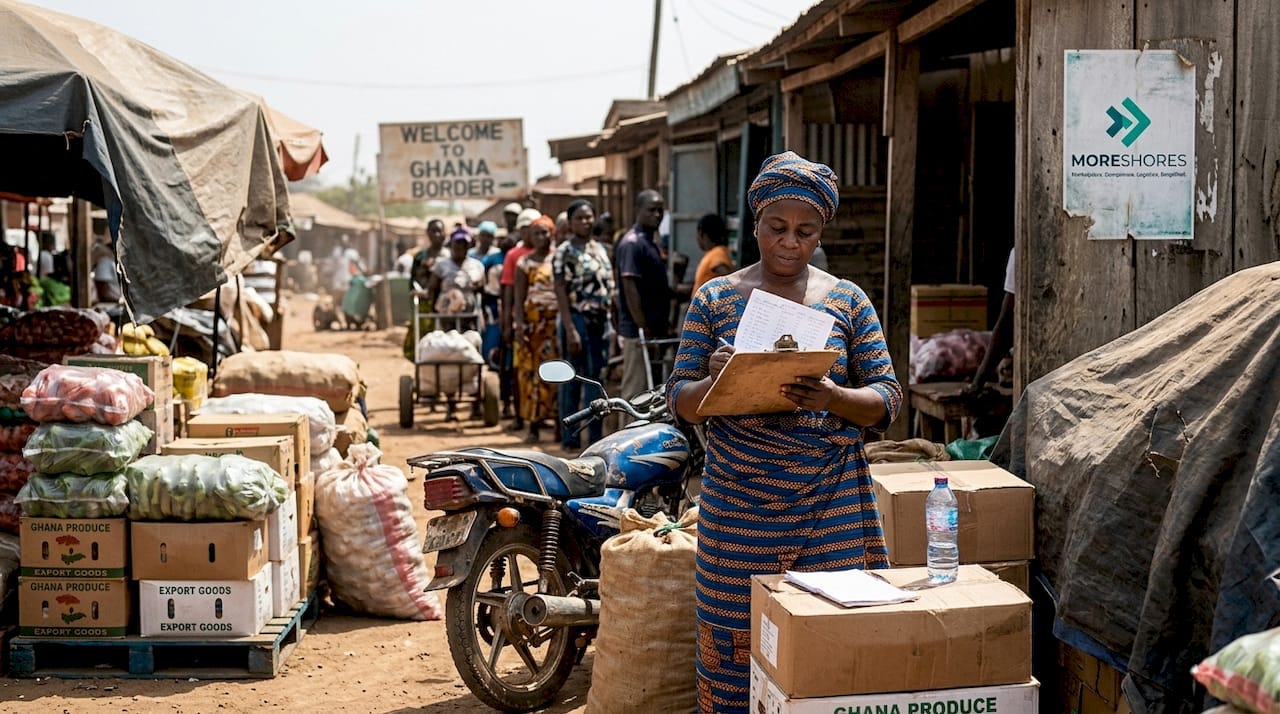
Informal trade operates outside those official channels. Think of traders carrying goods across borders at small crossing points, selling in open markets, and transacting in cash. It’s not illegal in most cases. It’s simply outside the formal documentation system.
Here’s what surprises most entrepreneurs: informal cross-border trade in Africa is not small. It’s estimated at $10 to $24 billion annually, and in the Southern African Development Community (SADC) region, up to 70% of informal traders are women. This is a massive, active, and underserved commercial ecosystem.
| Trade type | Documentation | Channels | Scale |
|---|---|---|---|
| Formal | Full customs, invoices | Ports, airports | Measurable, regulated |
| Informal | Minimal or none | Border markets, small crossings | $10-24B annually |
| Hybrid | Partial | Mixed channels | Growing with digitization |
The AfCFTA, which came into force in 2021, is reshaping this landscape. Its goal is to reduce tariffs across 54 African nations and create a single continental market. For e-commerce businesses, this means fewer trade barriers, more predictable costs, and a clearer path to scaling across multiple countries from a single operational base.
Why does the informal channel matter to you as a digital seller? Because informal markets reveal real consumer demand. Products that move well through informal channels are often under-served by formal e-commerce. That’s a signal worth acting on.
- Consumer electronics and accessories
- Apparel and textiles
- Fast-moving consumer goods (FMCG)
- Agricultural inputs and processed foods
Pro Tip: Before committing to a full market entry, identify whether your product category already moves through informal channels in your target country. High informal volume often means strong latent demand that formal e-commerce can capture at scale. You can review the cross-border process overview to understand how to formalize that entry efficiently.
Key drivers: Trade protocols, digital integration, and evolving payments
Once you grasp the types of cross-border trade, the next step is to navigate how regulation and technology actually shape the landscape.
The AfCFTA’s Digital Trade Protocol is one of the most significant developments for e-commerce entrepreneurs. It creates a framework for digital commerce across borders, covering data flows, electronic transactions, and consumer protection. In practical terms, it lowers the regulatory friction for selling digitally across African markets.
But policy alone doesn’t move products. Payments do. And Africa’s payment landscape is genuinely complex.
Cash-on-delivery still accounts for roughly 23% of transactions in several markets. Payment processing costs run between 7.4% and 8.3%, which is significantly higher than what you’d encounter in North America or Europe. These costs eat directly into your margins if you haven’t planned for them.
The good news is that mobile money has transformed accessibility. Platforms like M-Pesa in Kenya and MTN Mobile Money across West and Central Africa let consumers transact without bank accounts. The Pan-African Payment and Settlement System (PAPSS) is also gaining traction as a real-time cross-border payment rail that reduces reliance on correspondent banking and cuts transaction costs.

| Payment method | Cost | Reach | Best for |
|---|---|---|---|
| Cash on delivery | Low setup | Wide | Low-trust markets |
| Card payments | Medium | Urban | Mid-to-high income |
| Mobile money | Low per transaction | Very wide | Mass market |
| PAPSS | Lowest cross-border | Growing | B2B and formal trade |
Here’s a numbered breakdown of how to approach payment strategy for African market entry:
- Identify which payment methods dominate in your target country before launch.
- Build mobile money acceptance into your checkout from day one.
- Price your products to absorb processing fees without eroding your margin.
- Explore PAPSS integration if you’re operating B2B or at volume.
- Use simplified trade regimes (STRs) and one-stop border posts (OSBPs) for small shipments to reduce customs friction.
Pro Tip: Nigeria, Kenya, and South Africa have the most mature digital payment ecosystems on the continent. If you’re testing a new product category, start in one of these three markets before expanding. Explore e-commerce expansion strategies to see how platform infrastructure can support that rollout.
Challenges: Non-tariff barriers, logistics, and gender dynamics
Despite policy and technology gains, persistent real-world barriers still impact bottom lines and equity.
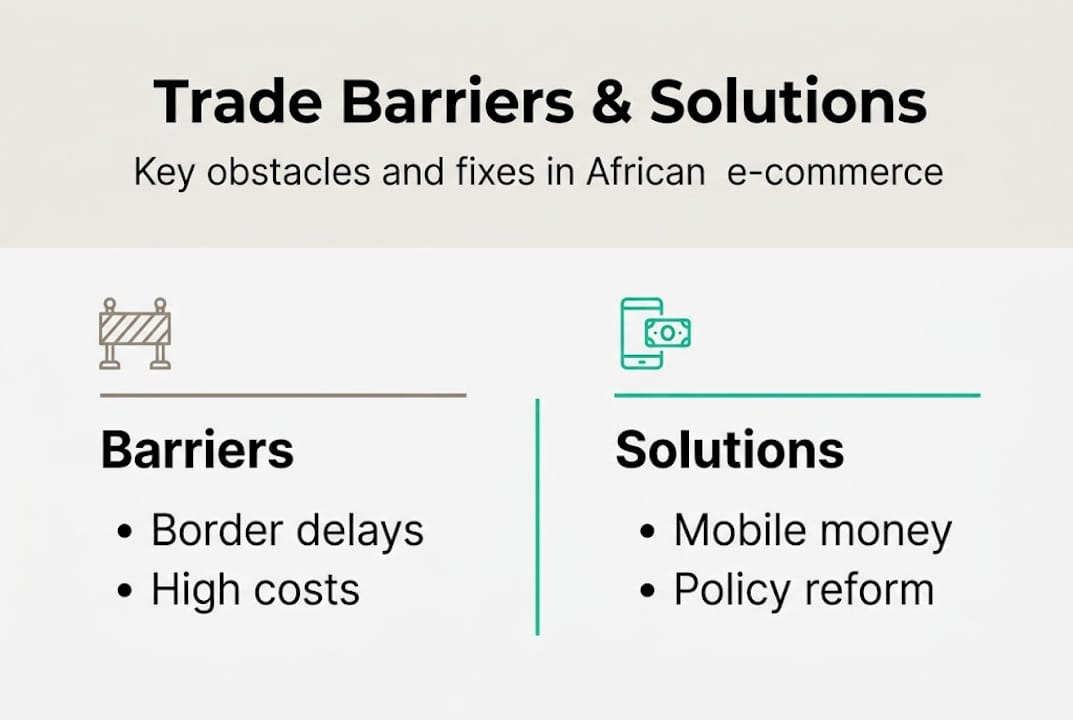
Tariffs get most of the attention in trade discussions. But non-tariff barriers (NTBs) are the bigger problem. NTBs include things like inconsistent product standards, excessive documentation requirements, border delays, and outright corruption. They’re harder to predict, harder to budget for, and harder to resolve than a straightforward import duty.
NTBs cost Africa an estimated $20 billion in GDP annually. That’s not a rounding error. It’s a structural drag on commerce that affects every business operating across African borders.
Logistics costs in African cross-border trade account for 40 to 60% of total transaction costs, compared to a global average closer to 10 to 15%.
That statistic should recalibrate how you think about pricing and margin planning. Poor road infrastructure, limited cold chain capacity, and fragmented courier networks all contribute to this cost burden.
The gender dimension of these challenges is also worth understanding. Women make up the majority of informal cross-border traders in many regions, yet they face disproportionate harassment at border crossings, exclusion from formal trade financing, and limited access to digital tools. This matters for entrepreneurs because it signals where market access is being suppressed and where support infrastructure is weakest.
Common NTBs you’ll encounter and how to address them:
- Border delays: Work with a licensed customs broker or Importer of Record (IOR) who knows local procedures.
- Inconsistent standards: Certify products to the highest regional standard (e.g., SABS in South Africa) to avoid country-by-country re-certification.
- Documentation errors: Use digital trade documentation platforms to reduce manual errors and speed up clearance.
- Corruption at crossings: Route shipments through established formal ports with electronic tracking and audit trails.
- Regulatory fragmentation: Partner with a platform that monitors NTB changes across your target markets.
For gender barriers and logistics support, purpose-built infrastructure and compliance support can reduce exposure to many of these friction points significantly.
Opportunities and strategies for e-commerce entrepreneurs
With these challenges acknowledged, what practical steps can entrepreneurs take to thrive in African cross-border e-commerce?
The opportunity is real. Africa’s e-commerce market is growing, driven by a young, mobile-first population and rising urban incomes. The key is identifying the right corridors and product categories before committing capital.
High-opportunity trade corridors currently include South Africa to the rest of SADC, Nigeria to West Africa, and Kenya to East Africa. These corridors have established logistics networks, growing digital payment adoption, and consumer demand that formal e-commerce is still catching up to serve.
Hybrid formal-informal strategies consistently outperform pure formal-only approaches for SME market entry. That means using formal channels for compliance and documentation while leveraging informal distribution networks for last-mile reach.
Steps to formalize your trade and leverage e-commerce platforms:
- Conduct corridor-specific market research to confirm demand and competition.
- Register your business entity or appoint an Importer of Record in your target market.
- Classify your products correctly under the AfCFTA rules of origin (RoO) to qualify for preferential tariffs.
- Integrate with local and regional marketplaces (Jumia, Kilimall, Takealot) to reach consumers where they already shop.
- Use API interoperability solutions to sync inventory and orders across platforms without manual reconciliation.
- Monitor NTB changes using trade alert systems and WTO benchmarking tools.
Mistakes to avoid when entering African cross-border markets:
- Assuming one country’s regulations apply continent-wide
- Underestimating last-mile delivery costs in peri-urban and rural areas
- Ignoring mobile-first UX design for your storefront
- Skipping local compliance checks before listing products
- Over-relying on a single courier or logistics partner
The unspoken truth: Why most cross-border strategies fail and what actually works
Most guides on African cross-border trade focus on policy frameworks and digital tools. They’re not wrong, but they’re incomplete. What they rarely address is the gap between what the policy says and what happens at the border on a Tuesday morning.
We’ve seen businesses enter African markets with solid regulatory knowledge and well-funded logistics plans, only to stall because they underestimated the importance of on-the-ground relationships. A customs agent who knows your shipment is coming. A local distributor who understands the informal retail network. A compliance partner who tracks NTB changes in real time. These aren’t soft advantages. They’re operational necessities.
Digital fragmentation is the other trap. Africa has dozens of payment systems, multiple marketplace platforms, and varying API standards across countries. Entrepreneurs who try to build custom integrations for each market burn time and budget fast. The smarter approach is to work with infrastructure that already bridges those gaps.
The businesses that succeed in African cross-border e-commerce share one trait: they treat local knowledge as a core asset, not an afterthought. Theory gets you to the starting line. Partnerships and ground-level insight get you to profitability. Review the brand onboarding realities to understand what a structured market entry actually looks like in practice.
Expand your business with proven cross-border solutions
Ready to move from strategy to action? The right platform partnership can bridge every gap covered so far.
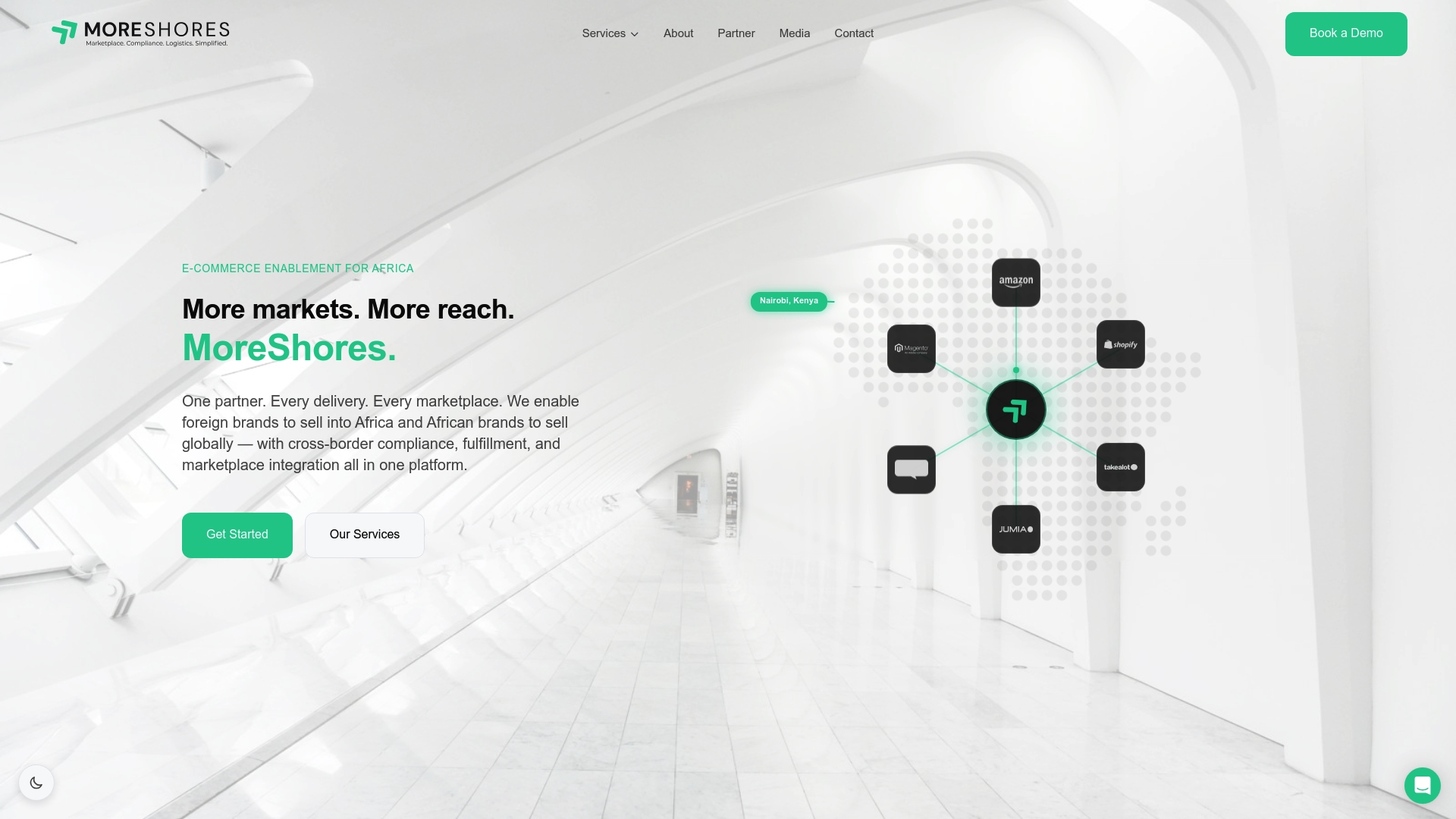
MoreShores is built specifically for e-commerce entrepreneurs who want to enter or expand within African markets without rebuilding their operations from scratch. Our cross-border enablement services cover customs clearance, duties, VAT, and regulatory compliance so you’re protected from day one. Our marketplace integration connects your product listings to Takealot, Jumia, Kilimall, Amazon SA, Shopify, and WooCommerce from a single dashboard. And our fulfillment and logistics network handles warehousing, inventory, and multi-courier delivery across the continent. You focus on growth. We handle the complexity.
Frequently asked questions
How large is informal cross-border trade in Africa?
Informal cross-border trade is valued at $10 to $24 billion annually and represents up to 72% of formal trade volumes in some regions, making it a critical part of the continental economy.
What are the most common non-tariff barriers in African trade?
The main non-tariff barriers are border delays, corruption, harassment, fragmented regulations, and poor infrastructure, all of which cost Africa an estimated $20 billion in GDP annually.
How can e-commerce businesses accept payments cross-border in Africa?
Mobile money platforms and newer systems like PAPSS are increasingly preferred for cross-border payments, offering lower costs and broader reach than traditional card-based payment infrastructure.
How does AfCFTA support e-commerce expansion?
AfCFTA creates a unified continental market by reducing tariffs and formalizing digital trade frameworks, giving e-commerce businesses a more consistent regulatory environment across 54 African nations.