Top advantages of logistics outsourcing for e-commerce expansion
TL;DR:
- Scaling African e-commerce requires outsourcing logistics to manage complex customs, infrastructure, and regulatory differences effectively. Outsourcing provides financial flexibility, rapid market entry, end-to-end visibility, and measurable performance through SLAs and KPIs. Tailoring strategies to individual country nuances ensures long-term success and operational resilience across diverse markets.
Scaling an e-commerce brand across African markets is not a simple plug-and-play operation. You face a patchwork of customs regimes, inconsistent last-mile infrastructure, fragmented courier networks, and regulatory requirements that shift from one country to the next. For international brands trying to grow efficiently in these markets, managing all of this in-house is not just expensive — it is a strategic liability. Logistics outsourcing, when done right, converts that complexity into a manageable, scalable model that gives you a real competitive edge.
Table of Contents
- Financial flexibility and capital efficiency
- Scalability and speed-to-market advantages
- End-to-end integration and digital visibility
- Risk reduction and accountability with SLAs/KPIs
- Tailored strategies for African cross-border markets
- Why orchestration and integration matter more than cost savings
- How MoreShores accelerates your cross-border logistics in Africa
- Frequently asked questions
Key Takeaways
| Point | Details |
|---|---|
| Cost flexibility | Outsourcing logistics shifts costs from fixed to variable, freeing capital for core growth. |
| Faster market access | Third-party providers enable quick entry and expansion in diverse African markets. |
| Integrated visibility | Technology-driven providers deliver transparency and control across the supply chain. |
| Accountability tools | SLAs and KPIs govern vendor performance—improving reliability and reducing risk. |
| Local strategy matters | Choosing adaptable partners ensures success in Africa’s varied logistics environments. |
Financial flexibility and capital efficiency
With cost structure challenges outlined, let’s see how financial flexibility through outsourcing becomes a strategic advantage.
Running in-house logistics in Africa means committing to fixed costs before you have proven your market. You pay for warehouse leases, fleet maintenance, customs brokerage licenses, and enterprise technology systems — all of this regardless of whether order volumes justify the spend. For a brand testing a new market like Nigeria or Kenya, that capital exposure is significant.
Outsourcing flips this model. Shifting logistics costs from fixed to variable reduces the need for capital investment and ties your logistics spend directly to actual order volume. You pay for what you use. When demand spikes during peak seasons or promotional campaigns, your provider scales with you. When volume drops, your costs contract accordingly.
This kind of financial flexibility matters especially in African markets, where demand can be unpredictable and consumer behavior is still maturing in many segments. A brand that locks up capital in owned warehouse infrastructure and fleet assets loses the agility to respond to market changes, redirect resources toward marketing, or pivot its product mix.
Key financial benefits of logistics outsourcing include:
- Elimination of fixed capital expenditure on warehousing, technology platforms, and last-mile fleets
- Usage-based cost models that tie logistics spend to actual shipment volumes
- Shared infrastructure costs spread across a provider’s entire client base, lowering per-unit expenses
- Reduced working capital pressure, freeing budget for product development and market expansion
- Access to premium logistics tech without licensing or implementation costs
Pro Tip: When evaluating outsourced fulfillment models, request a full cost-per-order breakdown from potential partners. Compare this against your current loaded cost of fulfillment, which should include labor, technology, lease, and error-handling costs, not just shipping fees. Most brands discover outsourcing is cheaper at virtually every volume level.
The combination of variable cost structures and access to shared infrastructure is what makes outsourcing a smart financial play for brands pursuing African e-commerce solutions across multiple markets simultaneously.
Scalability and speed-to-market advantages
After unlocking capital flexibility, the next challenge for e-commerce leaders is scaling fast. Here is how outsourcing provides unparalleled speed and elasticity.
Building logistics capability in a new African market from scratch can take 12 to 18 months. You need to secure warehousing, establish relationships with local couriers, hire and train staff, and navigate customs and import requirements. By the time you are operational, your window of opportunity may have closed.

Outsourcing changes that equation entirely. Specialized logistics providers increase speed-to-market by leveraging existing infrastructure and local expertise that you would otherwise spend years building. A third-party logistics provider (3PL) operating in South Africa, Ghana, or Egypt already has the warehouse network, customs relationships, and last-mile partnerships in place. You plug into their infrastructure and launch in weeks, not months.
Here is a step-by-step view of how fast market entry works through a logistics partner:
- Define your product catalog and SKU requirements for the target market, including any regulatory approvals needed
- Ship inventory to the partner’s regional warehouse using established import channels, with the partner acting as Importer of Record
- Integrate your storefront or marketplace listings through the partner’s technology layer, connecting inventory and order data in real time
- Activate fulfillment and last-mile delivery using the provider’s existing courier network, which typically covers both urban and peri-urban zones
- Monitor performance through dashboards provided by the partner, tracking orders, returns, and delivery times from day one
Comparison: outsourced vs. in-house logistics for African market entry
| Factor | Outsourced model | In-house model |
|---|---|---|
| Time to market | 4 to 8 weeks | 12 to 18 months |
| Upfront capital required | Low (operational cost only) | High (infrastructure investment) |
| Scalability speed | Immediate, based on volume | Slow, limited by owned capacity |
| Local market expertise | Built-in from day one | Requires hiring and training |
| Risk on market exit | Minimal (contract-based) | High (stranded assets) |
| Technology readiness | Included in service | Separate procurement needed |
Pro Tip: When planning a new market launch, use your logistics partner’s cross-border enablement capabilities as the foundation for your go-to-market timeline. Many brands underestimate how much faster they can move when they do not have to build logistics infrastructure independently.
The scalability benefit also works in reverse. If a market underperforms, you can scale back without writing off warehouse leases or fleet assets. That flexibility is a strategic risk management tool, not just an operational convenience.
End-to-end integration and digital visibility
Scalability and speed gain power when matched with coordinated visibility. Here is what e-commerce leaders need from their outsourcing partners.
One of the most persistent problems in cross-border e-commerce is the operational blind spot. Your product leaves the origin warehouse, enters a shipping lane, clears customs, transfers to a local courier, and arrives at the customer’s door. Without integrated digital visibility, you rely on fragmented status updates from multiple providers, each using different systems and terminology.
Logistics providers coordinate end-to-end execution for cross-border e-commerce, with leading platforms now supporting integration via technologies such as blockchain-based customs documentation and AI-enabled freight visibility tools. These are not future-state technologies — they are operational capabilities available through established providers today.
“The transition from fragmented logistics management to an integrated orchestration model is not just a technology upgrade — it is a fundamental shift in how brands manage risk, compliance, and customer experience in complex markets.”
When one partner owns the full chain from import to last-mile delivery, operational blind spots shrink significantly. You get a single source of truth for shipment status, inventory levels, and exception management. That accountability is especially valuable in African markets, where customs delays, port congestion, and regional regulatory differences can create unpredictable disruptions.
Key integration features you should expect from a leading logistics partner:
- Real-time inventory visibility across warehousing and in-transit stock
- Automated customs declaration processing with built-in compliance checks for each market
- AI-driven logistics visibility tools that flag delays and recommend corrective actions before they impact customers
- Unified tracking interfaces accessible via API, web dashboard, or direct marketplace integration
- Returns management workflows that feed data back into inventory and reporting systems
Integration comparison: outsourced platform vs. fragmented model
| Capability | Integrated outsourced partner | Fragmented multi-vendor model |
|---|---|---|
| Shipment visibility | Single dashboard, real-time | Multiple portals, manual reconciliation |
| Customs compliance | Automated, in-house expertise | Separate broker, gap in accountability |
| Returns processing | Integrated with inventory system | Manual, delayed restocking |
| Error tracking and SLAs | Centralized and enforceable | Distributed, harder to enforce |
| Data quality | Consistent, single source | Variable across providers |
For brands working with integrated cross-border coordination and logistics platform partners in Africa, this level of integration is the difference between reactive problem-solving and proactive operational management.
Risk reduction and accountability with SLAs/KPIs
A streamlined, integrated model delivers operational advantages. But how do brands ensure reliability and accountability? The answer is in smart contracts and measurement.
Outsourcing does not automatically reduce risk. The reduction comes from contractual frameworks that define, measure, and enforce performance standards. Service Level Agreements (SLAs) and Key Performance Indicators (KPIs) are the governance tools that make outsourced logistics both predictable and auditable.
KPIs and SLAs create a vendor accountability framework for reliability and cost control, giving e-commerce brands measurable benchmarks they can enforce through contract terms. Without these, you are relying on good faith and informal communication to manage a critical function of your business.
Common KPIs used in cross-border e-commerce logistics contracts include:
- On-time dispatch rate: Percentage of orders dispatched within the agreed processing window (typically 24 or 48 hours)
- On-time delivery rate: Percentage of shipments delivered within the committed transit window by destination zone
- Order accuracy rate: Percentage of orders fulfilled without picking or packing errors
- Returns processing time: Hours or days from return receipt to inventory update and customer credit
- Customs clearance time: Average days from port arrival to cleared and delivered status
- Damage rate: Percentage of shipments arriving with product damage attributable to handling
Example SLA/KPI structure for a cross-border e-commerce operation
| KPI | Target | Measurement frequency | Consequence for breach |
|---|---|---|---|
| On-time dispatch | 98% | Weekly | Credit against invoice |
| Delivery within SLA window | 95% | Monthly | Escalation review |
| Order accuracy | 99.5% | Weekly | Root cause analysis required |
| Returns processed within 48 hours | 90% | Monthly | Service improvement plan |
| Customs clearance within 5 days | 85% | Monthly | Joint review and corrective action |
Pro Tip: When negotiating with logistics partnership structures, insist on SLA remedies that are automatic, not subject to negotiation after the fact. Credits and escalation triggers built into the contract protect you without requiring relationship-damaging conversations every time a target is missed.
The governance layer that SLAs and KPIs provide is what separates professional logistics outsourcing from simply handing off a function. With clear metrics in place, you have full visibility into how your logistics partner is performing and a legal framework to enforce standards.
Tailored strategies for African cross-border markets
Even with world-class partners, success depends on strategy fit. Here is why tailored, local approaches matter for Africa.
Africa is not a single market. It is 54 countries with distinct regulatory regimes, infrastructure maturity levels, consumer payment preferences, and import processing capabilities. A logistics strategy that works effectively in South Africa may require significant adaptation for Ghana, Egypt, or Côte d’Ivoire.
Research shows that logistics digitalization impacts cross-border trade, but the effect size varies significantly depending on country income levels, institutional quality, and population density. This means that the value your logistics partner delivers will differ by market, and your selection criteria need to reflect those local realities.
A useful framework for evaluating and selecting logistics partners by African region should include:
- Technology capability: Does the partner have digital tools adapted for local payment systems, mobile-first consumers, and informal address systems?
- Compliance expertise: Does the partner understand import duties, VAT treatment, product registration, and labeling requirements specific to the country?
- Customs relationships: Does the partner have established working relationships with local customs authorities that reduce clearance delays?
- Returns management: Does the partner have a viable returns model for the local market, particularly where postal infrastructure is limited?
- Market coverage: Does the partner’s courier network extend beyond major urban centers to reach secondary cities and townships?
- Local team presence: Does the partner have staff on the ground who can resolve issues in real time without depending on remote support?
Reviewing cross-border e-commerce strategies for different market contexts reinforces that local adaptation is not optional. It is a primary determinant of whether your cross-border e-commerce expansion gains traction or stalls at the border.
Brands that treat Africa as a single homogeneous market consistently underperform against those that work with regionally specialized partners who understand the nuances at country level.
Why orchestration and integration matter more than cost savings
Most outsourcing decisions start with a cost reduction mandate. That is a reasonable starting point, but it is an incomplete framework for evaluating logistics partners in African markets. The brands that succeed long-term are the ones that prioritize orchestration and integration over pure cost efficiency.
Here is the distinction that most decision-makers miss: cost savings come from consolidating vendors, but sustainable competitive advantage comes from eliminating friction across the entire commerce chain. Moving from fragmented to orchestrated logistics models reduces operational risk and blind spots in ways that cost cutting alone cannot achieve.
Orchestration means your logistics partner coordinates customs clearance, warehousing, fulfillment, courier dispatch, tracking, and returns through a single operational framework. When that framework is also integrated with your storefront and marketplace listings, you get something far more valuable than a lower cost per shipment. You get real-time control over your customer experience.
In African markets specifically, this matters because the failure modes are different from more mature markets. Customs delays are less predictable. Last-mile delivery failures are more common. Regulatory changes can create sudden operational blockers. A partner who orchestrates the full chain can absorb and resolve these issues internally. A fragmented model pushes those problems back to you, where they consume management time and damage customer satisfaction.
The most sophisticated e-commerce brands we work with at MoreShores do not evaluate us primarily on shipping costs. They evaluate us on exception rate, clearance speed, and the degree to which our platform removes operational decisions from their teams. That is the real value of cross-border orchestration insights at the platform level.
How MoreShores accelerates your cross-border logistics in Africa
The advantages of logistics outsourcing are clear. The question is which partner can actually deliver them in the African markets you are targeting.
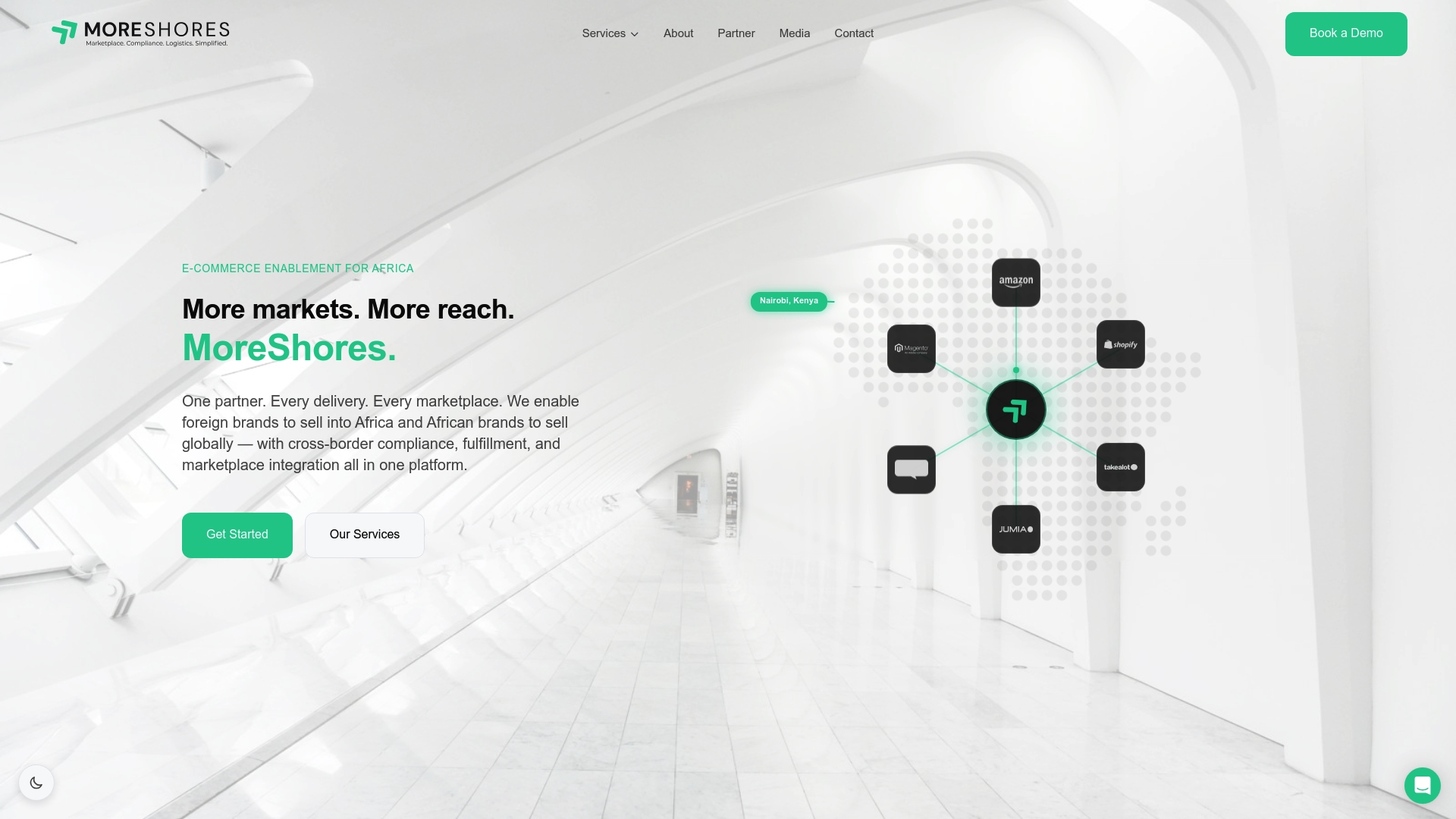
MoreShores is built specifically for this challenge. Our platform handles the full outsourcing stack, from acting as Importer of Record for customs clearance and duties, to warehousing, inventory management, and fulfillment through a multi-courier network across Africa. We integrate your product catalog directly with Takealot, Amazon SA, Jumia, Kilimall, and your own Shopify or WooCommerce storefront, so orders flow seamlessly from listing to doorstep. Cross-Border Enablement is at the core of everything we do, and we structure every engagement around the KPIs and SLAs that protect your brand’s performance standards. Whether you are launching your first African market or scaling across multiple countries, Partner With MoreShores or explore the full MoreShores platform to see how we simplify every step of the journey.
Frequently asked questions
What is the biggest cost advantage of logistics outsourcing?
Outsourcing converts fixed logistics costs into flexible, usage-based expenses and eliminates the need for capital investment in logistics facilities, fleets, and technology.
How does logistics outsourcing help with cross-border expansion?
It speeds up market entry and scaling by leveraging providers’ existing infrastructure, local knowledge, and integrated technology; specialized 3PLs increase speed-to-market for customs clearance and last-mile delivery from day one.
What digital benefits do logistics partners offer?
They provide end-to-end shipment visibility, automated customs processes, and operational accountability; providers coordinate execution via technology including AI-enabled tracking and blockchain-based documentation systems.
Are KPIs and SLAs essential for outsourced logistics?
Yes. KPIs and SLAs create an accountability framework that makes performance measurable, enforceable, and contractually protected, which is essential for managing reliability and risk in cross-border operations.
Why do logistics outsourcing benefits differ by African country?
Logistics digitalization impacts trade at different rates depending on local income levels, regulatory quality, and infrastructure maturity, which means the value a logistics partner delivers is shaped by the specific characteristics of each national market.