Why marketplace compliance drives real e-commerce growth

TL;DR:
- Marketplace non-compliance threatens revenue, market access, and brand reputation with significant fines.
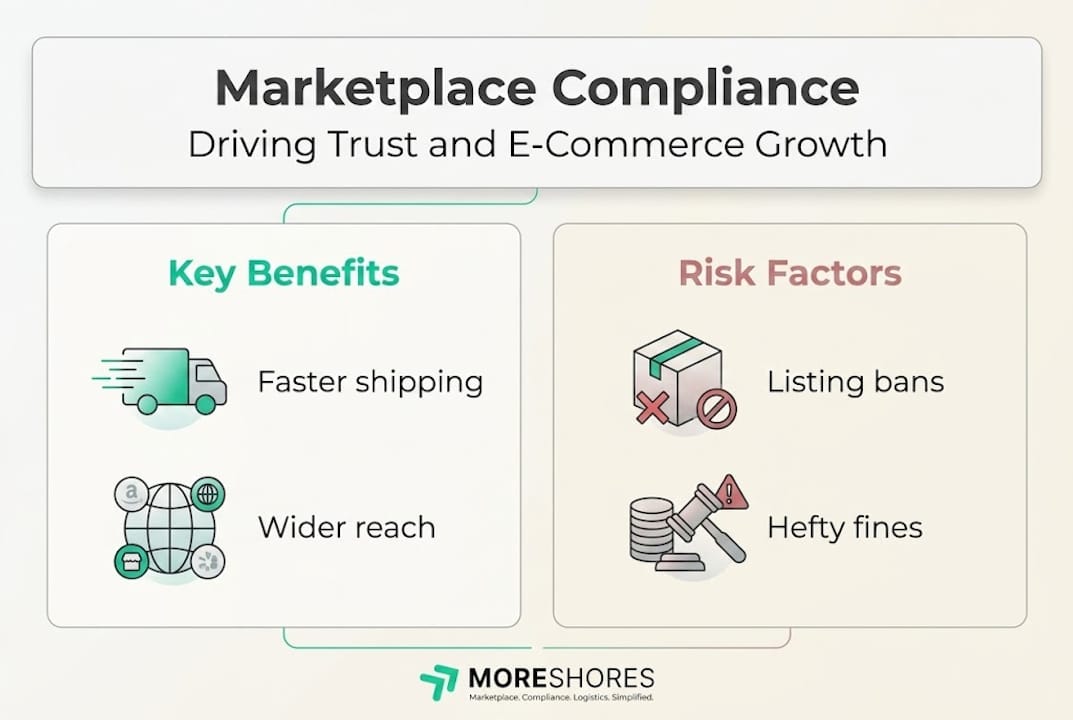
- Effective compliance enables faster customs clearance, better platform rankings, and increased sales.
- Proactive, automated compliance management supports scalable growth across African and global markets.
Marketplace non-compliance is no longer just a legal footnote. It is a direct threat to revenue, market access, and brand reputation. Fines up to 6% of global turnover under the EU Digital Services Act, combined with €847M in total penalties issued in Q4 2025 alone, signal that enforcement is accelerating fast. For e-commerce managers and compliance officers running cross-border operations, especially across African and global markets, the question is no longer whether compliance matters. It is whether your current approach is strong enough to protect and grow your business.
Table of Contents
- The real costs and consequences of non-compliance
- Key regulatory requirements in Africa and global marketplaces
- Marketplace compliance as a driver of trust and growth
- Proven strategies and tools for managing cross-border compliance
- What most compliance guides overlook: Smart management turns risk into real ROI
- Take the next step: Partner for compliance-led e-commerce growth
- Frequently asked questions
Key Takeaways
| Point | Details |
|---|---|
| Non-compliance is costly | Modern e-commerce brands risk steep fines, lost sales, and reputational damage by neglecting marketplace compliance. |
| Requirements vary by region | Africa and global marketplaces each present unique rules—from HS codes to payment limits that must be managed proactively. |
| Compliance fuels growth | Leading brands leverage strong compliance to build trust, enable expansion, and outpace competitors. |
| Automation streamlines success | AI and RegTech tools simplify cross-border compliance, saving time and reducing manual errors. |
The real costs and consequences of non-compliance
With the big picture set, let’s dig deeper into what can actually go wrong if compliance is neglected.
Most teams underestimate non-compliance until it hits the bottom line directly. The financial exposure is significant. Under the EU DSA, brands face fines up to 6% of global turnover, with €847M issued in Q4 2025. For cross-border e-commerce, the average cost per incident sits at $10,000. These are not theoretical numbers. They represent real enforcement actions against brands that assumed compliance was someone else’s problem.
Operational disruptions are equally damaging. Listing suspensions affected 15% of Amazon sellers in 2025, often triggered by incorrect HS codes, missing VAT registrations, or documentation errors. Inventory stranded at customs is a particularly painful outcome. You pay for storage, lose sales velocity, and risk product expiration or obsolescence, all while your competitors keep shipping.
| Consequence | Typical impact | Example trigger |
|---|---|---|
| Financial penalty | Up to 6% global turnover | EU DSA violation |
| Listing suspension | Lost revenue + reinstatement costs | Incorrect product categorization |
| Shipment delay | 7 to 21 days average | Missing certificates of origin |
| Inventory stranding | Storage fees + write-offs | HS code errors at customs |
| Reputational damage | Loss of marketplace privileges | Repeated VAT failures |
In Africa specifically, the penalties are less publicized but equally disruptive. Nigeria’s regulatory bodies can halt imports for missing NAFDAC or SON certifications. South Africa’s SARS enforces strict VAT and customs compliance, and errors in duty classification can trigger audits that freeze your entire import pipeline. These brand onboarding barriers are often invisible until you are already inside the market.
Key operational risks to monitor:
- Incorrect HS code classification leading to duty miscalculation and customs holds
- Missing VAT registration in destination markets, triggering fines and payment blocks
- Absent certificates of origin, especially critical under AfCFTA preferential tariff schemes
- Non-compliant product labeling, causing listing removals on Takealot, Jumia, and Amazon SA
- Failure to meet local safety standards, such as NRCS approval in South Africa
Pro Tip: Run a quarterly compliance audit specifically for your HS code assignments. A single misclassification across a high-volume SKU can result in months of overpaid duties or a retroactive penalty that erases your margin on that product line entirely.
The reputational angle is harder to quantify but just as real. Marketplace platforms track seller compliance scores. A suspension history, even if resolved, can reduce your eligibility for premium placements, advertising programs, and Buy Box wins. In competitive categories, that visibility loss translates directly into lower sales velocity.
Key regulatory requirements in Africa and global marketplaces
Understanding the risks leads naturally to asking: what are the exact rules you must manage? Here’s what’s in play region by region.
Regulatory complexity multiplies when you operate across multiple jurisdictions. Africa and global platforms each carry distinct requirements, and the overlap between them creates the most common compliance gaps.
Africa-specific requirements under AfCFTA and local law:
The African Continental Free Trade Area (AfCFTA) creates preferential tariff access across 54 member states, but only when documentation is correct. AfCFTA compliance requires accurate HS codes, valid certificates of origin, and country-specific licensing. In Nigeria, company registration with the CAC costs approximately ₦30,000. In South Africa, business registration fees range from ZAR 1,500 to ZAR 3,000. These are entry-level costs, but missing them blocks your ability to legally trade.
Payment regulations add another layer. South Africa’s Financial Surveillance Department (FinSurv) enforces a ZAR 50,000 limit per transaction for certain cross-border payments. Mobile money integration is essential in markets like Kenya, Ghana, and Nigeria, where M-Pesa and similar platforms dominate consumer transactions. Ignoring this means losing access to a significant portion of your customer base before you even list a product.
Global platform and regulatory requirements:
| Regulation | Region | Key requirement |
|---|---|---|
| EU DSA | Europe | Platform accountability, content moderation, seller verification |
| GDPR | Europe/Global | Data privacy, ROPA, DPIA for high-risk processing |
| IOSS | EU | VAT collection at point of sale for imports under €150 |
| KYC/KYB | Global | Identity and business verification for marketplace sellers |
| HS Code accuracy | Global | Correct tariff classification for customs and duty calculation |
For African cross-border onboarding, the documentation chain is longer than most teams expect. A single shipment from Europe or Asia into South Africa may require a commercial invoice, packing list, bill of lading, certificate of origin, SARS customs declaration, and product-specific certifications such as NRCS approval for electronics or SAHPRA registration for health products.
Key global compliance steps every cross-border brand must manage:
- GDPR compliance: Maintain a Record of Processing Activities (ROPA) and conduct Data Protection Impact Assessments (DPIAs) for high-risk data flows
- IOSS registration: Required for EU sales of goods valued under €150 to avoid VAT issues at customs
- KYC/KYB verification: Mandatory on Amazon, Takealot, and Jumia to maintain active seller status
- DSA Article 34 risk assessments: Required for larger platforms operating in the EU
- Audit-ready documentation: Maintain records for a minimum of five years in most jurisdictions
Pro Tip: Track your payment and tax thresholds by country in a centralized register. The South African ZAR 50,000 FinSurv limit and the EU’s €150 IOSS threshold are easy to breach without a monitoring system, and both can result in blocked transactions or VAT liability at scale.
Marketplace compliance as a driver of trust and growth
Once you know the rules, it’s tempting to see compliance as just a box to tick. But it’s much more than that.
The brands that grow fastest in cross-border e-commerce are not simply the ones with the lowest prices. They are the ones that buyers and platforms trust. Compliance is the foundation of that trust.
“Compliance protects brand reputation, builds customer trust, and provides competitive advantage by avoiding fraud, ensuring product safety, and enabling higher rankings and sales velocity on platforms like Amazon.”
When your products are correctly classified, your seller account is verified, and your documentation is clean, platforms reward you. Amazon’s algorithm, for example, factors seller compliance history into Buy Box eligibility and search ranking. Takealot and Jumia apply similar logic. A compliant seller with accurate listings, verified business credentials, and clean customs records consistently outperforms non-compliant competitors, even when the product itself is comparable.
Here is how compliance creates measurable competitive advantage:
- Premium placement eligibility: Platforms prioritize verified, compliant sellers for featured listings and promotional programs
- Faster customs clearance: Accurate HS codes and pre-cleared documentation reduce border delays by days or weeks
- Lower return rates: Correct product descriptions and safety certifications reduce customer disputes and returns
- Higher consumer trust: Transparent origin labeling and data privacy compliance increase conversion rates
- Reduced fraud exposure: KYC/KYB verification protects your brand from fraudulent resellers and counterfeit listings
For SMEs, compliance can feel like a pure cost center. The registration fees, legal reviews, and documentation overhead add up. But for international brands scaling across Africa and global markets, the math flips. The cost of a compliance program is consistently lower than the cost of a single major enforcement action, a marketplace suspension, or a customs hold on a high-value shipment.
Building a competitive edge in logistics means treating compliance as infrastructure, not overhead. The brands that invest early in clean processes capture market share faster because they face fewer operational interruptions. They also build the kind of seller reputation that platforms actively promote.

The cross-border e-commerce benefits of proactive compliance extend beyond avoiding penalties. They include faster time-to-market in new regions, stronger relationships with marketplace account managers, and the ability to scale volume without triggering compliance reviews.
Proven strategies and tools for managing cross-border compliance
If compliance isn’t just a cost but an opportunity, how do you make it efficient and scalable? Use the following expert-backed playbook.
Step-by-step compliance management strategy:
- Regulatory mapping: Identify every jurisdiction where you sell or plan to sell. Document the specific requirements for each, including customs, tax, data privacy, and product safety.
- Gap assessment: Compare your current documentation, registrations, and processes against each jurisdiction’s requirements. Prioritize gaps by risk level and revenue impact.
- Tool selection: Choose platforms that automate HS code classification, VAT calculation, KYC/KYB verification, and audit trail management. Evaluate tools against your specific Africa and global market mix.
- Automation implementation: Deploy AI-driven RegTech tools to handle repetitive compliance tasks. Automation across borders saves 25 to 30 hours per month per compliance function and reduces manual errors significantly. The RegTech market is projected to reach €1.2B by 2026.
- Ongoing review cycle: Schedule quarterly audits, monitor regulatory updates in each market, and update your compliance register whenever rules change.
Fulfillment compliance automation is one of the highest-impact areas to address early. Errors in duty calculation, incorrect labeling at the warehouse level, and missing documentation at dispatch are all preventable with the right systems.
| Compliance function | Manual approach | Automated approach | Time saved |
|---|---|---|---|
| HS code classification | 2 to 4 hours per SKU | Seconds per SKU | 90%+ reduction |
| VAT/IOSS calculation | Manual spreadsheet | Real-time calculation | 15 to 20 hours/month |
| KYC/KYB verification | 3 to 5 days per seller | 24 to 48 hours | 60%+ reduction |
| Audit trail management | Manual filing | Automated logging | 10+ hours/month |
A common controls framework, which maps a single compliance control to multiple regulatory requirements simultaneously, is one of the most efficient tools available. Instead of building separate processes for GDPR, DSA, and AfCFTA, you create one control that satisfies all three where requirements overlap. This approach significantly reduces duplication and makes multi-region compliance manageable for lean teams.
E-commerce compliance tools that integrate directly with your marketplace listings and marketplace integration tools ensure that compliance data flows automatically into your product catalog, customs declarations, and financial reporting. This integration eliminates the manual handoffs where most errors occur.
Pro Tip: Use a common controls framework to map your compliance obligations across GDPR, DSA, AfCFTA, and local African regulations simultaneously. One well-designed control can satisfy multiple requirements, cutting your compliance workload by 30 to 40% compared to managing each regulation in isolation.
What most compliance guides overlook: Smart management turns risk into real ROI
Bringing it all together, here’s what sets market leaders apart on compliance.
Most compliance guides focus entirely on rules. They tell you what to do but not why doing it proactively creates a structural advantage. That’s the part worth paying attention to.
Brands that treat compliance as a growth function, not a legal obligation, consistently outperform those that treat it reactively. They enter new markets faster because their documentation is already clean. They scale volume without triggering platform reviews because their seller history is strong. They capture preferential tariff rates under AfCFTA because their certificates of origin are always accurate.
African cross-border trade specifically rewards dynamic compliance management. The regulatory environment is evolving rapidly, and brands that anticipate changes rather than respond to them gain first-mover advantage in high-growth markets like Nigeria, Kenya, and South Africa. The cross-border insights available from operating across multiple African markets are themselves a competitive asset.
The missing ingredient in most compliance programs is leadership commitment. Compliance managed at the operational level, without executive sponsorship, tends to be reactive and underfunded. When leadership treats compliance as a market-entry lever, the investment follows, and so do the results.
Pro Tip: Instead of waiting for regulatory changes to force updates, assign a team member to monitor AfCFTA amendments, DSA enforcement actions, and local African regulatory updates monthly. Anticipating a rule change by 90 days gives you time to adapt without disruption, while competitors scramble.
Take the next step: Partner for compliance-led e-commerce growth
If you want to turn compliance from a headache into a driver of international growth, choose a strategic partner.
MoreShores is built specifically for brands managing cross-border complexity across Africa and global markets. We act as your Importer of Record, handling customs clearance, duties, VAT, and regulatory compliance so your products move without delays. Our fulfillment network covers warehousing, inventory management, and multi-courier dispatch, all with compliance built in at every step.

From listing integration on Takealot, Amazon SA, Jumia, and Kilimall to seamless marketplace integration with Shopify and WooCommerce, we make compliance scalable. Explore our cross-border enablement services or partner with MoreShores today to build a compliance program that protects your brand and accelerates your growth across Africa and beyond.
Frequently asked questions
What are the main risks of marketplace non-compliance for e-commerce brands?
Non-compliance can lead to major fines, listing bans, shipping disruptions, and reputational damage, potentially costing 6% of global turnover under rules like the EU DSA, plus an average of $10,000 per cross-border incident.
What is different about marketplace compliance in Africa compared to other regions?
Africa requires specific steps like AfCFTA documentation, local licensing in each country, payment transaction limits, and mobile money integration, each with country-by-country nuances that global compliance frameworks often miss entirely.
How can brands automate marketplace compliance?
Automation tools including AI dashboards, RegTech platforms, and audit frameworks can monitor compliance, reduce errors, and save 25 to 30 hours per month per compliance function while scaling across multiple jurisdictions simultaneously.
Is compliance just a cost, or can it increase sales?
Proactive compliance protects reputation and enables higher platform rankings, faster customs clearance, and stronger sales velocity on platforms like Amazon and Takealot, giving compliant brands a measurable and sustainable competitive advantage.