
Cross-border e-commerce is reshaping global trade at a pace few B2B decision-makers fully grasp. While selling internationally sounds straightforward, the reality involves navigating complex customs regulations, multi-currency transactions, localized payment systems, and logistics networks that vary dramatically across regions. For brands targeting African markets or expanding from Africa globally, understanding these mechanics isn’t optional anymore. The B2B cross-border market is projected to reach $18.6 trillion by 2033, with Africa leading growth rates. This guide breaks down what cross-border e-commerce actually means, how it works operationally, and the practical strategies you need to succeed in this high-stakes arena.
Table of Contents
- Key takeaways
- What is cross-border e-commerce? Core definition and flow
- Mechanics of cross-border e-commerce: boosting B2B success with localization and compliance
- B2B cross-border e-commerce in Africa and globally: scale, benefits, and emerging trends
- Logistics challenges and practical strategies for cross-border e-commerce in Africa
- Optimize your cross-border e-commerce with MoreShores
- What is cross-border e-commerce? Frequently asked questions
Key Takeaways
| Point | Details |
|---|---|
| Definition and flow | Cross border e commerce is the sale of goods or services online between parties in different countries, involving international logistics, payments, currencies, and compliance. |
| B2B complexity | For B2B buyers, higher order values, stricter regulatory scrutiny, and demanding documentation create heavy cross border enablement requirements. |
| Core mechanics | Successful cross border selling hinges on four mechanics: pricing display, payment acceptance, shipping terms, and regulatory compliance. |
| Currency boost | Multi currency display boosts conversion by twenty four percent because buyers prefer prices in their local currency. |
| Logistics solutions | DDP and regional third party logistics hubs are cited as strategies to reduce import bottlenecks and speed delivery in Africa and other regions. |
What is cross-border e-commerce? Core definition and flow
Cross-border e-commerce is the sale of goods or services online between parties in different countries, involving international logistics, payments, currencies, regulations, and customs. Unlike domestic sales, every transaction crosses at least one international border, triggering a cascade of compliance requirements and operational complexities. For B2B brands, this complexity multiplies because order values are higher, regulatory scrutiny is stricter, and buyer expectations around documentation and transparency are significantly more demanding than in consumer markets.
The fundamental transaction flow operates through distinct phases. Understanding each phase helps you identify where bottlenecks occur and where strategic intervention creates competitive advantage. A typical cross-border transaction unfolds like this:
- Order placement: Buyer discovers product through marketplace, website, or sales channel and places order in their local currency
- Payment processing: Transaction converts currencies, applies exchange rates, and routes through international payment gateways
- Fulfillment preparation: Seller prepares goods, generates commercial invoices, and completes export documentation
- Export clearance: Customs authorities in origin country verify documentation and approve goods for international shipment
- International transit: Goods move through freight networks, potentially crossing multiple jurisdictions with varying regulations
- Import clearance: Destination country customs assess duties, VAT, and compliance before releasing goods
- Final delivery: Local courier completes last-mile delivery to buyer’s specified address
Each phase introduces potential failure points. Payment processing can reject transactions due to fraud concerns or currency restrictions. Export clearance delays happen when documentation doesn’t match local requirements. Import clearance creates the biggest bottleneck, especially in African markets where customs processes vary dramatically between countries and even between ports within the same country.
B2B firms face specific complications that consumer-focused sellers rarely encounter. Your buyers expect detailed invoices with harmonized system codes, certificates of origin, and compliance documentation. They need transparent duty calculations before committing to purchases. Many operate under procurement policies requiring specific payment terms or credit arrangements that don’t translate easily across borders. These requirements make cross-border enablement services essential rather than optional for serious market entry.
Mechanics of cross-border e-commerce: boosting B2B success with localization and compliance
Successful cross-border selling hinges on getting four mechanics right: pricing display, payment acceptance, shipping terms, and regulatory compliance. Get any one wrong and conversion rates plummet. Multi-currency display boosts conversion by 24% because buyers instinctively trust prices shown in their local currency. They avoid mental math and the uncertainty around final costs.
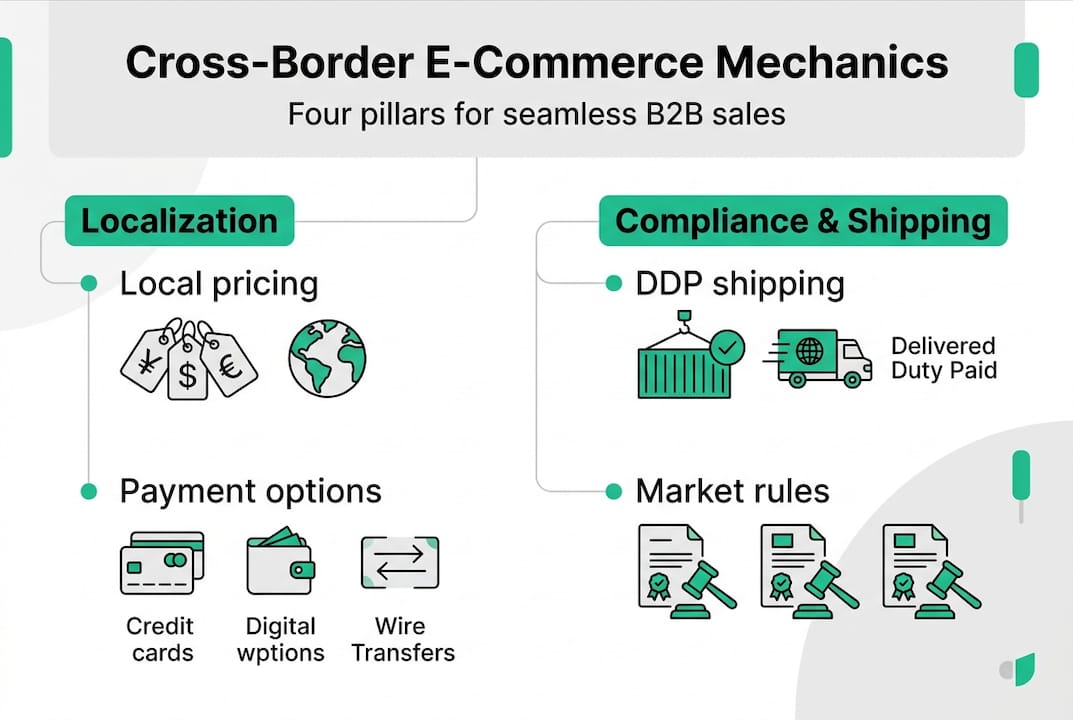
Payment localization matters even more than currency display. Different regions have deeply entrenched payment preferences that override even the convenience of credit cards. In the Netherlands, iDEAL captures 57% of online transactions. Brazilian buyers expect Boleto Bancário for installment payments. African markets show strong mobile money adoption, with M-Pesa dominating East Africa while other mobile wallets lead in West African countries. Accepting only international credit cards effectively locks out large buyer segments who either lack cards or distrust using them for cross-border purchases.
Shipping terms create or destroy trust in B2B relationships. Two incoterms dominate cross-border e-commerce:
- DDP (Delivered Duty Paid): Seller handles all costs including duties, taxes, and delivery to buyer’s door, providing price certainty and eliminating surprise fees
- DDU (Delivered Duty Unpaid): Buyer pays duties and taxes upon delivery, creating uncertainty and potential payment refusal at the final step
DDP shipping builds trust and compliance because buyers see one final price with no hidden costs. This transparency matters enormously in B2B contexts where procurement departments need accurate budget forecasting. DDU might seem cheaper initially, but it creates friction that kills repeat purchases when buyers face unexpected duty bills.
Compliance challenges vary dramatically by destination market. VAT registration requirements, product certification standards, labeling regulations, and restricted goods lists differ not just between countries but sometimes between regions within countries. African markets present particular complexity because regulatory frameworks are still evolving and enforcement can be inconsistent. What works in Lagos might fail in Nairobi despite both being major commercial hubs.
Pro Tip: Use phased market entry to validate demand before committing to full compliance infrastructure. Start with DDP shipping through a fulfillment partner to test product-market fit, then invest in local entity registration and e-commerce solutions only after confirming sustainable demand. This approach minimizes risk while gathering real data about local buyer preferences and operational challenges.
B2B cross-border e-commerce in Africa and globally: scale, benefits, and emerging trends
The numbers behind cross-border B2B e-commerce reveal why brands are racing to capture market share. The B2B cross-border market is projected to reach $18.6 trillion by 2033, driven by digital transformation in procurement and the breakdown of traditional distribution barriers. More striking is the shift in buyer behavior, with 73% of B2B buyers expecting B2C-like experiences including intuitive interfaces, mobile optimization, and transparent pricing.
Africa stands out as the fastest-growing region for cross-border e-commerce. African markets generated $12 billion in cross-border sales in H2 2025 alone, growing at 38% annually. This growth stems from rising internet penetration, mobile-first commerce adoption, and a young population comfortable with digital transactions. Nigeria, South Africa, Kenya, and Egypt lead in volume, but secondary markets like Ghana, Tanzania, and Côte d’Ivoire are emerging rapidly.
| Market Comparison | Global B2B CBEC | African B2B CBEC |
|---|---|---|
| Market size (2026) | $9.2 trillion | $25 billion |
| Growth rate | 18% annually | 38% annually |
| Mobile commerce share | 45% | 67% |
| Expected delivery time | 5-7 days | 7-10 days |
| B2C-like experience expectation | 73% | 81% |
The benefits of cross-border expansion extend beyond revenue growth. Geographic diversification reduces risk by spreading exposure across multiple economic cycles and regulatory environments. A brand heavily dependent on one market faces existential risk if that market experiences currency collapse, regulatory changes, or economic downturn. Cross-border presence provides natural hedging.
Access to new customer segments unlocks growth that’s impossible domestically. African brands gain access to premium markets willing to pay higher margins for unique products. International brands tap into African middle-class growth and underserved B2B segments hungry for quality products currently unavailable locally. This two-way flow creates opportunities for brands moving in either direction.
Emerging trends are reshaping buyer expectations and operational requirements:
- Mobile commerce dominance: African buyers conduct 67% of transactions on mobile devices, requiring mobile-optimized checkout and payment flows
- Delivery speed compression: Buyers increasingly expect 7-10 day delivery even for cross-border orders, pressuring logistics networks
- ERP integration: B2B buyers demand seamless integration between your storefront and their procurement systems through APIs and EDI connections
- Account-to-account payments: Traditional credit card processing is giving way to direct bank transfers and mobile money for larger B2B transactions
Meeting these expectations requires robust infrastructure. An e-commerce logistics platform that integrates inventory management, multi-courier shipping, and real-time tracking becomes essential rather than a luxury. Brands trying to manage cross-border operations through spreadsheets and manual processes simply can’t scale or meet the service levels buyers now demand.
Logistics challenges and practical strategies for cross-border e-commerce in Africa
African cross-border e-commerce faces distinct logistics barriers that differ fundamentally from challenges in developed markets. Infrastructure gaps and complex regulations create bottlenecks, but practical solutions exist for brands willing to adapt their approach. The key is understanding that strategies successful in Europe or North America often fail in African contexts without modification.
Infrastructure limitations manifest in several ways. Port congestion in major hubs like Lagos or Mombasa can add weeks to clearance times. Road networks between ports and inland destinations may be unreliable, especially during rainy seasons. Warehousing facilities meeting international standards are concentrated in capital cities, leaving secondary markets underserved. These realities make just-in-time inventory strategies nearly impossible in most African markets.
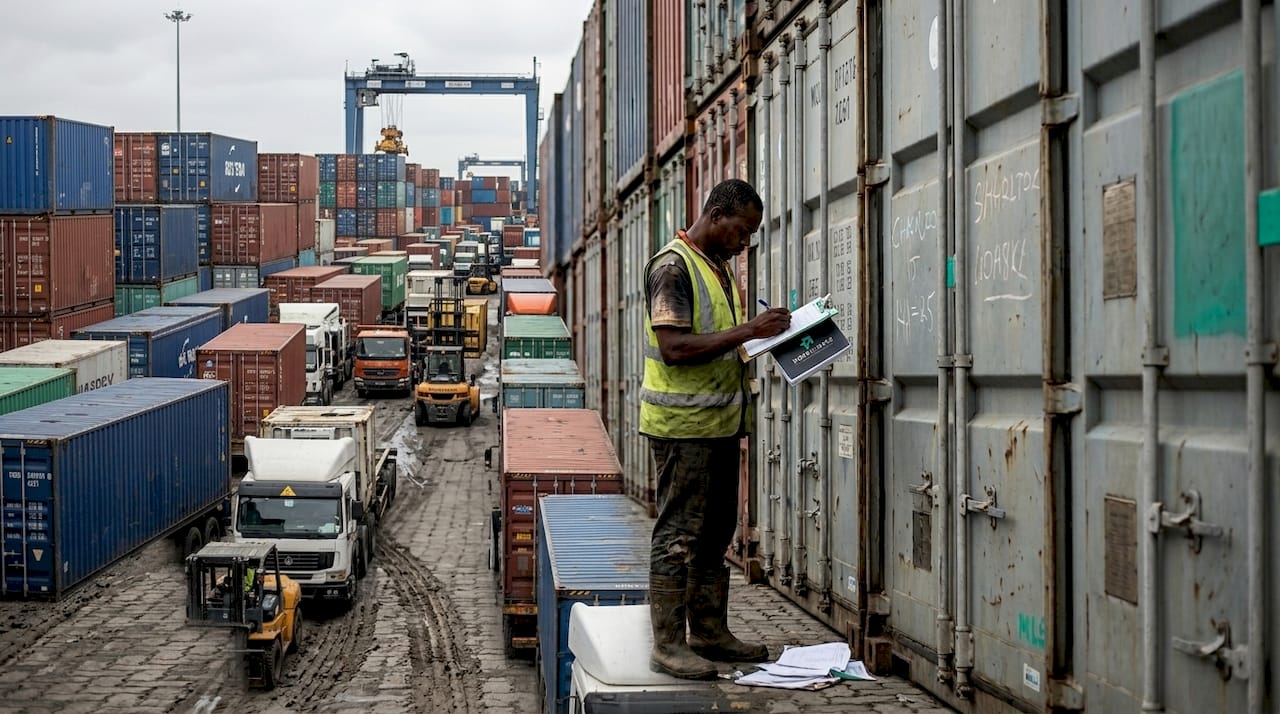
Regulatory complexity compounds infrastructure challenges. Each country maintains its own customs procedures, documentation requirements, and duty structures. Harmonization efforts like the African Continental Free Trade Area are progressing but implementation remains uneven. Some countries have streamlined digital customs systems while others still rely heavily on paper documentation and manual processing. This variability makes it difficult to create standardized processes across multiple African markets.
Traditional distribution channels remain entrenched in many sectors. Established importers and distributors control access to retail networks and resist disruption from direct-to-business e-commerce models. These gatekeepers often have strong relationships with regulators and can create obstacles for new entrants. Navigating this landscape requires either partnering with local players or building such strong direct relationships with end buyers that traditional intermediaries become irrelevant.
| Logistics Strategy | Best Use Case | Key Benefit | Implementation Complexity |
|---|---|---|---|
| Just-in-time delivery | High-volume, predictable demand in stable markets | Minimizes inventory costs | Very high (rarely viable in Africa) |
| Regional 3PL hubs | Multi-country expansion with moderate volumes | Balances cost and delivery speed | Moderate |
| DDP shipping | Building trust and ensuring compliance | Eliminates buyer surprise costs | Low to moderate |
| Trade agreement utilization | Intra-African trade under AfCFTA | Reduces or eliminates duties | Low (requires proper documentation) |
DDP shipping mitigates customs issues by shifting responsibility for clearance to the seller or their logistics partner. This approach works particularly well when you partner with fulfillment providers who have established customs relationships and understand local clearance procedures. Buyers receive predictable pricing and you gain control over the clearance process rather than depending on buyers to navigate unfamiliar customs procedures.
Regional hub strategies offer a middle path between full local presence and direct international shipping. Establishing inventory in strategic locations like Johannesburg for Southern Africa, Nairobi for East Africa, and Lagos for West Africa reduces delivery times while spreading inventory risk. These hubs enable 3-5 day delivery to major cities within each region, meeting buyer expectations without requiring country-by-country warehouse networks.
AI applications are transforming customs clearance efficiency. Machine learning systems can predict harmonized system codes with high accuracy, flag potential compliance issues before shipment, and optimize documentation for faster clearance. Some platforms now offer automated duty calculation and customs form generation, reducing errors that cause delays. As African customs authorities digitize their systems, these AI tools become increasingly effective.
Pro Tip: Leverage existing regional trade agreements to reduce customs complexity and costs. The AfCFTA provides duty-free access for qualifying goods traded between member countries. Products meeting rules of origin requirements can cross borders within Africa without duties, dramatically improving margins. Work with a fulfillment and logistics partner who understands how to document shipments for preferential treatment under these agreements.
Optimize your cross-border e-commerce with MoreShores
Navigating cross-border e-commerce complexity requires specialized expertise and integrated infrastructure that most brands lack internally. MoreShores specializes in cross-border enablement services designed specifically for brands expanding into or from African markets. We act as your Importer of Record, handling customs clearance, duty payments, VAT compliance, and regulatory documentation so you can focus on selling rather than logistics minutiae.
Our platform integrates warehousing, inventory management, and multi-courier fulfillment across African and global markets. We maintain regional hubs positioned for optimal delivery speed and cost efficiency. Whether you’re an international brand entering Africa or an African brand reaching global markets, our fulfillment and logistics services provide the operational foundation for sustainable growth. Partner with us through our e-commerce logistics platform to access the infrastructure and expertise that turns cross-border complexity into competitive advantage.
What is cross-border e-commerce? Frequently asked questions
What are the main challenges of cross-border e-commerce in Africa?
Infrastructure gaps, inconsistent customs procedures, and complex regulatory environments create the biggest obstacles. Port congestion and unreliable transportation networks add delivery time and unpredictability. Each country maintains different documentation requirements and duty structures, making standardized processes difficult to implement across multiple markets.
How does Delivered Duty Paid (DDP) shipping help cross-border sales?
DDP shipping eliminates surprise costs for buyers by including all duties, taxes, and delivery fees in the quoted price. This transparency builds trust and improves conversion rates because buyers know exactly what they’ll pay. It also transfers customs clearance responsibility to the seller, ensuring professional handling and reducing the risk of shipment rejection or delays.
What local payment methods are essential for African markets?
Mobile money dominates East Africa, with M-Pesa leading in Kenya, Tanzania, and Uganda. West African markets use various mobile wallets alongside bank transfers. South Africa shows higher credit card adoption but still requires options like EFT and SnapScan. Offering region-specific payment methods is essential because many buyers lack international credit cards or distrust using them for cross-border purchases.
Why is multi-currency pricing important in CBEC?
Displaying prices in local currencies increases conversion rates by 24% because buyers trust prices shown in familiar denominations. It eliminates mental math and uncertainty about final costs after exchange rate application. Multi-currency pricing also signals market commitment and professionalism, differentiating you from sellers who only show prices in their home currency.
How can AI improve customs clearance in cross-border trade?
AI systems predict correct harmonized system codes with high accuracy, reducing classification errors that cause clearance delays. Machine learning algorithms flag potential compliance issues before shipment and optimize documentation for faster processing. Automated duty calculation and customs form generation minimize human errors while speeding up the clearance process, particularly valuable as African customs authorities adopt digital systems.