Step-by-Step Guide to International Trade From Africa

TL;DR:
- Successful African export requires thorough business registration and compliance with regulatory certifications.
- Securing confirmed buyers and clear contracts, especially Incoterms, is vital before shipment.
- Proper documentation, certifications, and reliable logistics are essential to avoid delays and port seizures.
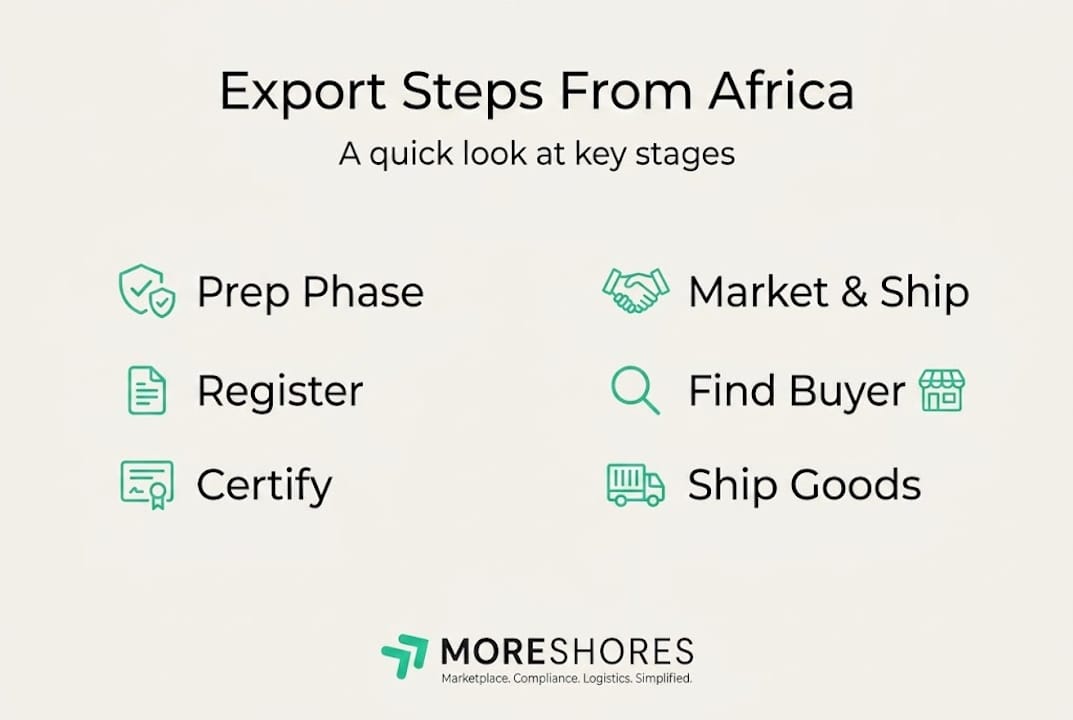
Missing one document or skipping a single compliance step can freeze your shipment at the port for weeks, cost you a buyer, and erase weeks of revenue. African e-commerce businesses face this reality constantly, not because the rules are impossible to follow, but because the full export process is rarely explained in one place. This guide breaks down international trade from Africa, using Nigeria as the primary example, into a clear sequence of stages you can act on immediately, from business registration and buyer contracts to freight forwarding and post-shipment repatriation.
Table of Contents
- Prepare your business for international trade
- Conduct market research and secure contracts
- Compliance, documentation, and pre-shipment steps
- Logistics, secure payment, and post-shipment requirements
- The African international trade process: What experts miss
- Accelerate your international trade growth with expert support
- Frequently asked questions
Key Takeaways
| Point | Details |
|---|---|
| Register before exporting | You must register your business and secure all certifications before starting international trade. |
| Structure contracts with Incoterms | Well-defined contracts using Incoterms prevent costly misunderstandings with buyers. |
| Prepare full documentation | Incomplete or missing documents cause the bulk of Africa’s export delays and losses. |
| Leverage digital tools | Digital solutions speed up compliance, logistics, and cross-border payments. |
| Follow-up after shipment | Ensure payment security and compliance with repatriation timelines for legal, profitable trade. |
Prepare your business for international trade
Before you ship a single unit across a border, your business must be legally structured and officially recognized as an exporter. Many merchants skip this stage or try to shortcut it, and that decision almost always leads to rejected shipments or regulatory penalties later.
Business registration is the foundation. In Nigeria, you must register your company with the Corporate Affairs Commission (CAC). This is not optional. As the export process requires, business registration with CAC, NEPC exporter certification, and a mandatory e-NXP form from the Central Bank through your bank are all required before you can legally export goods. Individuals cannot export. The law is clear on this point.
Once your business is registered, you need to enroll with the Nigerian Export Promotion Council (NEPC), which certifies you as an authorized exporter. NEPC registration typically takes 3 to 5 days when all documents are submitted correctly. After that, you complete the e-NXP form, which is the Electronic Nigerian Export Proceed form, through your commercial bank. This form is linked to the Central Bank of Nigeria and tracks export proceeds.
Understanding the brand onboarding process for cross-border trade can help you see how these requirements fit into a larger operational framework before you commit resources.
Here is a summary of the mandatory upfront requirements:
| Requirement | Issuing Body | Estimated Timeline |
|---|---|---|
| CAC business registration | Corporate Affairs Commission | 1 to 3 weeks |
| NEPC exporter certification | Nigerian Export Promotion Council | 3 to 5 days |
| e-NXP form | Commercial bank / Central Bank | Same day to 48 hours |
| Tax identification number | Federal Inland Revenue Service | 1 to 5 days |
Essential documents and certifications checklist:
- Valid CAC certificate of incorporation
- Memorandum and articles of association
- Tax identification number (TIN)
- NEPC exporter certificate
- Completed e-NXP form
- Bank domiciliary account for foreign currency proceeds
- Valid means of identification for company directors
Pro Tip: Start with lower-complexity product categories like processed foods, agricultural produce, or handcrafted goods. These categories typically require fewer certifications than electronics or pharmaceuticals, giving you the chance to learn the process before tackling higher-regulation exports.
Conduct market research and secure contracts
Once you’re legally registered, the next step is finding buyers and finalizing your agreements. Exporting without confirmed buyers and written contracts is one of the most expensive mistakes an African e-commerce business can make. You bear all the costs of shipping and compliance upfront, so having a secured deal before you move goods is non-negotiable.

Effective market research starts with knowing where your product fits globally. Some African exports, particularly processed foods, shea butter, cocoa derivatives, textiles, and timber products, have strong international demand. Others require deeper market analysis. As the full export roadmap outlines, the step-by-step process begins with market research and buyer identification, followed by securing a contract with Incoterms, quality certification, the NXP form, pre-shipment inspection, freight forwarding, securing payment, and repatriating proceeds within 180 days.
Three practical ways to identify and connect with international buyers:
- B2B trade platforms. Sites like Alibaba, TradeKey, and GlobalSources allow you to list products and connect directly with verified international buyers. Create a professional seller profile with product specs, certifications, and pricing.
- Trade shows and export fairs. NEPC organizes Nigerian participation in international trade exhibitions. These events give you direct access to importers and distributors in target markets.
- Digital channels and marketplace listings. Exporting through online marketplaces or your own storefront gives buyers a low-friction way to evaluate and order your products. Reviewing your marketplace integration options can show you how to list products across multiple international platforms simultaneously.
Once you identify a buyer, the contract is where many deals collapse if Incoterms are not clearly defined. Incoterms are standardized international shipping terms that define who is responsible for freight costs, insurance, and risk at each point of the journey. Using the wrong Incoterm or leaving it vague creates disputes over damaged goods and unexpected costs.
| Incoterm | What the exporter covers | What the buyer covers | Best for |
|---|---|---|---|
| EXW (Ex Works) | Nothing beyond making goods available | All freight, insurance, customs | Buyers who manage their own logistics |
| FOB (Free on Board) | Costs until goods are loaded on vessel | Freight from port, insurance | Most common for African exporters |
| CIF (Cost, Insurance, Freight) | Freight and insurance to destination port | Local import clearance and delivery | Buyers who prefer a simpler arrangement |
Pro Tip: FOB is the most practical Incoterm for most African exporters starting out. You control the goods until they leave your port, and your buyer takes responsibility from there. This limits your exposure to unpredictable international freight costs.
Prioritize products with lower export complexity first. Crafts, processed foods, and agricultural products typically have shorter certification timelines and more established international buyer networks, which means you get paid faster on your first few shipments.
Compliance, documentation, and pre-shipment steps
After your buyer deal is set, attention shifts to compliance and shipment prep. This is the stage where most delays happen, because exporters underestimate how many certifications must be in place before a shipment is legally cleared to leave the country.
Key certifications by product type:
- NAFDAC (National Agency for Food and Drug Administration and Control): Required for food, beverages, cosmetics, and pharmaceutical products.
- SON (Standards Organization of Nigeria): Required for industrial and consumer goods to confirm they meet Nigerian quality standards before export.
- NAQS (National Agricultural Quarantine Service): Required for agricultural and plant-based products to certify they are pest-free and safe for international transport.
You must obtain these certifications before approaching your freight forwarder or booking vessel space. Attempting to move goods without them is a direct path to seizure. As Nigeria’s export regulations confirm, prohibited and restricted export categories exist, mandatory inspections apply to many product types, and non-compliance leads to seizures and delays that can permanently damage buyer relationships.
Warning: A single missing document or uncompleted inspection can result in your shipment being held at the port indefinitely, or confiscated outright. Always verify your full compliance checklist before booking freight.
The NESS levy (Nigerian Export Supervision Scheme levy) is set at 1% of the FOB (Free on Board) value of your goods. FOB value means the price of the goods at the point they are loaded onto the shipping vessel. This levy must be paid before shipment is released. It is a frequently overlooked cost that catches first-time exporters off guard.
You can access export compliance solutions that help you map out certification requirements by product category and destination market, reducing the risk of oversights.
Most commonly overlooked compliance documents:
- Pre-shipment inspection certificate
- NESS levy payment receipt
- Phytosanitary certificate (for plant-based products)
- Certificate of origin (required for preferential tariff treatment under trade agreements)
- Packing list aligned to commercial invoice
Working with fulfillment and logistics support partners who understand Nigerian export compliance can save you significant time and money at this stage. They know which documents customs officials will check first and can flag gaps before you reach the port.
Logistics, secure payment, and post-shipment requirements
With paperwork in order, it’s time to execute on logistics and wrap up with payment and post-shipment regulations. Many exporters treat this stage as straightforward, but logistics execution and payment security have their own rules that must be followed carefully.
Step-by-step logistics and shipment execution:
- Select a licensed freight forwarder. Your forwarder handles documentation submission at the port, coordinates with the Nigerian Customs Service, and books cargo space on vessels or flights. Verify their NEPC and Customs registration before signing any contract.
- Complete port and customs clearance. Submit your full documentation package, including the e-NXP form, NESS levy receipt, pre-shipment inspection certificate, commercial invoice, and packing list, to Nigerian Customs for approval.
- Book vessel or air cargo space. Your freight forwarder will coordinate with shipping lines or airlines. Confirm the Bill of Lading (a document issued by the carrier acknowledging receipt of cargo) before goods are loaded.
- Obtain marine or cargo insurance. This protects against loss, damage, or theft in transit. Under CIF Incoterms, you provide this. Under FOB, the buyer usually arranges it.
- Track the shipment and notify your buyer. Share tracking details and estimated arrival windows so the buyer can arrange import clearance on their end.
As the Nigerian export benchmarks confirm, NEPC registration takes 3 to 5 days, the NESS levy is 1% of FOB value, export proceeds must be repatriated within 180 days, and programs like the Export Expansion Grant (EEG) provide financial incentives for qualifying exporters. Leveraging these programs directly improves your profit margins. Working with expert fulfillment partners who understand these timelines helps you stay compliant without last-minute scrambles.
Best practices for securing international payment:
- Use Letters of Credit (LC), which are bank-guaranteed payment instruments that protect both buyer and seller, for new buyer relationships where trust is not yet established.
- For repeat buyers, Telegraphic Transfer (TT) or open account terms become viable once you have a track record.
- Always confirm that your bank’s domiciliary account is active before the shipment departs, since export proceeds must land there.
- Repatriate proceeds within the 180-day window. Failing to do so exposes your business to Central Bank of Nigeria penalties and can result in loss of your export license.
Pro Tip: Apply for the Export Expansion Grant (EEG) if your business qualifies. The EEG provides rebates of between 5% and 30% of export revenue, depending on the value and type of goods exported. Many exporters leave this money unclaimed simply because they are unaware it exists. You can also join our network to connect with partners who actively help exporters identify and claim available incentives.
Digital export channels are increasingly important. Exporting through online marketplaces or integrated e-commerce platforms gives you real-time order tracking, automated invoicing, and faster payment processing compared to traditional trade routes.
The African international trade process: What experts miss
Most step-by-step export guides do a reasonable job of listing the stages. What they rarely address is the gap between following the steps correctly and actually scaling a sustainable export business.
Here is the uncomfortable truth: tariff exemptions exist, but they are only part of the story. The African Continental Free Trade Area (AfCFTA) offers duty reductions across member states, which sounds like a major advantage. But as research on African trade barriers shows, non-tariff barriers persist even where duty exemptions apply. These include product standards mismatches, inconsistent customs enforcement, documentary requirements that vary by border crossing, and delays caused by inadequate port infrastructure.
So an exporter who focuses only on tariff compliance and ignores operational reliability will still lose deals to competitors with faster, more predictable logistics.
The second thing guides consistently miss is the role of digital infrastructure. Evidence from China-Africa trade patterns shows that digital channels and logistics investments significantly accelerate cross-border commerce. African exporters who invest in e-commerce platforms, digital invoicing, and integrated fulfillment systems grow faster than those relying on manual processes and traditional freight brokers alone.
Success in international trade from Africa is not just about knowing the steps. It is about building relationships with the right logistics and digital trade solutions partners who help you execute those steps consistently, at scale, and faster than your competition.
Pro Tip: Build long-term partnerships with your freight forwarder, compliance consultant, and digital marketplace operator. These relationships reduce your per-shipment cost over time and give you a practical edge over exporters who shop for the cheapest option on each transaction.
Accelerate your international trade growth with expert support
If you’re ready to streamline your exports and scale globally, here’s how expert solutions can bridge the gap.
Navigating African export compliance, logistics, and marketplace integration on your own is possible, but it is slow and costly. MoreShores brings together cross-border enablement, compliance support, and warehousing under one platform, so you spend less time managing documentation and more time growing your order volume.
From acting as your Importer of Record and managing duties and VAT, to listing your products across Takealot, Jumia, Amazon SA, and Kilimall, MoreShores gives you the infrastructure to reach global buyers reliably. Our e-commerce solutions and fulfillment and logistics network are built for African exporters who want to grow beyond their home market without building an operations team from scratch.
Frequently asked questions
What documents are mandatory to export goods from Nigeria?
You need CAC registration, NEPC certification, and a completed e-NXP form obtained through your commercial bank. Additional certifications like NAFDAC or SON apply depending on your product type.
How long does NEPC exporter registration take?
NEPC registration takes 3 to 5 days when all required documents are submitted correctly and completely.
What are common mistakes that delay shipments?
Poor documentation and missing inspections are the most frequent causes of port delays or shipment seizures, particularly missing pre-shipment inspection certificates and NESS levy receipts.
What is the NESS levy and when is it paid?
The NESS levy is 1% of FOB value and must be paid before your shipment can be released from the port.
Is it possible to export as an individual from Nigeria?
No. Business registration is required by law, and only registered companies can legally export goods from Nigeria.