Multi-courier fulfillment: your cross-border e-commerce guide

TL;DR:
- Multi-courier fulfillment distributes shipping risk, reduces costs, and improves route coverage.
- Implementing it requires a transport management system and ongoing performance reviews.
- It is essential for African merchants to meet rising customer expectations and enable global growth.
If you’re still relying on a single courier to handle all your international shipments, you’re likely leaving money, speed, and reliability on the table. Many e-commerce merchants assume that locking in one carrier simplifies operations. In practice, it creates a single point of failure that can stall your entire supply chain. The South Africa CEP market is valued at USD 672 million in 2026, and merchants who want a share of that growth need a smarter shipping strategy. This guide will show you exactly what multi-courier fulfillment is, why it matters for Africa-global trade, and how to put it into practice.
Table of Contents
- Defining multi-courier fulfillment
- How multi-courier fulfillment enables seamless cross-border trade
- Implementing a multi-courier strategy: best practices and tools
- Challenges, pitfalls, and how to overcome them
- Why multi-courier fulfillment is the new competitive essential
- Unlock global growth with MoreShores multi-courier solutions
- Frequently asked questions
Key Takeaways
| Point | Details |
|---|---|
| Flexible shipping options | Multi-courier fulfillment lets you blend courier strengths for cost and speed advantages. |
| Cross-border expansion | Adopting multi-courier fulfillment is vital for African merchants expanding internationally. |
| Tech-driven coordination | Transport management systems are essential for seamless multi-courier operations. |
| Common pitfalls exist | System fragmentation and customs can trip up beginners, so robust planning is key. |
| Competitive advantage | Retailers using multi-courier fulfillment will outpace those relying on single-courier models. |
Defining multi-courier fulfillment
With an understanding of why e-commerce merchants need efficient international shipping, let’s define the mechanics and value of multi-courier fulfillment.
Multi-courier fulfillment is a logistics strategy where you distribute your shipping volume across two or more courier partners rather than committing everything to one provider. Each courier is selected based on its strengths, whether that’s speed on a specific route, competitive pricing for a certain package weight, or reliability in a target region.
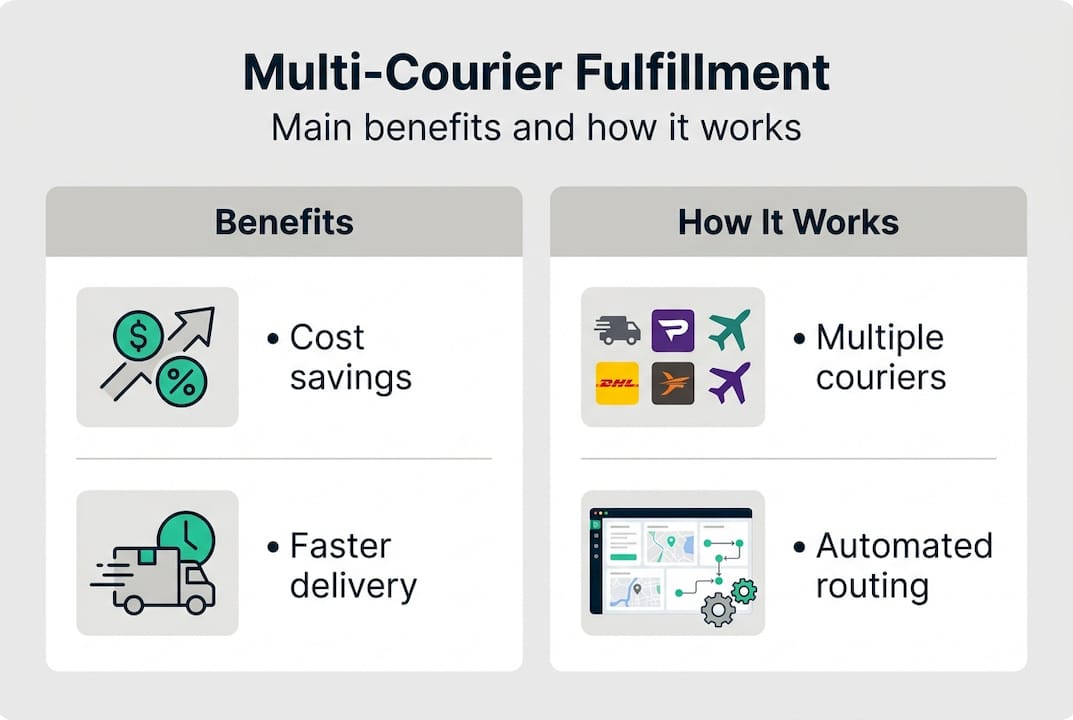
This is fundamentally different from the traditional single-courier model. With a single courier, you negotiate one rate card, use one tracking system, and accept one set of service limitations. It feels simple. But when that courier raises rates, experiences delays, or struggles with customs in a specific country, your entire operation absorbs the impact.
Multi-courier fulfillment distributes that risk. Here’s a direct comparison:
| Factor | Single-courier model | Multi-courier model |
|---|---|---|
| Cost flexibility | Fixed rate card | Competitive rate selection per shipment |
| Risk exposure | High (one point of failure) | Low (distributed across partners) |
| Route coverage | Limited to carrier network | Broader, combined coverage |
| Delivery speed | Dependent on one carrier | Optimized per destination |
| Scalability | Constrained | Flexible as volume grows |
The South Africa CEP market is growing at a 7.08% CAGR, which means demand for parcel delivery is accelerating. Merchants who want to compete in this environment need fulfillment operations that can flex with that growth, not ones that bottleneck at a single carrier’s capacity.
The core benefits of multi-courier fulfillment come down to three pillars:
- Flexibility: You assign each shipment to the courier best suited for that specific route, weight, or timeline.
- Risk mitigation: If one courier experiences disruption, your other partners absorb the volume without customer-facing delays.
- Cost efficiency: You negotiate with multiple carriers, creating competitive pressure that keeps your per-shipment rates lower over time.
For African e-commerce merchants shipping to global markets or receiving inbound stock from international suppliers, these three pillars are not optional extras. They are the foundation of a resilient cross-border operation.
How multi-courier fulfillment enables seamless cross-border trade
Now that you know what multi-courier fulfillment is, let’s see how it specifically helps e-commerce retailers expand cross-border operations.
The practical impact of multi-courier fulfillment shows up in three areas: cost, route optimization, and delivery speed. Each of these directly affects your customer experience and your bottom line.
On cost, the numbers are compelling. Platforms like Cargoson enable meaningful cost savings even at volumes of 10,000 shipments for approximately €499 per month by automatically selecting the most competitive carrier for each shipment. That kind of systematic rate optimization is impossible when you’re locked into a single provider.
Here’s how multi-courier fulfillment performs across key operational metrics for Africa-global trade:
| Metric | Single-courier | Multi-courier |
|---|---|---|
| Average cost per shipment | Higher (no competition) | Lower (carrier selection) |
| Route coverage to Africa | Limited | Expanded via partner network |
| Customs clearance support | Varies by carrier | Specialized by region |
| Delivery time variability | High | Reduced through route matching |
For merchants expanding through cross-border enablement, multi-courier fulfillment also solves a structural problem in African logistics: no single carrier covers every corridor well. A courier that excels on the Johannesburg-to-London route may perform poorly on Lagos-to-Dubai. Multi-courier fulfillment lets you match the right carrier to each corridor.
The benefits for Africa-to-global merchants include:
- Improved last-mile delivery by using local courier expertise in destination markets
- Faster customs clearance by selecting carriers with established relationships at key ports of entry
- Reduced delivery failures by routing around carriers with known performance issues in specific regions
- Better marketplace integration because faster, more reliable delivery improves your seller ratings on platforms like Takealot, Jumia, and Amazon SA
Pro Tip: Map your top five shipping corridors by volume and identify which courier performs best on each. Even switching two corridors to a better-matched carrier can reduce your average shipping cost by a meaningful margin.
The South African e-commerce market is a strong case study. As cross-border trade volumes grow, merchants who have already diversified their courier mix are better positioned to absorb demand spikes without compromising delivery promises.
Implementing a multi-courier strategy: best practices and tools
Understanding the benefits, the next step is practical: how do you actually implement a multi-courier approach for your business?
The transition from single to multi-courier fulfillment doesn’t have to be disruptive. A structured approach keeps your operations stable while you build out your carrier network. Organizations with over $1 billion in revenue consistently optimize logistics through diversification, and the same principle scales down to growing e-commerce merchants.
Here are the key steps to implement a multi-courier strategy:
-
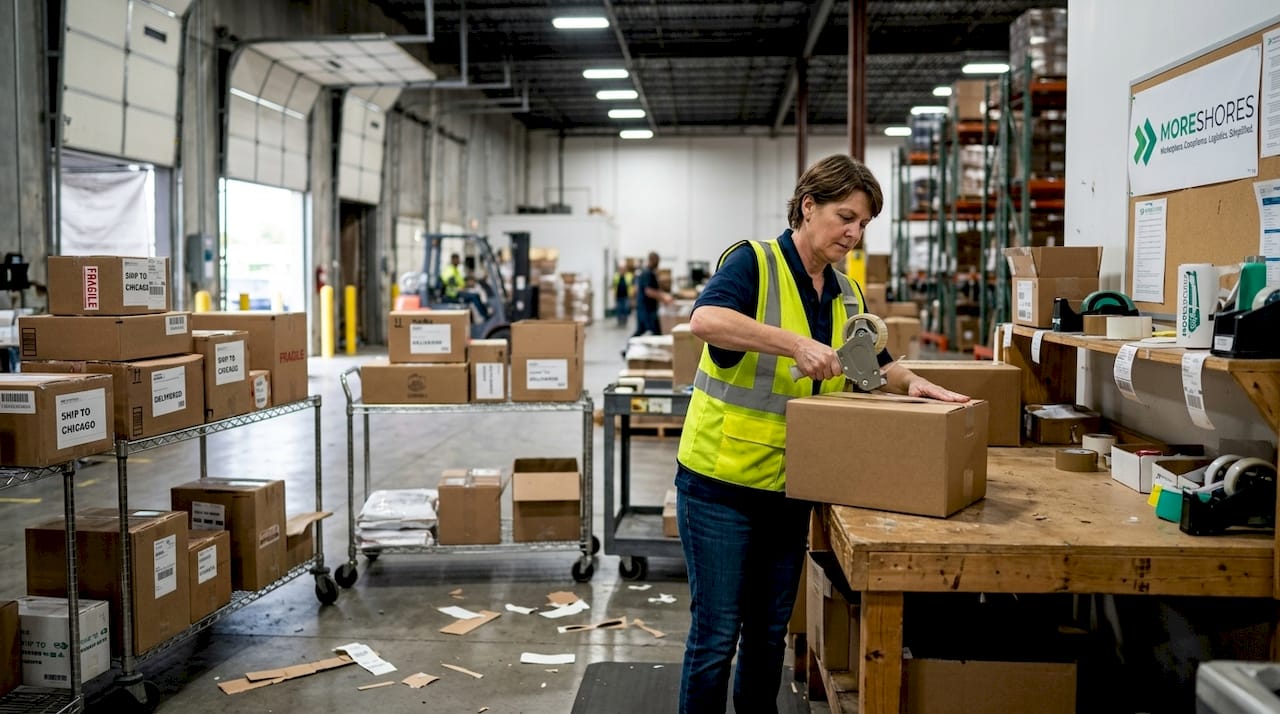
Audit your current shipping data. Pull your last six months of shipment data. Identify your top routes by volume, your average cost per shipment, and your delivery success rate. This baseline tells you where your current carrier is underperforming.
-
Define your carrier selection criteria. Decide what matters most for each corridor: price, speed, tracking quality, customs expertise, or last-mile reliability. Different corridors will have different priorities.
-
Onboard two to three additional courier partners. Don’t try to manage ten carriers at once. Start with two or three that cover your highest-volume or most problematic corridors. Test them on a portion of your volume before committing more.
-
Implement a transport management system (TMS). A TMS is software that connects to multiple carriers, compares rates in real time, assigns shipments automatically, and consolidates tracking data into one dashboard. This is the technology layer that makes multi-courier fulfillment manageable. Without it, coordinating multiple carriers manually becomes error-prone. Your e-commerce logistics infrastructure needs this layer to scale.
-
Integrate with your storefront and marketplaces. Your TMS should connect to your Shopify or WooCommerce store and to any marketplace you sell on. This ensures tracking updates flow automatically to customers without manual intervention. Explore e-commerce solutions that support this kind of integration from the start.
-
Review performance quarterly. Multi-courier fulfillment is not a set-and-forget strategy. Review carrier performance data every quarter and reallocate volume based on results.
Pro Tip: When evaluating logistics partners, ask specifically about their customs clearance capabilities in your target African markets. A carrier with strong local relationships at South African or Kenyan customs can save you days on each shipment.
Workflow automation is the other critical element. Automating carrier selection rules, label generation, and tracking notifications reduces human error and frees your team to focus on growth rather than shipment administration.
Challenges, pitfalls, and how to overcome them
Let’s ensure your strategy is resilient by anticipating and overcoming the top challenges of multi-courier fulfillment.
Multi-courier fulfillment delivers real advantages, but it also introduces complexity that you need to manage proactively. Understanding the common pitfalls before you encounter them is the fastest way to avoid them.
The most frequent challenges include:
- System fragmentation: Each courier has its own portal, rate card, and tracking format. Without a TMS, your team ends up logging into multiple systems, which wastes time and increases the chance of errors.
- Tracking inconsistency: Customers expect a single, unified tracking experience. When shipments move through different carriers, tracking updates can be delayed, formatted differently, or simply missing. This drives customer service inquiries.
- Customs complexity: Cross-border shipments in African markets involve duties, VAT, and regulatory requirements that vary by country and product category. Different couriers have different levels of expertise here, and a mismatch can cause costly delays.
- Carrier performance drift: A courier that performs well in month one may degrade over time. Without regular performance reviews, you won’t catch this until customers start complaining.
- Contract management: Managing rate agreements, service level commitments, and volume thresholds across multiple carriers requires administrative discipline.
The South Africa CEP market’s 7.08% CAGR growth means more merchants are entering the space, and the ones who manage these challenges well will gain a durable competitive advantage.
“The merchants who win in cross-border e-commerce are not the ones who avoid complexity. They’re the ones who build systems to manage it reliably.”
To overcome these challenges, focus on three areas. First, invest in a TMS that provides unified tracking and automated carrier selection. Second, partner with a fulfillment provider that has established customs expertise in your target markets, particularly for multi-marketplace selling across African platforms. Third, build a quarterly carrier review into your operations calendar so performance drift gets caught early.
For Africa-global sellers specifically, customs complexity is the highest-risk area. Working with a provider that acts as Importer of Record and handles VAT and duty compliance removes this burden from your internal team entirely.
Why multi-courier fulfillment is the new competitive essential
Bringing it all together, here’s why multi-courier fulfillment will define the winners in e-commerce over the next decade.
Here’s the uncomfortable reality: if you’re still running a single-courier operation in 2026, you’re not just behind on logistics strategy. You’re behind on customer expectations. Consumers and B2B buyers alike now expect fast, trackable, reliable delivery as a baseline. Not a differentiator. A baseline.
The data reinforces this urgency. US e-commerce shipments reached 22.37 billion in 2024 and are projected to hit 30 billion by 2030. Global shipping volumes are rising, and the pressure on any single carrier’s network will only increase. Merchants who depend on one courier are betting their entire customer experience on that carrier’s ability to scale with global demand.
Multi-courier fulfillment is not a technical upgrade. It’s a strategic posture. It signals that your business is built to absorb disruption, optimize continuously, and serve customers across multiple geographies without breaking. For African merchants expanding globally or international brands entering African markets, this posture is what cross-border e-commerce enablement looks like in practice.
The brands that will lead African e-commerce over the next decade are already building multi-courier infrastructure now. The ones still waiting are already behind.
Unlock global growth with MoreShores multi-courier solutions
Ready to put multi-courier fulfillment to work for your business? Here’s how MoreShores can help.
MoreShores is built specifically for merchants who want to move goods efficiently between Africa and global markets. Our platform connects you to a multi-courier network, handles customs compliance as your Importer of Record, and integrates your inventory across marketplaces like Takealot, Jumia, and Amazon SA.
Whether you need to strengthen your cross-border enablement, scale your fulfillment services, or explore end-to-end e-commerce solutions, MoreShores gives you the infrastructure to grow without the operational headaches. Reach out to our team today and let’s map out a fulfillment strategy built for your specific corridors and markets.
Frequently asked questions
What is multi-courier fulfillment in e-commerce?
Multi-courier fulfillment uses several courier partners to ship and deliver orders, offering greater flexibility, cost control, and risk mitigation than single-courier approaches. With global e-commerce shipments projected to reach 30 billion by 2030, this strategy is becoming essential for scaling merchants.
Why is multi-courier fulfillment important for Africa-global e-commerce?
It allows African merchants to choose the best shipping options for each destination, overcoming local bottlenecks and improving international delivery. The South Africa CEP market growing at 7.08% CAGR means demand is rising faster than any single carrier can reliably serve.
What technology supports multi-courier fulfillment?
Transport management systems (TMS) and e-commerce integrations are crucial for coordinating shipments and tracking across multiple couriers. Platforms enabling cost savings at scale, like Cargoson at approximately €499 per month for 10,000 shipments, show how much technology can reduce per-shipment costs.
What challenges come with multi-courier fulfillment?
The main challenges are fragmented systems, tracking inconsistencies, and customs complexity, but good software and careful partner selection help overcome these. In growing markets like South Africa, where the CEP market is valued at USD 672 million, merchants who solve these challenges early gain a lasting advantage.