Why Marketplace Sellers Need Customs Solutions to Grow

TL;DR:
- Inefficient customs processes can reduce African export volumes by 4% per document and 2% per delay day.
- Customs compliance costs include delays, penalties, lost sales, and damage to reputation, impacting margins.
- Tailored, automated customs solutions improve efficiency, reduce errors, and support scalable cross-border growth.
Most African marketplace sellers underestimate just how much inefficient customs processes are costing them. Trade corridor research shows that each additional document required in the customs process reduces exports by 4%, and each extra day of delay cuts them by another 2%. Those numbers add up fast. For sellers expanding into global markets or sourcing from abroad, customs inefficiency is not just an inconvenience — it is a direct threat to your revenue and marketplace reputation. This guide breaks down the real costs, the compliance requirements, and the practical steps you can take to turn customs from a barrier into a competitive advantage.
Table of Contents
- The hidden costs of inefficient customs processes
- Why marketplace sellers can’t ignore customs compliance
- How tailored customs solutions transform cross-border success
- Selecting a customs solution: What to look for
- Our take: The real game-changer for African marketplace sellers
- Accelerate your marketplace growth with the right customs solution
- Frequently asked questions
Key Takeaways
| Point | Details |
|---|---|
| Customs inefficiencies are costly | Every extra document or day in customs can dramatically lower exports and profits. |
| Compliance is non-negotiable | Staying compliant prevents costly delays, fines, and lost marketplace privileges. |
| Solutions unlock growth | Tailored customs tools can boost exports, cut costs, and open new global markets. |
| Choose wisely | Select customs solutions with automation, integration, and up-to-date compliance support. |
The hidden costs of inefficient customs processes
Many marketplace sellers think about customs as a one-time hurdle: get the paperwork done, pay the duties, move on. The reality is more damaging. Customs inefficiency creates a chain of costs that compound quietly over every shipment, every quarter, and every year.
Start with the headline number. SSA trade costs average 31.2% of goods’ value across Sub-Saharan Africa, one of the highest in the world. For context, that means for every $10,000 shipment, sellers absorb more than $3,000 in trade-related costs before a single product reaches a customer. Domestic logistics alone account for 15-20% of the cost, insurance, and freight (CIF) value, which is 3-4 times the global average. These are not abstract figures. They eat directly into your margins.
Here is a breakdown of the hidden cost categories sellers often overlook:
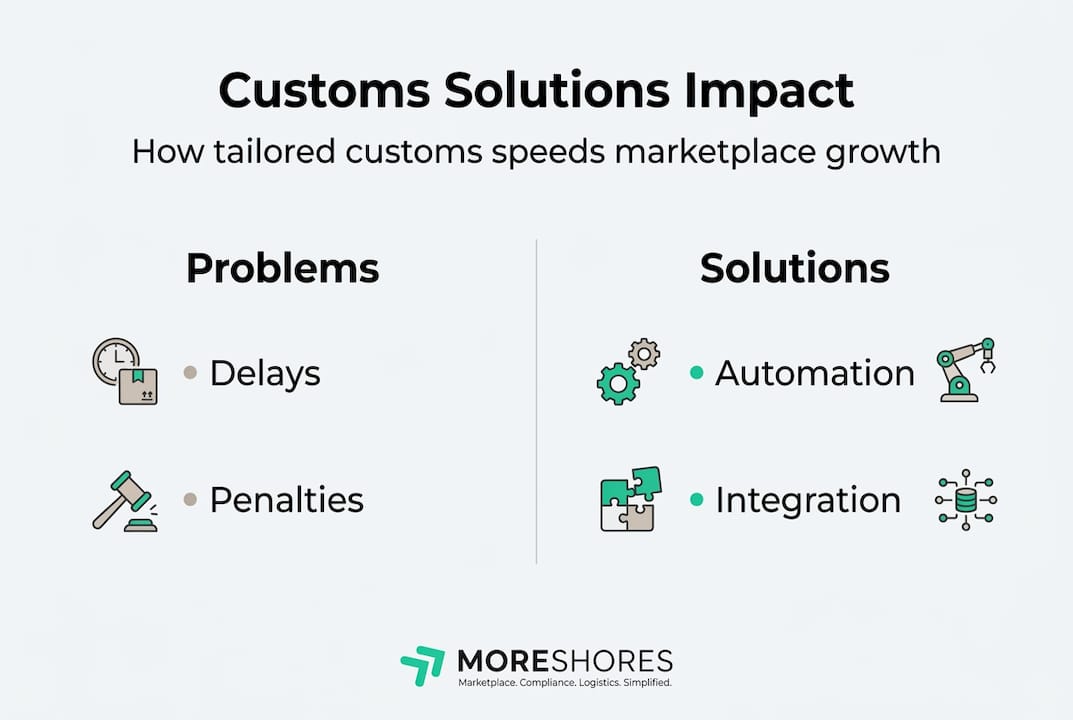
- Delay costs: Goods held in customs warehouses incur storage fees daily. Perishables and time-sensitive products suffer the most.
- Penalty exposure: Incorrect tariff classification or missing documentation triggers fines that can exceed the duties owed.
- Lost sales: Marketplace buyers expect fast delivery. A customs delay pushes fulfillment timelines past promised windows, resulting in canceled orders and negative reviews.
- Reputational damage: Frequent customs issues can flag your seller account on platforms like Takealot, Amazon SA, or Jumia.
- Working capital strain: Funds tied up in delayed shipments or penalty disputes are funds not available for restocking or marketing.
“Customs efficiency is not a back-office concern. It is a front-line business driver that shapes whether African sellers can compete globally.”
| Cost category | Typical impact |
|---|---|
| Trade cost as % of goods value | 31.2% average in Sub-Saharan Africa |
| Domestic logistics as % of CIF | 15-20% (3-4x global average) |
| Export reduction per extra document | 4% per document |
| Export reduction per extra day of delay | 2% per day |
Understanding African e-commerce challenges at this level is the first step toward solving them. Every shipment you optimize is margin you recover.
Why marketplace sellers can’t ignore customs compliance
With those cost realities clear, the question becomes: what exactly does customs compliance require, and what happens when you get it wrong?
International marketplaces are strict. Platforms that operate across borders require sellers to meet the import and export regulations of every country they ship to or from. This is not optional, and it is not forgiving. Here is how the compliance process typically works:
- Tariff classification: Every product must be assigned a Harmonized System (HS) code. This code determines the duty rate. Misclassification is one of the most common and costly mistakes sellers make.
- Customs valuation: The declared value of your goods must be accurate and consistent with your commercial invoice. Undervaluing goods to reduce duties is a compliance violation with serious consequences.
- Documentation preparation: You will typically need a commercial invoice, packing list, certificate of origin, and sometimes additional regulatory approvals depending on the product category.
- Physical inspection: Customs authorities may select shipments for physical inspection. Incomplete or inconsistent documentation significantly increases the likelihood of being flagged.
- Duty and VAT payment: Correct calculation and timely payment of import duties and value-added tax (VAT) is mandatory. Errors lead to shipment holds.
The consequences of non-compliance are significant. Each additional customs document required due to errors reduces your export volume by 4%. That is not a one-time penalty: it is a compounding loss every time a shipment is flagged.
Beyond delays, penalties can include goods seizure, financial fines, and in repeat cases, suspension of your import or export privileges. On marketplace platforms, this often translates to account restrictions or removal.
Pro Tip: Build compliance into your product listing process from the start. Before you list a new product for cross-border sale, confirm its HS code, required documentation, and any destination-country restrictions. Catching issues before shipment is far cheaper than resolving them at the border.
Sellers who treat compliance as a system rather than a task gain a measurable advantage. Seamless marketplace integration with built-in compliance checks means fewer errors, faster clearance, and better seller ratings. Use your onboarding guide to set this up correctly from day one.
How tailored customs solutions transform cross-border success
Once you understand the compliance requirements, the next question is practical: how do you actually manage all of this without it consuming your entire operation?
The answer is a tailored customs solution, which means a system or partner configured specifically for your product types, trade corridors, and marketplace platforms. Not every seller has the same needs. A seller shipping electronics from South Africa to Europe faces different requirements than one importing textiles from Asia into Nigeria. A good customs solution accounts for those differences.

Here is a comparison of what manual customs management looks like versus a digital, integrated solution:
| Factor | Manual process | Digital customs solution |
|---|---|---|
| Documentation | Prepared individually per shipment | Auto-generated from product data |
| HS code classification | Done manually, error-prone | Automated with validation |
| Duty calculation | Estimated, often inaccurate | Real-time, accurate calculation |
| Shipment tracking | Limited visibility | End-to-end digital tracking |
| Compliance updates | Manual monitoring required | Automatically updated |
| Error rate | High | Significantly reduced |
The efficiency gains are real. Research shows that a 1% improvement in customs efficiency boosts export volumes by 1.25%. For sellers operating at scale, those gains accumulate into meaningful revenue growth.
Tailored solutions typically include:
- Automated document generation that pulls from your existing product catalog
- Digital submission to customs authorities, reducing manual handling
- Real-time duty and tax calculation at the point of sale
- Integration with optimized fulfillment and logistics to align customs clearance with warehouse and delivery timelines
- Regulatory compliance monitoring for your specific trade corridors
Pro Tip: If you sell across multiple African markets, prioritize a solution that covers your top three trade corridors first. Trying to solve every market simultaneously often leads to poor execution everywhere. Build depth in your core routes, then expand.
The right cross-border enablement services do not just clear your goods. They optimize the entire flow from origin to marketplace shelf, reducing both cost and time at every stage.
Selecting a customs solution: What to look for
Choosing the right customs solution is a business decision, not just a technical one. The wrong provider can create as many problems as it solves. Here is what to evaluate.
Key features to require from any customs solution:
- Automation capability: Can it auto-generate documentation, classify products, and calculate duties without manual input for every shipment?
- Regulatory update coverage: Trade regulations change frequently. Your solution must reflect current rules for every market you operate in.
- Marketplace platform integration: Does it connect directly with Takealot, Amazon SA, Jumia, or your Shopify and WooCommerce stores? Manual data transfer between systems creates errors.
- Transparency and tracking: You need full visibility into where every shipment is in the customs process, not just a status update when something goes wrong.
- Importer of Record (IOR) capability: For sellers entering new markets, having a provider that can act as the legal Importer of Record removes significant compliance burden from you.
Questions worth asking any provider:
- Which African trade corridors do you specialize in?
- How do you handle regulatory changes, and how quickly are they reflected in your system?
- What is your average customs clearance time for our product category?
- How do you handle disputes or customs holds?
Domestic logistics costs in Sub-Saharan Africa are 15-20% of CIF value, far above global norms. A provider that integrates customs with last-mile logistics can reduce that cost by eliminating redundant handling and optimizing routing.
Pro Tip: Ask your provider for a sample clearance timeline for a shipment in your category. If they cannot give you a specific answer, that is a signal their process lacks the structure you need.
Know when to upgrade. If your customs errors exceed 5% of shipments, or if your average clearance time is more than two days above the corridor benchmark, it is time to move to a more advanced solution. Partnering with logistics experts who specialize in African trade corridors accelerates this transition significantly.
Our take: The real game-changer for African marketplace sellers
Here is what we have learned working directly with African online sellers across multiple markets: most sellers attribute their growth limitations to logistics. Shipping is too slow. Warehousing is too expensive. Last-mile delivery is unreliable. These are real problems. But they are not the primary barrier.
Customs complexity is. It is invisible in the way that it builds up gradually, one misclassification, one documentation error, one delayed shipment at a time, until sellers find themselves operating on margins that make international expansion feel impossible.
The data supports this. A 1% customs efficiency gain produces a 1.25% boost in exports. That is a stronger multiplier than most logistics improvements deliver. And unlike warehouse optimization or courier negotiations, customs efficiency compounds in market access terms. Sellers who clear goods reliably and quickly build credibility with marketplace platforms and earn better placement, better seller ratings, and better terms with suppliers.
Adopting a strong customs solution early, before scaling, is not a cost. It is infrastructure. Explore comprehensive e-commerce enablement options now, and you will be building on a foundation that holds as your volume grows.
Accelerate your marketplace growth with the right customs solution
If you are ready to simplify customs and capture new markets, MoreShores is built for exactly this challenge.
MoreShores provides end-to-end cross-border enablement for African and global sellers, including acting as Importer of Record, managing customs clearance, duties, and VAT across key African markets. Our marketplace integration connects your product listings to Takealot, Amazon SA, Jumia, Kilimall, Shopify, and WooCommerce from a single platform. And our fulfillment and logistics network ensures that once your goods clear customs, they reach your customers efficiently. You handle the selling. We handle the compliance and the complexity.
Frequently asked questions
How do customs solutions reduce export costs for African marketplace sellers?
By automating documentation and streamlining the clearance process, customs solutions reduce delays and errors that compound costs. Given that SSA trade costs average 31.2% of goods’ value, even modest efficiency gains translate directly into better margins.
What are the main risks of not having a proper customs solution?
Without a structured customs process, you risk shipment delays, financial penalties, compliance violations, and lost sales on global platforms. Research shows each extra document reduces export volumes by 4%, and every additional day of delay costs another 2%.
What features should marketplace sellers look for in a customs solution?
Prioritize automation, real-time regulatory compliance, full shipment tracking, and direct integration with your marketplace platforms. These features reduce manual errors and keep your clearance process moving without constant oversight.
Can customs solutions help with domestic logistics costs?
Yes. An integrated platform that connects customs clearance with fulfillment can significantly reduce domestic logistics costs, which currently run at 15-20% of CIF value in Sub-Saharan Africa, three to four times the global average.