International marketplace listing guide: Succeed in cross-border e-commerce

TL;DR:
- Success in African marketplaces requires proper legal documentation, understanding fees, and optimized listings.
- Listing optimization includes clear titles, high-quality images, localized descriptions, and complete attribute fields.
- Starting on marketplaces helps validate demand before building a direct-to-consumer brand, minimizing risk.
Expanding into international marketplaces sounds straightforward until you’re staring at a seller registration form in a new market, unsure which documents to submit, what fees to expect, or whether your product titles will even surface in search results. Africa’s e-commerce sector is growing fast, with platforms like Jumia, Takealot, and Kilimall attracting millions of active buyers across the continent. For e-commerce merchants and brands ready to move beyond their home market, a structured approach makes the difference between a stalled launch and a profitable cross-border operation. This guide walks you through every key stage, from preparation and listing to optimization and fulfillment.
Table of Contents
- Prepare for international marketplace success
- Step-by-step listing process for African marketplaces
- Optimize listings for visibility and conversion
- Manage fulfillment, compliance, and after-sales
- A smarter path: Balancing marketplace reach with brand control
- Accelerate your success with expert support
- Frequently asked questions
Key Takeaways
| Point | Details |
|---|---|
| Check requirements first | Gather business documents and research marketplace policies before you list. |
| Follow platform listing steps | Carefully complete each step from registration to optimization for best results. |
| Optimize for local buyers | Tailor your content, pricing, and images to the needs of African consumers. |
| Ensure fulfillment and compliance | Meet all logistics, tax, and regulatory requirements to avoid costly mistakes. |
| Start marketplaces, then scale DTC | Leverage marketplaces for validation, then expand to a direct-to-consumer site as you grow. |
Prepare for international marketplace success
With the challenge in mind, let’s start by ensuring you have the right foundation to enter international marketplaces. Before you upload a single product, you need to get your business and legal requirements in order. Skipping this step is the most common reason new sellers get rejected or suspended early on.
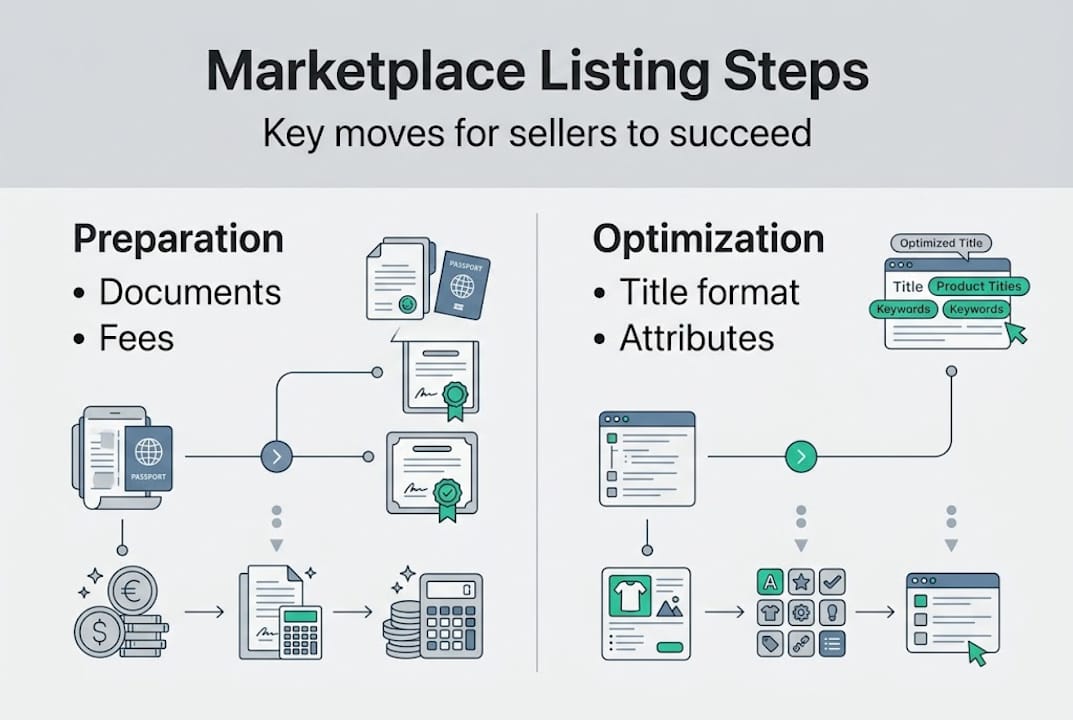
Most African marketplaces require a standard set of documents to activate a seller account:
- Valid government-issued ID (passport or national ID)
- Business registration certificate from your country of incorporation
- Bank account details in an accepted currency
- Contact information including a working email and phone number
- Tax identification number where applicable
- Product compliance certificates for regulated categories (electronics, food, cosmetics)
Once your documents are ready, research each platform’s commission structure. Fees vary significantly by product category, and overlooking them can erode your margins fast. Jumia seller commissions range from 3% to 15% depending on the product category, and registration itself is free. Takealot in South Africa charges a referral fee plus a fulfillment fee if you use their warehouse network. Konga in Nigeria operates on a similar model.
Here’s a quick comparison of three major African marketplaces:
| Marketplace | Registration cost | Commission range | Primary market |
|---|---|---|---|
| Jumia | Free | 3% to 15% | Pan-African (20+ countries) |
| Takealot | Free | 8% to 16% | South Africa |
| Konga | Free | 3% to 12% | Nigeria |
Our onboarding guide outlines exactly how MoreShores supports sellers through this initial setup, including document preparation and platform registration.
Pro Tip: Prepare at least 5 high-resolution product images (minimum 1000 x 1000 pixels) and a clear product title before you begin registration. Platforms reward well-prepared sellers with faster approval and better initial visibility.
A common pitfall is underestimating the time required for account verification. Some platforms take 5 to 10 business days to approve new sellers. Build this into your launch timeline so you’re not caught waiting.
Step-by-step listing process for African marketplaces
Once you’re prepared, it’s time to walk through the key actions to get your listings live and high-performing. The listing process on most African marketplaces follows a predictable sequence, but the details matter. Missing one step can delay your go-live date by days.
Here is the standard workflow:
- Create your seller account on the platform’s vendor portal using your business email.
- Submit required documents as digital uploads; ensure scans are clear and legible.
- Complete your store profile with your brand name, logo, and return policy.
- Add your product catalog using the platform’s bulk upload tool or manual entry form.
- Set pricing and stock levels, factoring in marketplace commissions and shipping costs.
- Upload product images that meet platform specifications (white background preferred).
- Write optimized product titles using the format: [Brand] + [Product] + [Key Specs].
- Submit listings for review; most platforms approve within 24 to 72 hours.
- Activate your payment method so you can receive payouts after the first sale.
- Monitor your seller dashboard for any flagged listings or pending actions.
Here is how a standard approach compares to an optimized strategy:
| Stage | Standard approach | Optimized strategy |
|---|---|---|
| Product title | Generic name | Brand + Product + Specs format |
| Images | 1 to 2 basic photos | 5+ high-res images with lifestyle shot |
| Description | Short paragraph | Structured with bullet features |
| Pricing | Cost + margin | Competitive research-informed pricing |
| Keywords | Not considered | Platform-specific keyword research |
For title formats, Jumia Kenya’s selling steps confirm that using [Brand] + [Product] + [Specs] is the recommended structure for better search visibility.
Our marketplace integration service handles catalog uploads, title formatting, and compliance checks across multiple platforms simultaneously, saving you significant setup time.
Pro Tip: Before finalizing your listings, search for your top 3 competitor products on each platform. Note which keywords appear in their titles and descriptions. Use those same terms in your listings to compete directly in the same search results.
One mistake sellers consistently make is skipping the attribute fields during product upload. These fields (size, color, material, compatibility) feed the platform’s filter system. Buyers who use filters to narrow searches will never find your product if those fields are empty.
Optimize listings for visibility and conversion
With your listing live, now focus on making it stand out and convert buyers. Getting listed is step one. Getting found and purchased is an entirely different challenge, and it requires ongoing attention.
Here are the core optimization practices that produce results:
Do:
- Use specific, keyword-rich titles in the Brand] + [Product] + [Specs] format as recommended in [Jumia’s seller guidelines
- Write descriptions that lead with the primary benefit, then list key features as bullet points
- Display prices in local currency (ZAR for South Africa, KES for Kenya, NGN for Nigeria)
- Include a size guide, compatibility chart, or how-to section where relevant
- Respond to buyer questions within 24 hours to maintain your seller rating
Don’t:
- Use all-caps in product titles (platforms penalize this)
- Stuff keywords unnaturally into descriptions
- Upload blurry or watermarked images
- Set stock levels you can’t actually fulfill
- Ignore your seller rating metrics
Localization matters more than most sellers expect. African consumers are increasingly price-sensitive and brand-aware. A product description that resonates in China or Europe may not communicate value clearly to a buyer in Nairobi or Lagos. Adapt your language, use relatable product use cases, and highlight locally relevant benefits like durability in warm climates or compatibility with local voltage standards.
Our e-commerce solutions include listing localization support to help you adapt content for specific African markets without losing your brand voice.

Pro Tip: Run an A/B test on your top product by changing only the main image. Use the version with higher click-through rate as your primary image for 30 days, then test again. Small image changes can shift conversion rates significantly.
Manage fulfillment, compliance, and after-sales
Successful listings are just the beginning; the real challenge is keeping customers happy and staying compliant after orders start flowing in.
Fulfillment speed and accuracy directly affect your marketplace ranking. Most African platforms use a seller performance score that factors in dispatch time, order cancellation rate, and return rate. A slow or inaccurate fulfillment operation will push your listings lower in search results over time.
“Your seller rating on African marketplaces is a living score. One week of delayed shipments can take months to recover from. Reliable fulfillment is not optional; it is the foundation of your marketplace presence.”
Key compliance checkpoints to manage on an ongoing basis:
- Customs documentation: Ensure commercial invoices, packing lists, and certificates of origin are accurate for every cross-border shipment
- Import duties and VAT: Know the applicable rates for your product category in each destination country
- Product safety standards: Electronics and personal care items often require local certification before sale
- Labeling requirements: Many African markets require labels in local languages or specific formats
- Restricted goods: Verify your product category is not restricted or banned in the destination market
For returns, set a clear policy before your first sale. African marketplaces typically allow 7 to 30 day return windows depending on the platform and product type. Communicate your return process clearly in your store profile.
A hybrid model is recommended for cross-border sellers: start with marketplaces for validation and lower risk, then build your own store for long-term brand control. Platforms like Shopify support multi-currency, making the transition manageable when the time comes.
Our fulfillment solutions and logistics partners support same-day dispatch, multi-courier routing, and compliant documentation for cross-border shipments into and across Africa.
A smarter path: Balancing marketplace reach with brand control
Now that you know the key steps, let’s step back and look at the bigger strategic picture. Most guides present marketplace selling and direct-to-consumer (DTC) as competing options. We think that framing leads merchants to make the wrong choice too early.
Marketplaces offer quick access and lower risk, but they limit branding and data ownership. Your own store gives you control but requires upfront setup and marketing investment. The real insight is that these models work best in sequence, not in opposition.
Start on marketplaces to validate demand, understand which products resonate with African buyers, and build your seller reputation without committing to heavy infrastructure. Once you have real sales data and a loyal customer base, you can selectively move high-margin products to your own storefront while maintaining marketplace presence for volume and visibility.
This is especially relevant for African cross-border enablement because markets like South Africa, Kenya, and Nigeria each have distinct consumer behaviors. What sells well in one market may not perform in another. Marketplaces give you a low-cost testing environment before you localize your full DTC strategy.
The brands that succeed long-term in Africa are not the ones who picked the right channel. They’re the ones who sequenced their channel strategy intelligently.
Accelerate your success with expert support
If you’re ready to move faster and avoid common mistakes, here’s how to get help. Navigating marketplace registration, listing optimization, customs compliance, and fulfillment across multiple African markets is a significant operational load for any brand team.
MoreShores provides end-to-end cross-border enablement designed specifically for brands entering African markets. From document preparation and platform onboarding to marketplace integration services across Jumia, Takealot, Kilimall, and Amazon SA, we handle the operational complexity so you can focus on growing your sales. Our fulfillment support ensures fast, compliant delivery to your customers across the continent. Talk to our team today and get your African market entry moving.
Frequently asked questions
What documents do I need to list on African marketplaces?
You’ll typically need business registration, a valid ID, contact info, and bank details; some platforms may also ask for product compliance certificates depending on your category.
How do marketplace commissions and fees work?
Jumia charges commissions ranging from 3% to 15% depending on the product category, with no upfront registration fee for new sellers.
Is it better to start with marketplaces or launch my own e-commerce store?
Starting with marketplaces is lower risk for initial market validation; a hybrid approach that transitions to DTC once you have sales data gives you the best long-term outcome.
How can I make my marketplace listings more visible?
Use specific product titles in the [Brand] + [Product] + [Specs] format, upload high-resolution images, complete all attribute fields, and price in the local currency of your target market.
What are the most common mistakes sellers make?
Skipping required documents, using vague product titles, and leaving attribute fields empty are the most common pitfalls; always follow each platform’s seller guidelines closely before going live.