
Managing cross-border trade often feels like juggling a thousand moving pieces at once. For E-commerce logistics managers and global brands entering African markets, success depends on more than just great products—it requires a solid foundation of e-commerce infrastructure that can handle complex regulatory compliance and unpredictable fulfillment challenges. Understanding the systems that move orders from screen to doorstep helps you prevent costly delays, simplify customs, and position your business for rapid African market growth.
Table of Contents
- Defining E-Commerce Infrastructure In Trade
- Types And Core Components Explained
- How Cross-Border E-Commerce Systems Work
- Legal, Customs, And Compliance Essentials
- Risks, Bottlenecks, And Cost Implications
Key Takeaways
| Point | Details |
|---|---|
| Comprehensive E-Commerce Infrastructure | A robust infrastructure integrates technology, logistics, and compliance, crucial for successful cross-border trade. |
| Importance of Automation | Automated systems streamline processes, reducing delays, errors, and operational costs, particularly in fragmented markets like Africa. |
| Focus on Compliance | Attention to compliance is essential to avoid costly disruptions in cross-border operations and to ensure smooth customs processes. |
| Risk Management Strategy | A proactive approach to managing risks, data accuracy, and regulatory compliance can significantly enhance operational efficiency and profitability. |
Defining E-Commerce Infrastructure in Trade
E-commerce infrastructure isn’t just technology—it’s the complete system that makes cross-border trade possible. Think of it as the skeleton holding up your entire operation, from warehouse to customer doorstep.
Foundational digital frameworks include the hardware, software, networks, and data storage systems that process every transaction, manage inventory, and connect you to global customers. Without these systems, your products stay locked in local markets.
For e-commerce logistics managers entering African markets, this infrastructure directly impacts your ability to scale. A weak foundation means shipping delays, customs complications, and frustrated customers abandoning their carts.
Core Components of E-Commerce Infrastructure
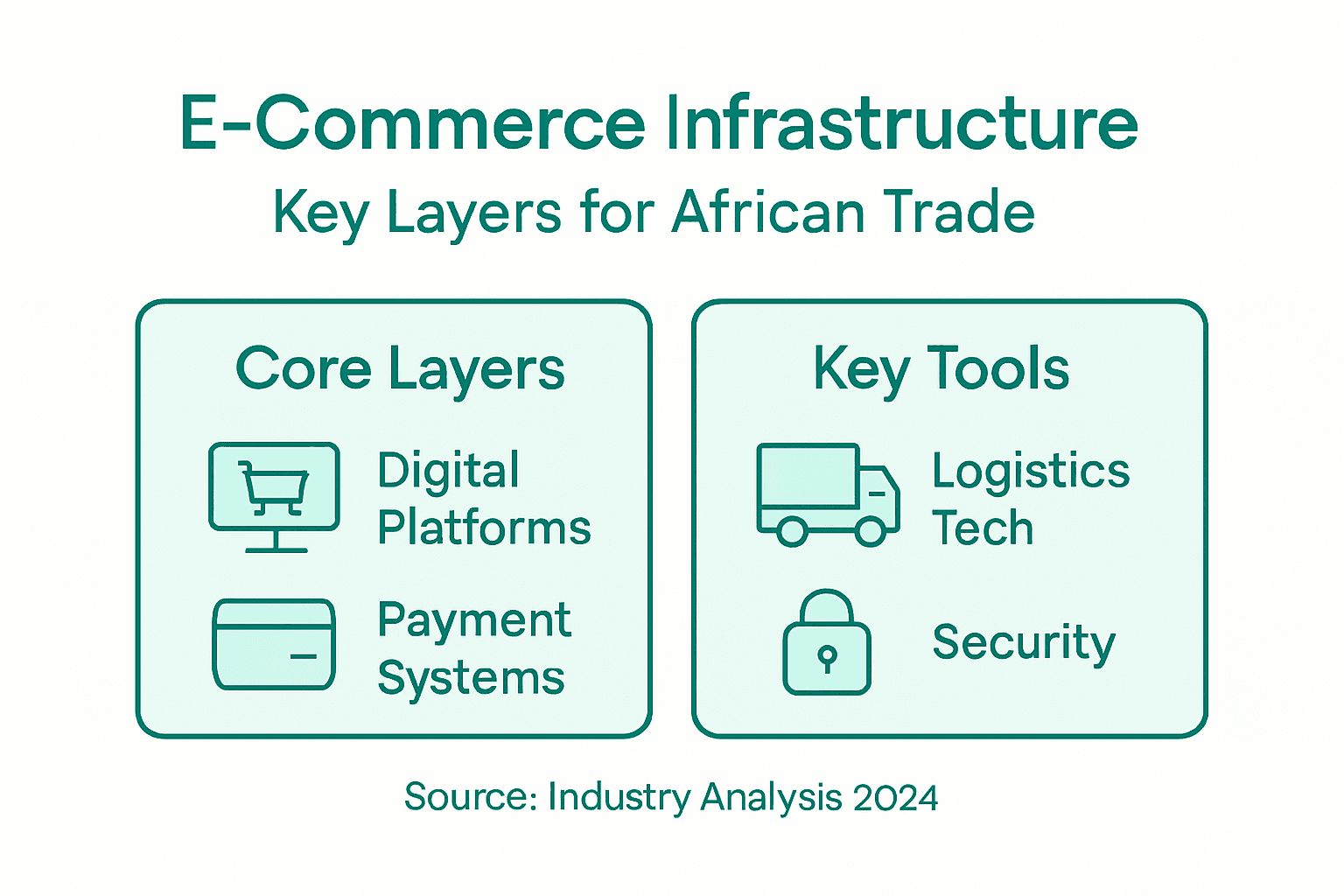
E-commerce infrastructure consists of several interconnected layers:
- Digital platforms and marketplaces where products are listed and customers browse
- Payment systems that securely process transactions across currencies and regions
- Logistics networks managing warehousing, fulfillment, and last-mile delivery
- Compliance systems handling customs documentation, duties, and regulatory requirements
- Data management tracking inventory, orders, and customer information in real time
Each component serves a specific function, but they only work effectively when integrated together.
Strategic deployment of IT resources including online platforms, communications technology, and payment systems collectively reduce barriers in cross-border trade, enabling seamless global commerce.
Why African Trade Demands Stronger Infrastructure
Africa’s e-commerce growth is accelerating, but infrastructure gaps remain significant. You’ll encounter fragmented payment methods, inconsistent logistics networks, and complex regulatory environments across different countries.
This is where infrastructure becomes your competitive advantage. Strong systems bridge these gaps:
- Consolidating orders from multiple African marketplaces into one dashboard
- Automating customs clearance and compliance documentation
- Managing currency conversions and international payment flows
- Coordinating fulfillment across multiple courier networks
Without this infrastructure, you’re manually managing chaos—spreadsheets, email chains, and constant back-and-forth with customs brokers.
Here’s a comparison of manual versus integrated e-commerce infrastructure for African cross-border operations:
| Aspect | Manual Approach | Integrated Infrastructure |
|---|---|---|
| Order Management | Spreadsheets and email chains | Automated, unified dashboard |
| Customs Compliance | Manual documentation, higher error risk | Automated, real-time checks |
| Payment Handling | Separate, fragmented systems | Multi-currency, seamless processing |
| Cycle Time | Days due to bottlenecks | Hours with real-time coordination |
| Cost Impact | High due to delays and labor | Lower via automation and visibility |
| Scalability | Limited by manual processes | Easily supports market expansion |
Infrastructure as a Business Enabler
Infrastructure removes friction. A brand sourcing from Asia needs to land inventory in South Africa, list on Takealot and Jumia simultaneously, process payments from multiple regions, and ship orders same-day.
That’s not possible without integrated infrastructure handling every step. Your infrastructure either enables this seamlessly or forces you to choose between markets.
When you partner with platforms that offer marketplace integration, you’re leveraging pre-built infrastructure designed specifically for African e-commerce complexities.
Pro tip: Evaluate any infrastructure solution by asking: Can it handle simultaneous operations across multiple African countries, currencies, and payment methods? If not, you’ll spend more time managing logistics than growing your business.
Types and Core Components Explained
E-commerce infrastructure operates across multiple layers, each serving a distinct purpose. Understanding these components helps you identify what your operation actually needs versus what sounds impressive in a vendor pitch.
The Hardware Foundation
Web and database servers form the backbone of your entire operation. These machines process customer requests, store product information, and handle transactions around the clock.
Networking equipment routes data between servers, customers, and payment processors. Poor networking means slow page loads, abandoned shopping carts, and angry customers.
Cloud services provide scalable server capacity without owning physical hardware. During peak seasons like Black Friday, cloud infrastructure automatically scales up to handle traffic spikes.
Use this table as a reference for key infrastructure types and their primary business benefits:
| Infrastructure Type | Core Function | Business Impact |
|---|---|---|
| Cloud Services | Scalable server capacity | Handles peak traffic affordably |
| Payment Gateways | Transaction processing | Builds trust, enables conversions |
| CRM Platforms | Manage customer data | Drives personalization, retention |
| Logistics Integration Tools | Sync physical and digital ops | Reduces delivery times, errors |
| Compliance Automation | Regulatory adherence | Minimizes shipment delays, fines |
The Software and Platform Layer
Web servers and backend frameworks handle the logic behind every action. When a customer searches for products or adds items to their cart, software processes these requests.
- E-commerce platforms display products, manage shopping carts, and process checkouts
- Inventory management systems track stock levels across multiple warehouses
- Order management systems route orders to fulfillment centers
- CRM platforms store customer data and purchase history
Payment and Security Infrastructure
Payment gateways are non-negotiable. They secure customer financial data and process transactions across multiple currencies and payment methods.

Security systems protect against fraud, data breaches, and unauthorized access. In African markets where trust is critical, security infrastructure directly impacts customer confidence.
For cross-border operations, you need payment systems supporting multiple currencies and regions. A customer in Kenya shouldn’t struggle with payment options.
Logistics and Operational Tools
These systems connect your online storefront to physical fulfillment:
- Warehouse management systems optimize inventory placement and picking
- Shipping integration connects to carriers like FedEx, DHL, and local couriers
- Tracking systems give customers real-time delivery updates
- Returns management automates the reverse logistics process
When you sell on Takealot, Jumia, and your own store simultaneously, operational tools consolidate all orders into one fulfillment queue.
Strong infrastructure doesn’t just support sales—it compresses the time between order and delivery, directly impacting customer satisfaction and repeat purchases.
Pro tip: When evaluating infrastructure solutions, ask vendors to walk you through a real order from marketplace listing through customer delivery—this reveals what they can actually handle versus what they claim.
How Cross-Border E-Commerce Systems Work
Cross-border e-commerce systems eliminate the friction of international trade. Instead of dealing with individual customs brokers, currency converters, and fragmented logistics networks, everything connects through one digital platform.
Think of it like this: A customer in South Africa clicks “buy” on an item listed on Jumia. Behind that click, dozens of systems coordinate instantaneously to process payment, update inventory, and route the order to the correct fulfillment center.
The Digital Connection Process
Digital platforms connect buyers and sellers across borders by handling the complexity you never see. Payment data flows securely. Inventory updates in real time. Customs documentation generates automatically.
For e-commerce logistics managers, this means you’re not manually matching orders to warehouses or filing separate customs declarations for each shipment. The system does it.
How Data Flows Through the System
Cross-border systems operate through interconnected data layers:
- Order intake captures customer purchases from multiple marketplaces simultaneously
- Payment processing converts currencies and settles funds across regions
- Inventory synchronization reserves stock and prevents overselling
- Customs preparation generates required documentation automatically
- Logistics routing selects the fastest, most cost-effective carrier
- Customer tracking provides real-time updates from warehouse to doorstep
Each layer depends on the others working flawlessly. One breakdown cascades through the entire operation.
Enabling Market Access Without Physical Presence
Networked marketplaces support SMEs entering global markets by removing the requirement to establish local operations in every country. You don’t need an office in Kenya, South Africa, or Nigeria.
Instead, your inventory sits in strategic regional warehouses. Customers purchase locally. Local fulfillment happens. You manage everything from one dashboard.
The African Market Advantage
Cross-border infrastructure becomes especially powerful in Africa because it bridges fragmented markets. Each country has different payment preferences, regulatory requirements, and shipping networks.
A unified system handles all of this:
- Multiple payment methods across different countries
- Regulatory compliance tailored to each market
- Multi-carrier logistics optimization
- Currency conversion and fund settlement
The difference between manual operations and automated cross-border systems shows in cycle time: orders process in hours instead of days, directly improving customer satisfaction and enabling you to compete with established players.
Pro tip: Before committing to a cross-border system, verify it handles simultaneous transactions across your target African markets—don’t assume global solutions work equally well in all regions.
Legal, Customs, and Compliance Essentials
Cross-border trade through Africa demands obsessive attention to compliance. Unlike selling domestically, you’re navigating multiple legal jurisdictions, customs regimes, and tax systems simultaneously. One misstep triggers delays, penalties, or shipment seizures.
For e-commerce logistics managers, compliance isn’t optional—it’s the difference between smooth operations and costly disruptions.
The Core Compliance Challenges
Every African market has unique requirements. South Africa has one customs process. Kenya has another. Nigeria differs again. Add VAT calculations, product-specific regulations, and documentation requirements, and complexity multiplies fast.
Customs risk management and data quality for taxation form the foundation of reliable cross-border operations. Without accurate data, shipments get held at customs. With poor risk management, you face non-compliance penalties.
Key Compliance Areas You Must Address
Successful cross-border operations require attention to multiple areas:
- Customs declarations must match actual product contents, values, and origins
- Harmonized tariff codes determine duties and must be accurate
- VAT registration varies by country and sales threshold
- Product compliance certifications differ across markets
- Documentation requirements include proofs of origin and regulatory approvals
- Payment records must show clear audit trails for tax purposes
Missing or incorrect information in any category stops shipments.
Risk Management Through Data Accuracy
The difference between compliant and non-compliant operations shows in data quality. Accurate product descriptions, correct classifications, and precise valuations prevent customs holds.
Operational controls catch errors before shipments leave your warehouse. Systematic verification processes reduce risk at every stage.
When you work with Importer of Record services, they handle compliance documentation, manage customs interactions, and maintain the regulatory relationships that keep goods moving.
Building Sustainable Compliance Programs
Manual compliance processes fail at scale. You need systematic approaches:
- Standardize documentation across all shipments
- Automate classification using product databases
- Maintain audit trails for every transaction
- Monitor regulatory changes in target markets
- Build relationships with local customs authorities
Programs that prioritize data accuracy from order entry through final delivery reduce compliance risks significantly.
Compliance infrastructure that works proactively prevents problems rather than reacting to them. Each shipment delayed costs customer satisfaction and marketplace ratings.
Pro tip: Request documentation of your compliance partner’s audit practices and customs track record—ask specifically about shipment hold rates and how they resolve customs disputes in your target markets.
Risks, Bottlenecks, and Cost Implications
Cross-border e-commerce in Africa isn’t risk-free. The same infrastructure that enables global reach also exposes you to vulnerabilities that can drain profitability. Understanding these risks upfront helps you plan defensively.
You’re managing international coordination across time zones, currencies, regulatory systems, and logistics networks. Each layer introduces potential failure points.
Supply Chain and Logistics Risks
Supply chain management bottlenecks arise from international coordination and long shipping distances across Africa. A single delayed shipment from a regional warehouse cascades into customer dissatisfaction and marketplace penalties.
Logistics disruptions come from multiple sources:
- Port congestion creating unpredictable delays in key markets like South Africa and Kenya
- Last-mile challenges where final delivery coverage remains patchy across rural areas
- Multi-carrier complexity managing different couriers across different countries
- Inventory fragmentation requiring strategic placement across multiple warehouses
- Reverse logistics handling returns across international borders
Each issue increases operational costs if not managed systematically.
Financial and Security Risks
Data breaches, payment fraud, and regulatory compliance issues represent substantial financial exposure. Payment fraud alone can wipe out margins on dozens of transactions.
You’re handling customer payment data, banking information, and personal details across multiple African countries with varying security standards. Each transmission point creates vulnerability.
Regulatory fragmentation means what’s compliant in one country triggers fines in another. The cost of non-compliance—fines, shipment seizures, and operational halts—often exceeds the profit from those transactions.
The Real Cost of Poor Infrastructure
Manual, fragmented operations generate hidden costs:
- Personnel time managing spreadsheets and multiple systems
- Customs delays from documentation errors
- Payment processing fees across multiple currency conversions
- Inventory holding costs from poor forecasting and placement
- Customer refunds from order mismatches and delivery failures
- Regulatory penalties from compliance mistakes
Many operators don’t realize these costs until they’ve lost significant revenue.
Risk Mitigation Through Digital Transformation
Strategic infrastructure investments reduce risks substantially. Systematic approaches to compliance, automated documentation, and integrated logistics cut problems before they escalate.
Integrated technical, legal, and operational frameworks aren’t luxuries—they’re requirements for sustainable profitability in cross-border trade.
Pro tip: Calculate your true operational cost per transaction including compliance, logistics, and payment processing—most businesses discover hidden costs consuming 15-25% of margins when they audit thoroughly.
Unlock Seamless African E-Commerce Expansion with MoreShores
The article highlights critical challenges like fragmented payment systems, complex customs compliance, and multi-market logistics that slow your growth in Africa’s booming e-commerce landscape. If you struggle with managing inventory across multiple marketplaces such as Takealot and Jumia or face costly delays in customs clearance, you understand how fragmented infrastructure drains both time and profits. MoreShores provides an integrated cross-border trade solution built to conquer these pain points by acting as your dedicated Importer of Record and automating duties, VAT, and compliance seamlessly.

Empower your brand with MoreShores’ unified platform that handles warehousing, multi-courier fulfillment, and synchronizes your product listings across popular African and global marketplaces. Don’t let fragmented operations hold you back when you can leverage a robust infrastructure designed specifically to simplify complex African trade logistics. Visit MoreShores today and start scaling with confidence. Explore how our Importer of Record services and marketplace integrations support effortless cross-border commerce that reduces costs, eliminates bottlenecks, and speeds delivery.
Take control of your African e-commerce journey now and turn infrastructure complexity into your competitive advantage.
Frequently Asked Questions
What are the core components of e-commerce infrastructure in trade?
E-commerce infrastructure consists of several interconnected layers, including digital platforms and marketplaces, payment systems, logistics networks, compliance systems, and data management tools. Each component plays a critical role in facilitating transactions and ensuring smooth operations.
How does e-commerce infrastructure impact cross-border trade?
E-commerce infrastructure directly influences cross-border trade by streamlining logistics, simplifying customs compliance, and enabling efficient payment processing. A robust infrastructure helps eliminate delays and reduces the risk of cart abandonment by ensuring a seamless customer experience.
Why is strong infrastructure essential for e-commerce growth in developing markets?
Strong infrastructure is crucial in developing markets because it bridges gaps in payment methods, logistics networks, and regulatory compliance. It empowers businesses to efficiently manage operations, meet customer expectations, and scale effectively across borders.
What risks are associated with inadequate e-commerce infrastructure in cross-border operations?
Inadequate infrastructure can lead to various risks, such as delays in shipping, customs complications, high operational costs, and potential compliance issues. These risks can diminish customer satisfaction and harm a business’s reputation in the market.