Cross-border VAT: A practical guide for global sellers

TL;DR:
- Cross-border VAT obligations depend on customer location, not where the business is registered.
- Using tools like OSS and IOSS simplifies compliance for EU sales; non-EU sellers may need local registration.
- Proper documentation and proactive compliance strategies are essential to avoid fines, audits, and market access loss.
Cross-border VAT catches more businesses off guard than you might expect. Over 170 countries use VAT, and a single international sale can trigger tax obligations in a country where you have never set foot. This is not a problem reserved for large multinationals. Small and mid-sized e-commerce sellers, digital service providers, and B2B suppliers all face the same rules. This guide breaks down what cross-border VAT actually means, how the rules work across key regions, and what you need to do to stay compliant and protect your market access.
Table of Contents
- What is cross-border VAT and why does it matter?
- Navigating VAT rules for EU cross-border trade
- VAT obligations for e-commerce platforms and digital services
- Common edge cases and compliance pitfalls
- Managing documentation and fraud risks in cross-border VAT
- The overlooked reality of cross-border VAT compliance
- Simplify your cross-border VAT journey with expert help
- Frequently asked questions
Key Takeaways
| Point | Details |
|---|---|
| Cross-border VAT triggers | Selling goods or services internationally often creates VAT obligations based on the buyer’s location. |
| EU VAT simplification | OSS and IOSS schemes help e-commerce sellers streamline EU VAT registration and compliance. |
| Risk management is vital | Poor documentation and non-compliance can lead to fines, bans, and missed business opportunities. |
| Digital and marketplace challenges | Platforms and digital goods require special VAT handling and proof of customer location. |
What is cross-border VAT and why does it matter?
VAT, or Value Added Tax, is a consumption tax applied at each stage of a product’s journey from production to final sale. Unlike a corporate income tax, VAT is collected from the end customer and remitted to the tax authority by the seller. The key word in “cross-border VAT” is destination: when you sell internationally, VAT obligations arise based on where your customer is located, not where your business is registered.
This is called the destination principle, and it fundamentally changes how you think about tax. Selling from South Africa to a customer in Germany? German VAT rules apply. Selling software from the US to a buyer in France? French VAT applies. Your home country’s tax registration is largely irrelevant to the transaction.
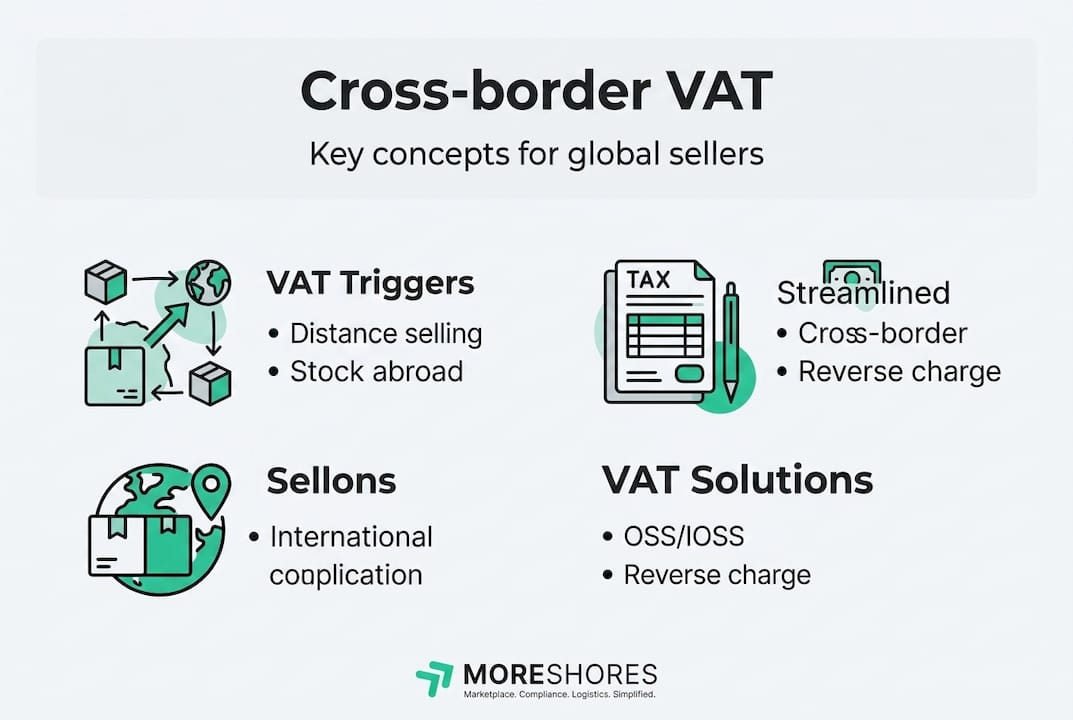
Why does this matter practically? Because non-compliance is not a minor administrative issue. Tax authorities can issue fines, demand back-payment of VAT with interest, and in serious cases, block your ability to sell on major marketplaces. For e-commerce sellers, losing access to platforms like Amazon EU or Takealot due to a VAT violation can be devastating.
EU member states and 170+ countries operate VAT systems, making it one of the most widely used tax mechanisms globally. Here is a snapshot of how VAT rates vary across key trading markets:
| Country/Region | Standard VAT Rate | Key Threshold for Foreign Sellers |
|---|---|---|
| European Union | 15% to 27% (varies by state) | €10,000 EU-wide for B2C |
| United Kingdom | 20% | £85,000 for UK-established; £0 for non-UK |
| South Africa | 15% | ZAR 1,000,000 annual turnover |
| Kenya | 16% | KES 5,000,000 annual turnover |
| Nigeria | 7.5% | NGN 25,000,000 annual turnover |
“VAT is not just a tax. It is a market access requirement. Sellers who treat it as optional quickly discover that regulators disagree.”
For global e-commerce solutions that span multiple continents, understanding these thresholds and rates is the foundation of your pricing and compliance strategy. Getting this wrong from the start creates compounding problems as your sales volume grows.
Navigating VAT rules for EU cross-border trade
The EU has the most structured and well-documented cross-border VAT framework in the world, which makes it both a model to understand and a complex system to navigate. The rules differ depending on whether you are selling B2C (to consumers) or B2B (to registered businesses).

For B2C sellers, the EU introduced a €10,000 annual threshold. Businesses under €10,000 in cross-border EU sales can apply their home country’s VAT rate. Once you exceed that threshold, you must charge VAT at the destination country’s rate. Rather than registering in every EU member state separately, you can use the One Stop Shop (OSS), a single registration that lets you report and pay VAT for all EU countries through one portal.
For imported goods valued at €150 or less, the Import One Stop Shop (IOSS) applies. Platforms like Amazon are deemed suppliers for VAT purposes on these transactions, meaning they collect and remit VAT on behalf of third-party sellers. If you sell directly through your own storefront, you are responsible for IOSS registration yourself.
For B2B sales, the reverse charge mechanism simplifies things considerably. The reverse charge applies when your buyer provides a valid VAT ID. In this case, you do not charge VAT on the invoice. Instead, the buyer accounts for VAT in their own country. This eliminates the need for the seller to register in the buyer’s country for most B2B transactions.
Non-EU sellers face a stricter landscape. Many EU countries require registration from the very first sale, with no minimum threshold for foreign businesses. You may also need EU VAT registration in specific countries depending on where you store stock or fulfill orders.
Choosing the right registration path:
- If your EU B2C sales exceed €10,000 annually, register for OSS through any EU member state
- If you import goods valued under €150 directly to EU consumers, register for IOSS
- If you sell only to VAT-registered businesses, use the reverse charge and confirm buyer VAT IDs
- If you store inventory in an EU warehouse, register locally in that country regardless of sales volume
- If you sell in countries like France or Italy as a non-EU business, check whether fiscal representation is required
Pro Tip: Track your destination country sales monthly, not just at year-end. Threshold breaches can happen mid-year, and retroactive VAT registration is far more costly than proactive compliance through cross-border enablement planning.
The EU framework rewards sellers who plan ahead. OSS and IOSS exist specifically to reduce administrative burden. Using them correctly, combined with sound fulfillment and logistics planning, keeps your compliance costs predictable.
VAT obligations for e-commerce platforms and digital services
If you sell through an online marketplace or deliver digital products, your VAT obligations work differently from standard physical goods trade. Understanding these distinctions protects you from unexpected liabilities.
Marketplace seller rules have changed significantly since 2021. Platforms like Amazon are deemed VAT suppliers and must collect and remit VAT on behalf of sellers for certain transaction types. This applies specifically to non-EU sellers and to goods imported into the EU valued at €150 or less. As a seller, this means the platform handles VAT collection for qualifying sales, but you still need to understand which sales are covered and which remain your direct responsibility.
Digital services operate under their own ruleset entirely. Digital services are taxed at the customer’s location, and you must collect at least two non-contradictory pieces of evidence to confirm where your customer is based. Acceptable evidence includes billing address, IP address, bank location, and country-specific phone prefix. If two pieces of evidence conflict, you need a third to resolve the discrepancy.
Here is a practical step-by-step process for managing digital service VAT:
- Identify whether your product qualifies as a digital service (software, streaming, e-books, online courses)
- Determine the customer’s country using at least two independent data points
- Apply the correct VAT rate for that country at the point of sale
- Store the evidence for a minimum of 10 years in the EU context
- Register for the relevant VAT scheme (OSS for EU-based sellers, non-Union OSS for non-EU sellers)
- File quarterly VAT returns through your chosen registration portal
Pro Tip: Build evidence collection into your checkout process automatically. Capturing IP address and billing country at the point of purchase costs almost nothing technically but protects you significantly during an audit. This is especially important for marketplace integration across multiple platforms where transaction data can become fragmented.
The rules for digital services are enforced actively. Tax authorities in the EU, UK, and Australia have all increased scrutiny of digital service providers in recent years, particularly those operating without a local physical presence.
Common edge cases and compliance pitfalls
Standard VAT guidance covers the basics well, but real-world cross-border trade regularly produces situations where standard rules do not apply cleanly. These edge cases are where most compliance failures occur.
Warehouse and fulfillment stock abroad is the most common trigger. Physical presence in an EU state requires VAT registration in that country, regardless of your sales volume. If you use Fulfillment by Amazon (FBA) and Amazon stores your inventory in a German warehouse, you are required to register for VAT in Germany. Many sellers discover this obligation only after receiving a demand from the German tax authority.
Fiscal representation adds another layer of complexity. Non-EU sellers may need fiscal representatives in countries like France, Italy, and Poland. A fiscal representative is a locally registered entity that assumes joint liability for your VAT obligations. Finding and appointing one takes time and adds cost, so factor this into your market entry planning.
Cross-border VAT fraud in the EU is estimated at €780 million to €1.5 billion annually, representing roughly 4% of total cross-border trade volume. This level of fraud has prompted regulators to increase enforcement and audits, meaning legitimate sellers face more scrutiny than ever before.
“The sellers most at risk are not fraudsters. They are legitimate businesses who assumed their home-country compliance was sufficient for international sales.”
Common mistakes and how to avoid them:
- Assuming your home VAT registration covers all international sales (it does not)
- Missing the registration requirement triggered by storing stock in a foreign warehouse
- Failing to verify buyer VAT IDs before applying the reverse charge
- Not updating VAT rates when destination countries change their standard rates
- Treating marketplace-collected VAT as covering all your obligations on that platform
- Ignoring intragroup transfer pricing adjustments that may have VAT implications
If you are scaling across multiple countries, working with logistics partners who understand local VAT triggers is essential. The right partner with logistics experts can flag warehouse-triggered registration requirements before they become enforcement issues.
Managing documentation and fraud risks in cross-border VAT
Strong documentation is your primary defense in a cross-border VAT audit. Tax authorities do not simply check whether you filed returns. They examine the evidence behind each transaction, and gaps in your records are treated as red flags.
Fraud rates are higher in low-GDP and high-corruption environments, which means regulators apply stricter scrutiny to trade flows involving certain markets. Robust documentation for at least five years is the baseline standard across most jurisdictions.
Some VAT reforms reduce fraud but may increase compliance costs for legitimate businesses. Real-time reporting requirements, e-invoicing mandates, and digital audit trails are being introduced across the EU and in markets like South Africa and Kenya. Adapting your systems early reduces the cost of each new requirement.
Best practices for documentation and compliance:
- Retain all invoices, customs declarations, and proof-of-delivery documents for a minimum of five years
- Store digital copies of buyer VAT ID verifications for every B2B transaction using the reverse charge
- Maintain a transaction log showing the destination country, VAT rate applied, and evidence used
- Reconcile your VAT returns against your sales platform data monthly, not quarterly
- Monitor regulatory updates in each country where you are registered or approaching a threshold
- Use accounting software that supports multi-jurisdiction VAT reporting
Understanding transfer pricing VAT implications is also relevant for businesses operating through related entities in different countries. Intragroup transactions can create unexpected VAT obligations if not structured carefully.
If you are building out your compliance infrastructure, reviewing how onboarding works with a cross-border enablement partner can help you identify documentation gaps before they become audit findings.
The overlooked reality of cross-border VAT compliance
Most advice on cross-border VAT focuses on staying below thresholds or finding the simplest possible registration path. We understand the appeal. Compliance has a cost, and minimizing it seems logical. But this approach consistently backfires for growing sellers.
The businesses we see struggle most are not the ones who registered too early. They are the ones who delayed registration, relied on marketplace VAT collection to cover all their obligations, or assumed that operating below a threshold in one country meant they were below it everywhere.
The compliance landscape is tightening. Real-time reporting, e-invoicing, and cross-border data sharing between tax authorities are all expanding. Sellers who build e-commerce VAT strategies into their market entry plans from day one spend less time and money on remediation later.
Our practical recommendation: treat VAT registration as a market access investment, not an administrative burden. Document thoroughly, build systems for each new country you enter, and price VAT costs into your expansion model from the start. The financial benefits of robust compliance almost always outweigh the short-term savings from cutting corners.
Simplify your cross-border VAT journey with expert help
Cross-border VAT compliance is manageable when you have the right infrastructure behind you. MoreShores helps e-commerce sellers and international brands navigate the full complexity of cross-border trade, from cross-border VAT support and Importer of Record services to warehousing, fulfillment, and marketplace solutions across Africa and beyond.

Whether you are entering a new market or scaling an existing one, our platform integrates compliance, logistics, and e-commerce compliance into a single, manageable workflow. You focus on growing your business. We handle the regulatory complexity that comes with crossing borders. Reach out to our team to explore how we can reduce your compliance burden and open new markets with confidence.
Frequently asked questions
Which countries require cross-border VAT registration?
VAT registration is mandatory in any country where you exceed distance-selling thresholds, store stock, or provide digital services to consumers. Physical presence triggers mandatory registration in countries like France, Italy, and Poland regardless of sales volume.
What is the difference between OSS and IOSS?
OSS simplifies EU VAT reporting for B2C sales exceeding €10,000 across the EU; IOSS handles import VAT specifically for goods valued under €150 sold to EU consumers. OSS and IOSS create simplified registration pathways that replace the need for individual country registrations in most cases.
When does the reverse charge mechanism apply?
The reverse charge applies for cross-border B2B sales when the buyer provides a valid VAT ID, shifting VAT accounting responsibility to the buyer. Reverse charge for B2B cross-border eliminates the seller’s need to register in the buyer’s country for most transactions.
How do digital services handle VAT in cross-border sales?
Digital services must charge VAT based on the customer’s location using at least two pieces of non-contradictory evidence such as billing address and IP address. Digital services require two proofs of customer location to apply the correct VAT rate at the point of sale.
What are the main risks of ignoring cross-border VAT obligations?
Non-compliance risks fines, back-payment demands, audit exposure, and potential bans from major marketplaces. EU VAT fraud is estimated at €780M to €1.5B annually, which drives strict enforcement that affects legitimate sellers who fail to register correctly.