Cross-border inventory management essentials for Africa

TL;DR:
- Effective African cross-border inventory management requires addressing customs, infrastructure, and demand localization complexities.
- Technology integration with local marketplace APIs and proactive compliance strategies are essential for success.
- Partnering with logistics experts familiar with African markets enhances supply chain efficiency and reduces risks.
Most e-commerce managers assume inventory management is simply a matter of tracking stock levels and reordering when numbers drop. In African cross-border trade, that assumption creates costly problems fast. The reality involves customs compliance, localized demand patterns, fragmented infrastructure, and multi-market regulatory requirements that standard global frameworks rarely account for. This article walks you through what cross-border inventory management actually means in the African context, the specific challenges you will face, the tools that help, and the optimization strategies that produce real results. By the end, you will have a clear, actionable picture of what it takes to manage inventory effectively across African borders.
Table of Contents
- Understanding cross-border inventory management
- Key challenges and solutions for Africa’s cross-border inventory
- Tools and technologies powering inventory management
- Optimizing inventory management for African cross-border success
- Why traditional inventory approaches fail in African cross-border trade
- Connect with MoreShores for better cross-border inventory management
- Frequently asked questions
Key Takeaways
| Point | Details |
|---|---|
| Cross-border complexities | Inventory management in Africa is uniquely challenging due to logistics, customs, and localization demands. |
| Technology’s role | IMS, ERP, AI, IoT, and blockchain are central to optimizing inventory for cross-border e-commerce. |
| Local adaptation | Success hinges on adapting inventory strategies to African realities, not just following global best practices. |
| Partnership benefits | Teaming up with logistics specialists greatly improves compliance and efficiency in cross-border inventory flows. |
Understanding cross-border inventory management
With the stage set, let’s clarify what inventory management actually means in the cross-border e-commerce environment.
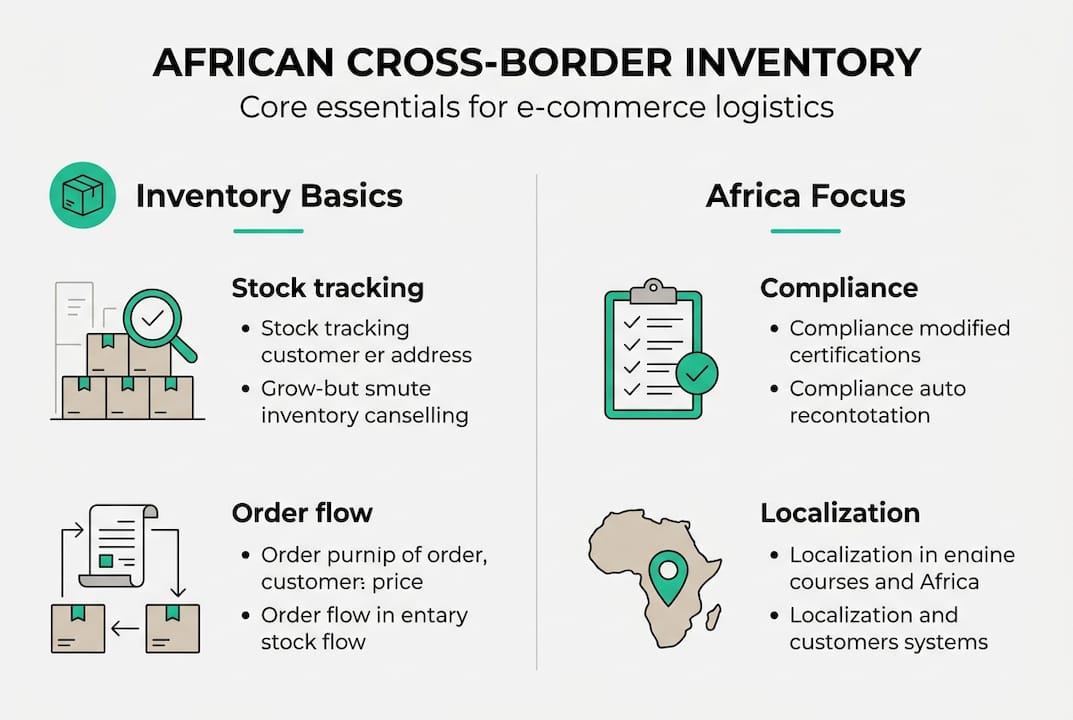
Inventory management in cross-border e-commerce involves overseeing, controlling, and optimizing inventory levels for products sold across international borders, including tracking stock, demand forecasting, supply chain coordination, customs compliance, and localization. That definition sounds straightforward until you apply it to African markets, where the variables multiply quickly.
Africa is not a single market. It is 54 countries, each with its own import regulations, tariff structures, currency risks, and consumer behavior. A product moving from China into South Africa travels a different compliance path than the same product entering Kenya or Nigeria. Your inventory strategy must account for each of these differences at every stage.
Here is how African cross-border inventory management differs from standard global models:
- Infrastructure gaps: Port congestion, unreliable road networks, and limited last-mile delivery coverage extend lead times significantly.
- Customs variability: Duty rates, VAT structures, and documentation requirements differ by country and can change with little notice.
- Demand localization: Consumer preferences vary sharply between regions. What sells in Johannesburg may not move in Nairobi.
- Currency exposure: Multiple currencies and exchange rate volatility affect landed cost calculations and pricing strategies.
- Marketplace fragmentation: Selling across Takealot, Jumia, and Kilimall simultaneously means managing separate inventory pools with different fulfillment expectations.
The core components of a functional cross-border inventory system for African markets include stock tracking, demand forecasting, supply chain coordination, customs compliance, and localization. Each component depends on the others. Weak demand forecasting leads to overstock in one market and stockouts in another. Poor customs compliance causes clearance delays that cascade into fulfillment failures.
“The biggest inventory errors in African cross-border trade come not from bad products but from good products managed with the wrong framework.”
| Component | Global standard approach | Africa-specific requirement |
|---|---|---|
| Stock tracking | Centralized warehouse view | Multi-country, multi-location visibility |
| Demand forecasting | Historical sales data | Localized seasonal and cultural demand signals |
| Customs compliance | Single-country documentation | Country-by-country regulatory mapping |
| Supply chain coordination | Fixed carrier networks | Flexible multi-courier routing |
| Localization | Language and currency | Product adaptation and regulatory labeling |
Our cross-border enablement infrastructure is built specifically to address these components across African markets, giving you a foundation that matches the actual complexity of the region.
Key challenges and solutions for Africa’s cross-border inventory
Once the fundamentals are clear, addressing Africa’s unique challenges is the next step.
Customs compliance and localization are not optional add-ons in African cross-border inventory management. They are central to whether your products clear borders on time and reach customers at all. The table below compares typical global challenges with what you actually encounter in African markets.
| Challenge | Global context | African context |
|---|---|---|
| Customs delays | Occasional and predictable | Frequent and variable by country |
| Regulatory compliance | Standardized frameworks | Country-specific, often updated without notice |
| Infrastructure reliability | Generally consistent | Highly variable, especially inland routes |
| Returns management | Established reverse logistics | Limited infrastructure, high cost |
| Demand visibility | Data-rich environments | Data gaps, especially in emerging markets |
Here is a sequential approach to managing these risks effectively:
- Map your compliance requirements by country. Before moving inventory, document the specific import duties, VAT rates, labeling requirements, and product certifications needed for each target market.
- Build demand forecasting from localized data. Use marketplace sales data from Jumia, Takealot, and Kilimall alongside regional trend signals rather than relying solely on global benchmarks.
- Coordinate supply chain stages with buffer stock. Given longer and less predictable lead times, maintain safety stock levels that reflect actual African transit variability, not global averages.
- Integrate compliance checkpoints into your workflow. Customs documentation should be prepared and verified before goods ship, not after they arrive at the border.
- Review and adapt regularly. Regulatory environments in African markets shift. Build a review cycle into your inventory planning calendar.
Pro Tip: Choose logistics partnerships with demonstrated cross-border expertise in African markets specifically. A partner who handles European or North American trade well may not understand the nuances of clearing goods through Durban or Mombasa.
The most resilient cross-border inventory operations in Africa combine proactive compliance planning with flexible supply chain structures. Rigidity is expensive here. The businesses that succeed build adaptability into their systems from the start.
Tools and technologies powering inventory management
Technology and automation further empower teams to tackle these challenges.
The right technology stack can close the gap between what African cross-border inventory management demands and what your team can realistically manage manually. Inventory management systems like TradeGecko, Cin7, and NetSuite; ERP platforms like SAP and Oracle; warehouse management systems (WMS); AI-powered forecasting tools; blockchain for supply chain transparency; and IoT for real-time tracking are all part of the modern cross-border toolkit.
Here is how each category addresses specific African cross-border pain points:
- IMS platforms (Cin7, NetSuite): Provide real-time stock visibility across multiple warehouses and markets, essential when your inventory is split between a South African fulfillment center and an in-transit shipment.
- ERP systems (SAP, Oracle): Integrate financial data, procurement, and inventory into one system, reducing the manual reconciliation that creates errors in multi-currency environments.
- WMS: Optimizes warehouse operations, pick-and-pack accuracy, and outbound shipping, which matters when fulfillment speed directly affects marketplace seller ratings.
- AI forecasting tools: Analyze sales velocity, seasonal patterns, and external signals to predict demand more accurately than spreadsheet-based methods.
- Blockchain: Creates an immutable record of product movement across borders, supporting compliance documentation and reducing disputes with customs authorities.
- IoT tracking: Provides shipment-level visibility in transit, helping you anticipate delays before they become customer-facing problems.
For African market contexts, implementation should prioritize tools that integrate with local marketplace APIs. Your fulfillment and logistics stack needs to connect directly with Takealot, Jumia, and Kilimall order management systems. Disconnected tools create data silos that slow response times when stock levels shift unexpectedly.
Businesses that adopt integrated inventory technology report significantly faster order processing times and lower error rates in customs documentation. The investment in the right e-commerce solutions platform pays back quickly when you consider the cost of a single customs delay or a stockout during a peak sales period.
Start with the tools that address your biggest pain point first. If customs compliance is your primary risk, prioritize systems with strong documentation and regulatory tracking features. If demand visibility is the gap, AI forecasting tools deliver faster returns.
Optimizing inventory management for African cross-border success
With the tools in place, optimization becomes the true driver of competitive advantage.
Optimizing inventory levels, tracking, forecasting, and localization to the local market is where the real competitive advantage is built. Here is a practical workflow to get there:
- Audit your current inventory positions by market. Identify where you are holding excess stock and where you are running thin. Use this as your baseline.
- Set reorder points based on localized lead times. A reorder point calculated for a European supply chain will not work for goods moving through African ports. Recalibrate using actual transit data.
- Segment your product catalog by market fit. Not every product belongs in every market. Prioritize SKUs with demonstrated local demand and phase out slow movers.
- Align your inventory cycle with marketplace promotional calendars. Black Friday on Takealot, Jumia’s anniversary sales, and local public holidays drive demand spikes that require pre-positioned stock.
- Build a returns workflow before you need it. Returns in African markets are costly and logistically complex. Having a clear process reduces both cost and customer friction.
Pro Tip: Use your marketplace integration data to identify which SKUs are gaining velocity in specific markets. Shift stock positioning proactively rather than reactively.
Quick-check optimization steps to review quarterly:
- Are your safety stock levels calibrated to actual African transit times?
- Is your demand forecasting model updated with the latest local sales data?
- Are your customs documents pre-prepared for each target country?
- Is your technology stack fully integrated with your active marketplace channels?
- Are you tracking landed cost accurately, including duties, VAT, and last-mile delivery?
Localization is not just a marketing function. It affects inventory decisions directly. Products that require local regulatory labeling, adapted packaging, or country-specific certifications need to be processed before they reach the warehouse, not after.

Why traditional inventory approaches fail in African cross-border trade
Most global inventory frameworks were built for markets with stable infrastructure, predictable customs environments, and centralized consumer bases. Applying them to African cross-border trade without adaptation is one of the most common and costly mistakes we see.
The problem is not the framework itself. It is the assumption that what works in Europe or North America translates directly. African markets reward contextual thinking. A blanket safety stock formula built on European lead times will leave you either overstocked or perpetually short. A compliance checklist designed for a single regulatory environment will miss country-specific requirements that hold your goods at the border.
What actually works is a combination of localized African cross-border insights and flexible technology that adapts to market conditions rather than forcing market conditions into a rigid system. Collaboration with partners who operate inside African logistics networks daily is not a nice-to-have. It is a structural requirement for consistent performance. The businesses winning in African cross-border e-commerce are not the ones with the most sophisticated global systems. They are the ones who adapted those systems to fit African realities.
Connect with MoreShores for better cross-border inventory management
For businesses ready to elevate their cross-border inventory game, partnering with experts offers tangible impact.

MoreShores provides end-to-end cross-border services designed specifically for the African market, including Importer of Record functions, customs clearance, duties and VAT handling, and regulatory compliance. Our fulfillment and logistics network covers warehousing, inventory management, and multi-courier delivery across key African markets. We also connect your inventory directly to Takealot, Amazon SA, Jumia, and Kilimall through integrated e-commerce solutions that keep your stock data synchronized across every channel. If you are managing cross-border inventory in Africa and want a partner who understands the operational realities, we are ready to help.
Frequently asked questions
What makes inventory management for cross-border e-commerce in Africa unique?
African cross-border inventory management requires navigating infrastructure and customs complexities, localized demand variation, and country-specific regulatory requirements that single-country models simply do not account for. The combination of these factors demands a purpose-built approach rather than an adapted global one.
Which technologies help streamline cross-border inventory management?
IMS, ERP, WMS, AI, IoT, and blockchain each address specific pain points, from real-time stock visibility and demand forecasting to customs documentation and shipment tracking. The most effective stacks integrate these tools with local marketplace APIs for seamless data flow.
What are the most common mistakes in cross-border inventory management?
Businesses most often underestimate localization, compliance, and technology requirements, treating them as secondary concerns rather than core operational priorities. These oversights lead to customs delays, stockouts, and avoidable losses.
How can partnerships help overcome cross-border inventory challenges?
Logistics provider partnerships with African market expertise smooth supply chain complexity, improve customs compliance rates, and provide the on-the-ground knowledge that remote inventory planning cannot replicate. The right partner reduces both risk and operational overhead significantly.