
Launching your brand across African marketplaces can feel complex with every platform demanding a distinct approach. Global branding calls for a shared identity yet must be shaped to match local buying behaviors in countries like South Africa and Nigeria. Careful preparation of marketplace accounts, product feeds, and compliance documentation sets you apart as a trustworthy seller. This guide brings practical steps and insight to help you enter African markets confidently and stay ahead of shifting regulatory demands.
Table of Contents
- Step 1: Prepare Your Marketplace Accounts
- Step 2: Integrate Product Feeds And Inventory
- Step 3: Optimize Listings For Market Compliance
- Step 4: Verify Listings And Monitor Performance
Quick Summary
| Key Insight | Explanation |
|---|---|
| 1. Audit Your Brand Materials | Ensure logos, descriptions, and images are consistent and tailored for African markets. |
| 2. Verify Legal Documentation | Prepare necessary legal documents to avoid account approval delays on platforms. |
| 3. Integrate Product Feeds Effectively | Use proper inventory management systems to sync stock levels and prevent overselling. |
| 4. Research Compliance Regulations | Understand specific product regulations by country to avoid delisting products. |
| 5. Monitor Performance Regularly | Track analytics and customer feedback to optimize listings and improve sales outcomes. |
Step 1: Prepare Your Marketplace Accounts
Setting up your marketplace accounts correctly is the foundation of your African expansion. This step ensures your brand appears professional, trustworthy, and compliant across all platforms where you’ll sell.
Start by auditing your brand materials. Gather your logo, product descriptions, high-quality images, and brand guidelines. Consistency matters across marketplaces, but you’ll need to adapt your messaging to local preferences. Global branding requires maintaining shared identity while tailoring strategies to regional preferences, so prepare variations of your marketing content that resonate with African audiences.
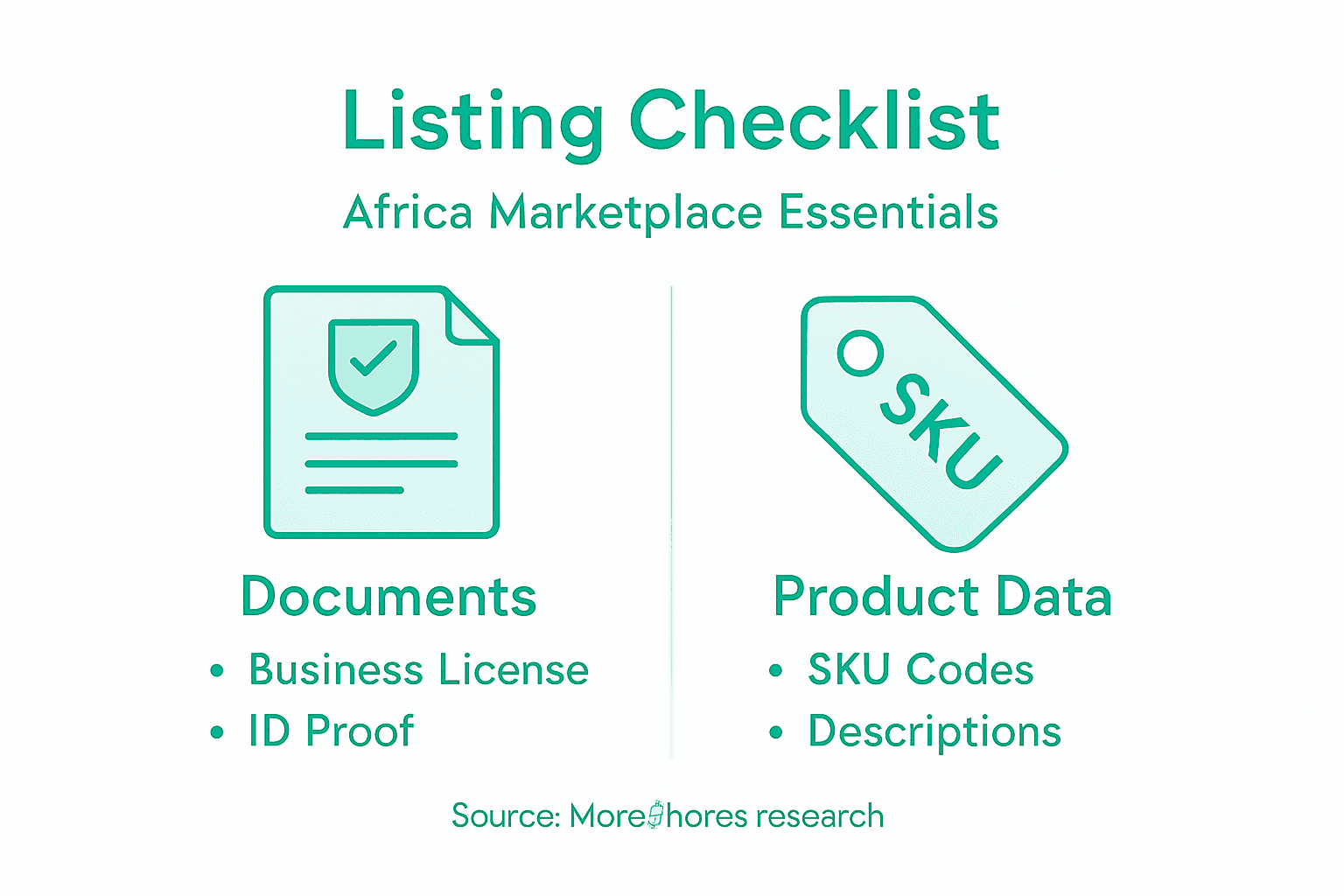
Next, verify your legal documentation. You’ll need:
- Business registration documents from your home country
- Tax identification numbers
- Proof of company ownership or authorization
- Bank account information for payments
- Identification documents for authorized signatories
Ensure all documents are current and clearly translated if needed. Marketplace platforms require these upfront, and delays here mean delayed account approval.
Then, research each marketplace’s specific requirements. Takealot, Jumia, Amazon SA, and Kilimall each have different onboarding processes, category restrictions, and compliance standards. Some require additional certifications for certain product categories. Some demand specific product data formats. Some have minimum seller rating expectations. Spend time on each platform’s seller center to understand what they want before applying.
Create separate email addresses for each marketplace account. This keeps your accounts organized and prevents confusion if one platform has issues. Use professional, branded email addresses whenever possible rather than personal ones.
Finally, set up your payment and banking information carefully. Most platforms pay sellers on fixed schedules—often 7 to 30 days after transaction. Ensure your bank account is in your company’s name, matches your business registration, and can receive international transfers. Double-check all banking details before submission, as errors here will halt payments.
Your marketplace account is your storefront. Taking time here prevents rejections, delays, and credibility problems down the line.
Pro tip: Create a master spreadsheet tracking each marketplace’s username, password, tax registration number, and key contact, then store it securely—you’ll reference this constantly as you manage multiple platforms.
Step 2: Integrate Product Feeds and Inventory
Connecting your product data to African marketplaces requires precision and ongoing management. This step automates how your inventory appears across multiple platforms, preventing overselling and keeping customer information accurate.
Start by preparing your product data feed. This is a structured file containing all product information: SKUs, titles, descriptions, prices, images, stock levels, and category mappings. Most marketplaces accept CSV or XML formats. Your data must match each platform’s exact specifications. Takealot wants different field names than Jumia, and both differ from Amazon SA. Download each marketplace’s product template and build your feed accordingly.

Next, map your inventory system to each marketplace. Your internal warehouse management system needs to communicate with external platforms. When you sell one unit on Takealot, your stock count updates everywhere else instantly. Without this connection, you’ll oversell products that are actually out of stock, damaging customer trust and generating refund headaches.
You have two main integration options:
Here’s a comparison of manual upload vs. automated API integration for managing marketplace product feeds:
| Integration Method | Setup Complexity | Scalability | Error Risk |
|---|---|---|---|
| Manual Upload | Low, mostly manual | Difficult with large range | Higher, due to manual entry |
| Automated API Integration | High, technical | Seamless even at scale | Lower, real-time syncing |
- Manual uploads involve exporting your product feed as a file and uploading it to each marketplace regularly (weekly or daily). This works for smaller catalogs but becomes tedious at scale.
- Automated API integration connects your system directly to marketplaces, syncing data in real-time. This requires technical setup but eliminates manual work.
Marketplace integration services can handle both approaches, connecting your products across Takealot, Jumia, Amazon SA, Kilimall, and your own Shopify or WooCommerce store through a single dashboard.
Then, test your product feeds before going live. Upload a small batch of products and verify they appear correctly on each platform. Check that images display properly, prices calculate correctly with local currency conversions, and stock levels sync accurately. One mistake here affects hundreds of potential customers.
Finally, establish a regular maintenance schedule. Product data isn’t a set-it-and-forget-it task. Prices change. Stock runs out. New products launch. Africa’s growing participation in global supply chains means your African customers expect current, accurate information just like international shoppers do.
Real-time inventory sync prevents the worst marketplace mistake: selling products you don’t have.
Pro tip: Set up automatic daily inventory sync at off-peak hours (like 2 AM) so system updates don’t slow customer browsing during peak shopping times.
Step 3: Optimize Listings for Market Compliance
Compliance isn’t optional in African marketplaces. Each country has specific regulatory requirements for product listings, labeling, and consumer protection. Getting this right prevents your listings from being delisted and builds trust with customers who expect legitimate sellers.
Start by researching country-specific regulations. South Africa, Nigeria, Kenya, and other African markets have different rules. Some require local language labels alongside English. Some mandate specific warning statements for certain product categories. Some require proof of product certification before you can list. Optimizing listings requires aligning with local regulatory standards across import regulations, quality certifications, and labeling rules.
Next, audit your product descriptions and claims. Remove anything misleading or unsubstantiated. Don’t claim “organic” without certification. Don’t say “clinically tested” without evidence. African consumers, like all consumers, are protected by law against false advertising. Marketplaces enforce these rules strictly and will remove violating listings immediately.
Then, ensure proper product categorization. Place your items in the correct marketplace categories. This isn’t just for organization. It determines what tax rates apply, which regulations govern the product, and whether special certifications are required. Electronics, food, cosmetics, and textiles each have different compliance needs.
Your compliance checklist should include:
Use this summary to understand common compliance requirements by product category:
| Product Category | Usual Certifications Needed | Typical Labeling Standards |
|---|---|---|
| Electronics | Safety, electrical compliance docs | English plus local language labels |
| Food & Beverage | Health, import, ingredient proofs | Allergen warnings, origin shown |
| Cosmetics | Toxicology, safety certificates | Ingredient list, safety symbols |
| Textiles | Material source, trade compliance | Fiber content, care instructions |
- Product safety certifications or testing documentation
- Ingredient lists and allergen warnings in required languages
- Country of origin and import documentation
- VAT registration numbers and tax compliance details
- Data privacy commitments for customer information
Address data privacy and consumer protection standards. Africa is developing robust digital governance frameworks for trade companies. Your listings must comply with evolving data regulations. Be transparent about how you collect and use customer data. Honor refund and return policies that meet or exceed local requirements.
Finally, document everything. Keep copies of certifications, testing results, and compliance approvals. When a marketplace questions your listing, you’ll need proof of compliance. This documentation also protects you legally if disputes arise.
Non-compliance costs more than compliance. A delisted product generates zero revenue.
Pro tip: Create a compliance spreadsheet for each country listing your products in, noting applicable regulations, certifications needed, and approval dates so you can quickly prove compliance when marketplaces ask.
Step 4: Verify Listings and Monitor Performance
Once your listings go live, verification and ongoing monitoring ensure they stay accurate, compliant, and profitable. This step involves confirming everything displays correctly across platforms and tracking how your products actually perform.
Start by manually verifying each listing. Visit each marketplace and search for your products by name, SKU, or category. Check that images load properly, prices display in local currency, and descriptions appear exactly as intended. Look for formatting errors, broken links, or missing information. What looks perfect in your backend sometimes displays incorrectly on the customer-facing storefront.
Next, verify product authenticity and data accuracy. Trusted verification services like GS1 help ensure your product barcodes, company identities, and location data are authentic and compliant. This builds consumer confidence and improves supply chain transparency. Customers increasingly expect verification badges on marketplace listings, especially for electronics, cosmetics, and premium products.
Then, set up performance monitoring dashboards. Most marketplaces provide seller analytics tools showing you:
- Product views and click-through rates
- Conversion rates (browsers who actually purchase)
- Customer reviews and ratings
- Return and complaint rates
- Sales velocity by product and category
Check these metrics weekly to identify trends. If a product gets clicks but no sales, your price might be too high or your images unconvincing. If sales are strong but returns spike, quality or description accuracy might be the problem.
Address customer feedback and reviews promptly. Respond to negative reviews professionally and helpfully. Ask what went wrong. Offer solutions. Positive response to criticism actually increases buyer confidence more than having no complaints at all.
Finally, create an action plan from your data. If product A outperforms product B by 300 percent, invest more inventory in A. If a category consistently underperforms, investigate whether compliance or pricing issues exist. Your marketplace data is your roadmap to optimization.
Performance data doesn’t lie. Use it to double down on what works and fix what doesn’t.
Pro tip: Export your marketplace analytics into a spreadsheet monthly so you can spot seasonal patterns, year-over-year growth trends, and which product variations your African customers actually prefer.
Simplify Your African Marketplace Expansion with MoreShores
Expanding your brand into African marketplaces means tackling complex challenges like compliance, inventory integration, and accurate product listings. You face pressures to ensure real-time stock updates, meet diverse regulatory standards, and maintain consistent, localized branding across platforms like Takealot, Jumia, and Amazon SA. This guide highlights how critical it is to avoid errors that lead to delisted products or lost revenue.
MoreShores takes the headache out of managing these complexities offering a full-spectrum cross-border trade solution designed specifically for brands entering African markets. With expert handling of duties, VAT, and customs as your Importer of Record, automated marketplace integration across multiple platforms, plus reliable warehousing and fulfillment, your brand gains seamless control over compliance and inventory synchronization. Stop risking oversells or compliance pitfalls and start building trust with African customers confidently.

Ready to eliminate delays and operational friction in your African marketplace launches? Visit MoreShores now to discover how our end-to-end platform empowers your brand to grow efficiently and compliantly across Africa’s booming e-commerce landscape.
Frequently Asked Questions
How do I prepare my marketplace accounts for African expansion?
To prepare your marketplace accounts effectively, first audit your brand materials like logos, product descriptions, and images. Next, verify all legal documentation including business registration and tax information, and research the specific requirements of each marketplace before creating your accounts.
What information do I need to integrate my product feeds into African marketplaces?
You need to prepare a structured product data feed that includes SKUs, titles, descriptions, prices, images, and stock levels. Ensure that your product data matches the exact specifications of each marketplace, and consider automating the integration via APIs to reduce manual uploads and potential errors.
How can I ensure my product listings comply with marketplace regulations?
To ensure compliance, research the specific regulations for product listings in the African marketplaces you are targeting. Audit your product descriptions for accuracy, verify proper categorization, and keep documentation of any required certifications to avoid delisting and build customer trust.
Why is it important to monitor the performance of my listings?
Monitoring the performance of your listings helps you track metrics like click-through rates and conversion rates. Regularly reviewing this data allows you to identify trends and make informed decisions on inventory, pricing, and potential issues impacting sales and customer satisfaction.
What steps should I take if I receive negative customer feedback?
Addressing negative customer feedback promptly is crucial for maintaining trust. Respond professionally, ask for specific issues, and offer solutions, turning criticism into an opportunity to improve and boost buyer confidence.
How often should I update my product information and listings?
Product information should be updated regularly to reflect changes in stock, pricing, and new product launches. Establish a maintenance schedule, such as weekly or bi-weekly, to ensure your listings remain current and relevant, which will help in aligning with customer expectations.