Warehouse management advantages for cross-border e-commerce

TL;DR:
- Effective warehouse management is vital for faster delivery, cost savings, and regulatory compliance in African cross-border e-commerce.
- Choosing the right WMS model—centralized, decentralized, or hybrid—depends on business size, product type, and market reach.
- Investing in warehouse infrastructure and expertise early yields high ROI by preventing operational disruptions and enhancing customer satisfaction.
Running a cross-border e-commerce operation in Africa without solid warehouse management is like building a storefront without a stockroom. Orders pile up, customs paperwork stalls shipments, and customers lose confidence fast. For logistics managers and e-commerce business owners moving goods across African borders, warehouse management is not a back-office detail. It is the operational engine that determines whether your supply chain delivers on its promises or breaks down under pressure. This article breaks down the core advantages, explains your main system options, and gives you a practical framework for choosing the right approach.
Table of Contents
- What makes warehouse management crucial for cross-border e-commerce?
- Major advantages of effective warehouse management
- Types of warehouse management systems: centralized, decentralized, and hybrid
- Comparison of warehouse management solutions: which is right for your business?
- Why most African e-commerce operations underestimate warehouse management’s ROI
- How MoreShores can elevate your warehouse management and cross-border success
- Frequently asked questions
Key Takeaways
| Point | Details |
|---|---|
| Warehouse management maximizes efficiency | Proper systems cut costs, speed up delivery, and reduce errors for African e-commerce operations. |
| Choose the right warehouse model | Centralized, decentralized, and hybrid options each serve different business needs and growth stages. |
| Invest early for strategic growth | Treat warehousing as a driver of long-term competitive advantage, not just a cost. |
| Data-driven warehousing reduces cross-border friction | Real-time tracking and compliance tools streamline customs and boost delivery reliability. |
What makes warehouse management crucial for cross-border e-commerce?
When goods cross international borders into or within Africa, every handoff point is a potential failure. Customs clearance, import duties, last-mile delivery networks, local regulations—each layer adds complexity. Warehouse management is the function that holds all of these moving parts together.
Strong warehouse fulfillment strategies directly influence four critical performance areas:
- Delivery speed: Inventory stored closer to the customer, with proper stock organization, moves faster. A disorganized warehouse adds hours or days to every order.
- Cost efficiency: Accurate inventory tracking reduces over-ordering, spoilage, and emergency freight costs. These savings compound quickly at volume.
- Reliability: Consistent warehouse processes translate to predictable order accuracy. When customers receive the right item on time, repeat purchase rates increase.
- Compliance: Cross-border shipments require proper labeling, documentation, and classification. A warehouse system that tracks compliance requirements prevents costly customs rejections.
In the African cross-border context, three operational pain points come up repeatedly: inventory delays caused by fragmented logistics infrastructure, customs bottlenecks from incomplete or inaccurate documentation, and product damage or loss during transit and storage. All three are directly addressable through disciplined warehouse management.
“Effective warehouse management is not just about storing goods. It is the integration of inventory control, freight handling, and cargo transportation into one cohesive, responsive system—especially critical in markets where infrastructure gaps can amplify every small operational misstep.”
A well-structured warehouse management system (WMS) serves as the foundation for fulfillment and last-mile delivery. Without it, even the best courier partnerships cannot perform consistently. With it, you gain the predictability your customers and marketplace partners expect through solid e-commerce integration across your sales channels.
Major advantages of effective warehouse management
Once you understand why warehouse management matters, the next question is what you actually gain by investing in it. Here are the key advantages, with context specific to African cross-border e-commerce operations.
-
Inventory accuracy and reduction of stockouts or overstock: A WMS tracks real-time stock levels across all SKUs (stock keeping units, the unique identifiers for each product). This prevents the twin problems of stockouts, which disappoint customers, and overstock, which ties up working capital. In markets like Nigeria or Kenya where restocking lead times from overseas can run four to eight weeks, accurate inventory data is not optional.
-
Improved order fulfillment speed: Automated pick-and-pack workflows reduce the time between order placement and shipment. For sellers on Takealot, Jumia, or Kilimall, meeting platform-mandated fulfillment windows is a requirement for maintaining good seller ratings. Fast fulfillment also reduces customer service inquiries, saving operational time.
-
Reduced operational costs: The savings from warehouse management compound across multiple cost lines. Better space utilization lowers storage fees. Fewer picking errors mean fewer returns and reshipments. Optimized inbound receiving reduces labor hours. For businesses using cross-border logistics enablement services, accurate warehouse data also improves freight planning and reduces emergency shipping spend.
-
Easier compliance with cross-border regulations: South Africa, Kenya, Ghana, and other African markets each have distinct labeling requirements, import duty classifications, and product compliance standards. A WMS can store and flag these requirements by product category, ensuring that shipments are prepared correctly before they reach customs. This reduces the risk of customs delays or rejections that can strand inventory for days or weeks.
-
Better visibility and real-time tracking: When you can see exactly where your inventory is at any point in your supply chain, you can make faster, better decisions. Visibility also gives you credibility with marketplace partners and B2B buyers who need accurate stock availability information.
-
Ability to scale or adapt to seasonal and global shifts: Peak seasons like Black Friday, Chinese New Year shipping windows, or regional holidays create demand spikes. A scalable WMS adjusts to these fluctuations without requiring a complete operational overhaul. This is particularly valuable for sellers operating across multiple African markets with different peak periods.
-
Data-driven negotiation leverage: This one often gets overlooked. When you have detailed data on order volumes, fulfillment times, error rates, and carrier performance, you hold real leverage in negotiations with logistics partners.
Pro Tip: Export your WMS fulfillment reports monthly and compare carrier performance metrics. When you show a courier your volume projections alongside their historical delivery accuracy, you are in a much stronger position to negotiate rates or service-level commitments.
Types of warehouse management systems: centralized, decentralized, and hybrid
After you understand the advantages, selecting the right WMS type is the next practical step. The three main models each suit different business profiles, product categories, and market footprints.
Centralized warehouse management operates from a single main facility. All inventory flows in and out of one location. This model gives you maximum control over stock accuracy, compliance documentation, and operational processes. The trade-off is delivery speed. If your warehouse is in Johannesburg but your customers are in Nairobi or Lagos, transit times and shipping costs increase significantly. Centralized systems work best for businesses with high-value or low-volume products, where control and documentation matter more than delivery speed.
Decentralized warehouse management uses multiple regional warehouses positioned closer to end customers. Orders ship from the nearest stocking location, which dramatically cuts last-mile delivery times. The complexity, however, multiplies. You are now managing multiple inventory pools, multiple compliance requirements, and multiple facility relationships. For sellers on marketplace warehousing platforms that support regional fulfillment, this model can be highly effective once your order volume justifies the overhead.

Hybrid warehouse management combines elements of both. You maintain a primary warehouse for bulk inventory and compliance processing, while using smaller regional hubs or third-party fulfillment partners for last-mile delivery in key markets. This model balances cost, control, and speed—and is the most commonly recommended approach for growing African e-commerce operations.
Here is a direct comparison of all three system types:
| System type | Core advantage | Best suited for | Potential drawback |
|---|---|---|---|
| Centralized | Operational control, compliance simplicity | High-value items, single-market sellers | Slower delivery to remote customers |
| Decentralized | Fast regional fulfillment | High-volume, multi-market operations | High complexity, higher fixed costs |
| Hybrid | Balanced cost, speed, and control | Scaling brands entering multiple markets | Requires strong coordination between locations |
Key factors to consider when choosing your model:
- Product category: Perishables, electronics, and regulated goods each have different storage and compliance requirements that affect which model is practical.
- Order volume: Low-volume operations rarely justify the overhead of decentralized warehousing.
- Market reach: If you are selling into two or three African countries, a centralized or hybrid approach is usually more cost-effective than building out regional warehouses.
- Capital availability: Decentralized and hybrid models require more upfront infrastructure investment or third-party fulfillment partnerships.
Comparison of warehouse management solutions: which is right for your business?
Now that you know the available types, here is how to match them to your specific business requirements. The goal is not to find the theoretically best system. It is to find the right fit for where your business is today and where you plan to be in 18 to 36 months.
| Business profile | Recommended WMS type | Key reason | Watch out for |
|---|---|---|---|
| Early-stage startup | Centralized | Lower cost, simpler operations | Growth constraints if demand spikes |
| Scaling e-commerce brand | Hybrid | Balances speed and cost as you expand | Coordination complexity between nodes |
| Seller of perishable goods | Decentralized or hybrid | Freshness requires proximity to customer | Higher logistics costs |
| High-value or regulated products | Centralized | Documentation control is critical | May require customs bonded warehouse |
| Multi-market African expansion | Hybrid | Different countries need regional presence | Requires strong logistics partnerships in Africa |
The decision factors come down to four variables: your current order volume, the capital you have available for infrastructure, the number of markets you are actively serving, and how much operational agility you need. A business shipping 200 orders per month from South Africa into one other market has very different needs than a brand managing 5,000 monthly orders across Nigeria, Kenya, and Ghana.
Pro Tip: Set up a simple tracking dashboard with four metrics: inventory turnover time, order accuracy rate, average fulfillment time, and return rate. Review these monthly. When two or more metrics consistently worsen, it is a reliable signal that your current WMS is no longer the right fit and it is time to evaluate alternatives.
One often-missed insight: the cost of staying with the wrong WMS is harder to see than the cost of switching. Missed marketplace performance thresholds, excess stock carrying costs, and lost customer trust all erode margin quietly. The operational data your WMS generates is the clearest early warning system you have.
Why most African e-commerce operations underestimate warehouse management’s ROI
Here is the uncomfortable truth we see repeatedly: most e-commerce businesses in Africa treat warehousing as a cost to minimize rather than a capability to develop.
This thinking is understandable. Warehouse space costs money. WMS software requires investment. Building out fulfillment infrastructure feels like overhead when your sales team is focused on driving revenue. But the return on investment calculation changes completely when you look at the downstream effects of poor warehouse management.
Consider what poor warehousing actually costs you. Delayed shipments trigger marketplace penalties and suppressed listings on platforms like Takealot or Jumia. Inventory inaccuracies cause overselling, which generates negative reviews and customer service backlogs. Customs rejections from incomplete documentation delay entire shipment batches, not just individual orders. These are not rare edge cases. They are the predictable outcomes of treating warehousing as an afterthought.
The businesses we see winning in African cross-border e-commerce share one common characteristic: they invested in warehousing infrastructure and fulfillment expertise earlier than felt comfortable. They built the capability before they needed it at full scale. As a result, when order volumes increased or they entered a new market, the infrastructure was already in place to absorb the growth without operational breakdowns.
Warehousing is not a back-office function. It is your competitive position made physical. When a customer in Lagos receives the right product in three days instead of ten, your warehouse made that happen. When a shipment clears South African customs without delay because your documentation was complete and accurate, your WMS made that happen. The ROI is real. It is just measured in avoided costs and retained customers rather than a single line on a revenue report.
The shift in mindset we encourage is this: stop asking “what does warehouse management cost?” and start asking “what does poor warehouse management cost?” You will find the answer is much larger than you expected.
How MoreShores can elevate your warehouse management and cross-border success
The advantages of strong warehouse management are clear. Building it from scratch, however, is a significant investment of time, capital, and operational expertise—especially when you are simultaneously managing marketplace listings, customs compliance, and logistics coordination across multiple African markets.
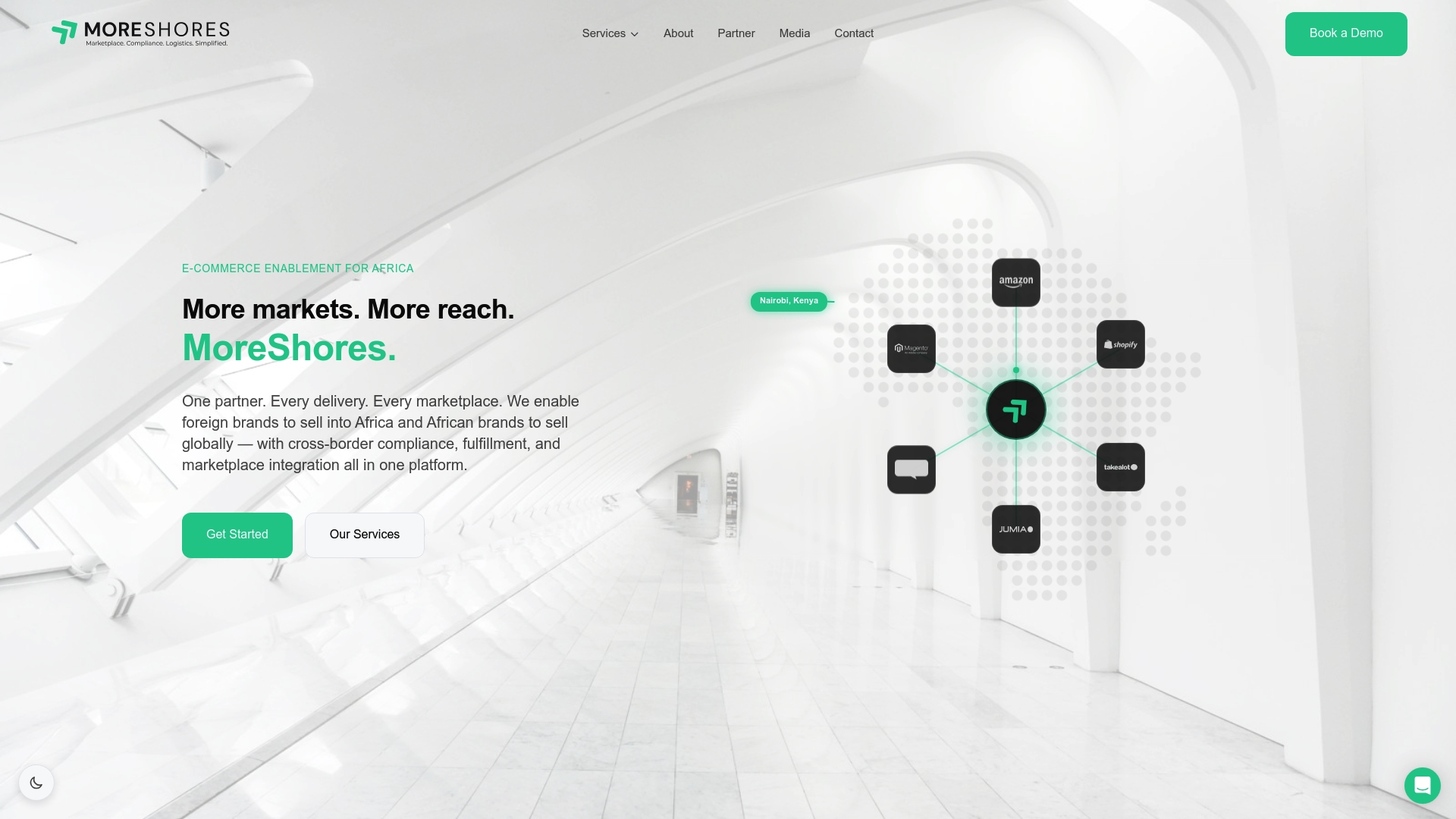
MoreShores provides cross-border enablement services that integrate warehouse management, fulfillment, and marketplace technology into one ready-to-use platform. You get access to established warehousing infrastructure, a multi-courier fulfillment network, and compliance handling for duties, VAT, and regulatory requirements. Our advanced fulfillment solutions are designed to scale with your business, so you are not rebuilding your operations every time you enter a new market or hit a new volume threshold. And with full e-commerce solutions that connect directly to Takealot, Amazon SA, Jumia, Shopify, and WooCommerce, your inventory data and order flows stay synchronized from warehouse to customer. If you are ready to stop managing logistics complexity and start growing your business, MoreShores is built for exactly that.
Frequently asked questions
What is warehouse management and why does it matter for African e-commerce?
Warehouse management is the process of optimizing storage, handling, and shipping of inventory. In Africa’s cross-border context, it is critical for faster delivery and cost control, as outlined in MoreShores’ fulfillment and logistics approach.
How do good warehouse practices reduce cross-border shipping problems?
Effective warehousing streamlines customs preparation and reduces delivery delays or losses by ensuring inventory accuracy and regulatory compliance, which is central to cross-border enablement operations.
Which type of warehouse system is most cost-effective for startups?
Centralized warehouse management systems are usually best for startups due to their lower fixed costs and simpler operations, making marketplace integration easier to manage at early scale.
When should a business invest in a hybrid warehouse management system?
A hybrid system is ideal when your business expands to multiple regions with varying demand or must balance cost-efficiency and fast delivery, a transition well supported through experienced e-commerce logistics partners.
Does warehouse management help my company scale for regional growth?
Yes, robust warehouse management provides the flexibility and control needed for seamless expansion across markets, and a strong fulfillment infrastructure is the foundation that makes regional scaling operationally viable.