Inventory management explained: Optimize e-commerce across borders

TL;DR:
- Inventory management is a strategic process involving ordering, tracking, and controlling goods across borders.
- Real-time, automated systems are essential to prevent stockouts, overstocking, and overselling in cross-border trade.
- Effective inventory management enhances scalability, reduces costs, and improves marketplace reputation in African-global e-commerce.
Most brands think inventory management is simply about knowing how many units are sitting in a warehouse. That’s stockkeeping. Inventory management is something far more strategic, especially when you’re moving goods across continents, navigating customs regulations, and selling through multiple marketplaces simultaneously. For e-commerce brands trading between Africa and global markets, getting inventory management right is the difference between scaling profitably and bleeding cash on avoidable mistakes. This guide breaks down exactly what inventory management is, why it matters in cross-border trade, and how to apply it effectively to your operations.
Table of Contents
- What is inventory management?
- Why inventory management matters in cross-border e-commerce
- Key components of an effective inventory management system
- Best practices for optimizing inventory management in Africa-global trade
- A fresh perspective: Rethinking inventory management for Africa’s global e-commerce future
- Take your inventory management global with MoreShores
- Frequently asked questions
Key Takeaways
| Point | Details |
|---|---|
| Inventory management defined | It’s the process of strategically ordering, storing, and tracking products for efficient sales and fulfillment. |
| Cross-border challenges | Managing inventory globally requires handling customs, logistics delays, and syncing multiple sales channels. |
| Best practices matter | Leveraging technology and proven strategies increases accuracy and speed in Africa-global e-commerce. |
| Optimize for growth | A robust inventory system is key for scaling e-commerce brands into new international markets. |
What is inventory management?
Inventory management is the process of ordering, storing, tracking, and controlling the flow of goods from the point of origin to the point of sale. It covers every stage a product moves through before it lands in a customer’s hands, including procurement, warehousing, order processing, and replenishment.
In e-commerce, this means tracking SKUs (stock keeping units, the unique identifiers for each product), monitoring warehouse stock levels, syncing quantities across online sales channels, and making sure the right products are available at the right time. It’s a continuous, real-time operation, not a monthly count.
Core components of inventory management
Here’s what a complete inventory management function actually covers:
- Ordering and procurement: Deciding when and how much to order based on sales velocity and lead times
- Storage and warehousing: Organizing physical goods so they can be picked, packed, and shipped efficiently
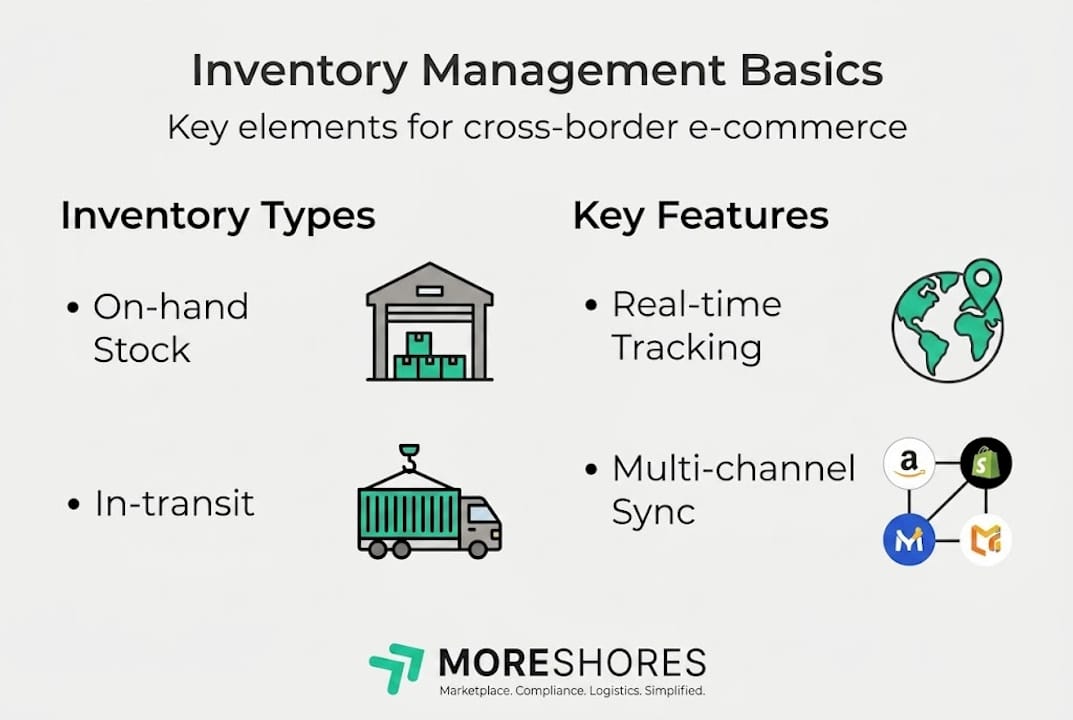
- Stock level monitoring: Maintaining real-time visibility into how many units are available, reserved, or in transit
- Sales channel synchronization: Updating quantities across every marketplace and storefront automatically when a sale happens
- Returns management: Processing returned goods back into sellable or disposable inventory
- Reporting and analytics: Using data to understand turnover rates, carrying costs, and slow-moving stock
Types of inventory in e-commerce
Not all inventory is the same. You’ll typically manage three types:
| Inventory type | Description | Cross-border relevance |
|---|---|---|
| Finished goods | Ready-to-sell products sitting in a warehouse | Most common in Africa-global e-commerce |
| In-transit stock | Goods currently being shipped between countries | Critical to track during sea or air freight |
| Safety stock | Buffer inventory held to cover demand spikes or delays | Essential for African import lead times |
The distinction between these types matters because in-transit stock, for example, can’t be sold but still represents capital. If you’re importing goods from Asia into South Africa or shipping African goods to European buyers, your in-transit inventory could represent weeks of stock value locked up in logistics. Inventory management systems track the flow of goods across logistics networks, giving you real-time visibility at every stage.
Pro Tip: Always account for in-transit stock separately in your reporting. If you count it alongside on-hand stock, you’ll consistently overestimate availability and trigger stockouts at your warehouse.
Inventory management vs. simple stockkeeping
Stockkeeping is reactive. You count what’s there. Inventory management is proactive. You plan what needs to be there, when, and at what quantity. For brands operating across borders, the proactive approach isn’t optional. A single customs delay can wipe out weeks of stock if you haven’t planned for it.
Why inventory management matters in cross-border e-commerce
With the groundwork set, it’s vital to understand why inventory management takes center stage in cross-border e-commerce, especially when moving goods between Africa and other regions.
Cross-border e-commerce introduces layers of complexity that domestic operations simply don’t face. Shipments cross multiple jurisdictions. Customs clearance can add days or weeks to lead times. Duties and VAT affect the landed cost of goods. And marketplaces in different regions have their own rules for listing, fulfillment, and returns.

The unique challenges of Africa-global trade
Here are the specific pain points brands consistently face:
- Supply chain variability: Shipping routes into and out of Africa often have fewer direct options, meaning longer lead times and greater variability in delivery windows
- Customs delays: Inadequate documentation or compliance gaps can hold goods at ports of entry, creating unplanned stockouts
- Overstocking risks: Ordering too much to compensate for uncertainty means capital tied up in slow-moving goods and higher warehousing costs
- Multi-marketplace complexity: Selling on Takealot, Jumia, and Amazon SA simultaneously means inventory can sell from different channels at different speeds, making manual sync near-impossible
- Currency and pricing fluctuations: Exchange rate shifts affect reorder cost calculations in ways that require dynamic inventory valuation
Manual vs. automated inventory systems
The gap between manual and automated inventory management is wide, and it widens further in cross-border operations.
| Factor | Manual management | Automated management |
|---|---|---|
| Stock accuracy | Updated periodically, prone to errors | Real-time, synced across channels |
| Customs documentation | Created manually, risk of gaps | Integrated with compliance workflows |
| Demand forecasting | Based on gut feel or simple spreadsheets | Data-driven, based on sales velocity |
| Reorder triggers | Set manually, often reactive | Automated alerts at defined thresholds |
| Scalability | Breaks down as SKU count grows | Scales with your catalog and channels |
The integration of inventory management with transportation platforms improves international operations significantly, reducing both error rates and fulfillment delays.
A brand managing 50 SKUs manually might just get by. Add a second warehouse in a different country, three marketplaces, and fluctuating import timelines, and manual systems collapse. Automation isn’t a luxury for cross-border brands. It’s the foundation.
The business impact of poor inventory management
The consequences are concrete. Stockouts cost you sales and damage marketplace rankings. Overstocking inflates warehousing fees and ties up cash you could use elsewhere. Inaccurate tracking leads to overselling, which triggers order cancellations and negative reviews. These aren’t small inconveniences. They compound quickly and can undermine your marketplace reputation in markets you’ve worked hard to enter.
Working with a platform that offers marketplace integration across African and global channels is one of the most effective ways to eliminate these risks at scale.
Key components of an effective inventory management system
Understanding why inventory management is important, let’s look at what makes up an effective inventory system for cross-border e-commerce.
A modern inventory management system (IMS) isn’t just software for counting stock. It’s a connected infrastructure that links your supply chain, warehousing, sales channels, and compliance requirements into a single operational view. Here’s what the best systems include.
1. Real-time stock level tracking
Your IMS should update inventory quantities the moment a sale occurs, a return is processed, or a new shipment is received. This prevents overselling and gives your team accurate data for every decision downstream. Real-time tracking becomes especially critical when you’re selling across time zones and your warehouse is in one country while your buyers are in another.
2. Multi-channel sales integration
If you sell on Takealot, Jumia, Amazon SA, Shopify, and WooCommerce simultaneously, your IMS needs to pull all of those channels into a single inventory pool. When a unit sells on Takealot, it must be deducted from availability on every other channel immediately. Without this, overselling is inevitable.
3. Demand forecasting and replenishment
Good systems analyze historical sales data, seasonal trends, and upcoming promotions to recommend reorder quantities and timing. For Africa-global trade, this must account for longer lead times. If your supplier is in China and shipping to South Africa takes 30 days, your reorder point needs to trigger earlier than it would for a domestic supplier.
4. Returns management
Returns processing is often underestimated. When a product comes back, your system needs to assess its condition, decide whether it goes back into sellable stock or gets written off, and update inventory accordingly. Technology solutions enable better tracking and management of inventory for logistics providers handling returns across borders.
5. Customs and compliance tracking
Cross-border inventory management must integrate with customs documentation workflows. Your system should track which shipments are in customs clearance, what duties have been paid, and which regulatory approvals are required for specific product categories. This is especially important for goods entering African markets, where NRCS (National Regulator for Compulsory Specifications) approvals and other compliance checks can affect whether stock clears port on time.
6. Reporting and analytics
You need visibility into turnover rates, carrying costs, dead stock, and fill rates. These metrics tell you whether your inventory strategy is actually working. A system that only tells you what’s in stock today isn’t giving you the insights you need to improve.
Pro Tip: Look for a system that generates landed cost reports, including shipping, duties, and warehousing, so you know the true cost of each unit on your shelves, not just the purchase price.
Building this infrastructure internally is complex. Working with logistics platform partnerships that already have these systems integrated can dramatically reduce your setup time and operational risk.
Best practices for optimizing inventory management in Africa-global trade
Once you know the components, the next step is applying best practices to optimize your cross-border inventory operations.
Synchronize inventory across all sales channels
Never manage inventory in silos. If Takealot and Jumia each see a separate inventory pool, you’ll either overcommit stock or leave units sitting unsold in one channel while the other runs out. Centralize your inventory and let your system allocate it across channels dynamically.
Build safety stock for cross-border delays
Safety stock is a buffer quantity you hold above your expected demand to absorb delays. For Africa-global routes, the calculation needs to be more generous than typical domestic formulas. Port congestion, customs holds, and longer freight routes are common, not exceptional. Build your safety stock based on your worst-case lead time, not your average.
Track in-transit inventory separately
Create a dedicated category in your IMS for goods that have shipped from your supplier but haven’t yet arrived at your warehouse. This prevents phantom availability (counting stock you can’t actually ship) and gives you a more accurate picture of when replenishment will land.
Use real-time data for purchasing decisions
Don’t reorder based on a weekly stock report. Set automated reorder points that trigger when stock drops to a defined level, accounting for your lead time and safety stock buffer. This keeps your purchasing decisions grounded in actual velocity rather than guesswork.
“Effective inventory management in cross-border e-commerce isn’t about having more stock. It’s about having the right stock, in the right place, at the right time, with full visibility across every step of the journey.”
Partner with reliable logistics and marketplace experts
Your IMS is only as good as the logistics network behind it. If your carrier can’t provide accurate tracking data, your in-transit inventory visibility breaks down. If your marketplace partner doesn’t sync stock changes in real time, you’ll face overselling. Freight transportation and logistics providers benefit from defined strategies for effective inventory management, and the brands that choose partners with those strategies built in gain a measurable operational advantage.
Conduct regular inventory audits
Even the best automated systems need periodic verification. Schedule physical counts or cycle counts (counting specific product groups on a rotating basis) at your warehouses to catch discrepancies early. In cross-border operations, a single data entry error can cascade into mis-shipped orders, customs documentation errors, and customer complaints.
A fresh perspective: Rethinking inventory management for Africa’s global e-commerce future
Most brands treat inventory management as an operational checkbox. They set it up, assume it’s running, and focus attention elsewhere. That mindset is costly in any market. In Africa-global trade, it’s particularly damaging.
Here’s what we’ve seen consistently: brands entering African markets underestimate how much regional trade realities reshape inventory logic. Standard safety stock formulas built for European or North American supply chains don’t hold up when your freight is crossing multiple borders, subject to variable customs timelines, and arriving through ports with periodic congestion.
The counterintuitive truth is that building more flexibility into your inventory buffers, rather than just optimizing for the leanest possible stock levels, often generates better margin outcomes in African market trade. Less stockout revenue loss. Fewer expedited freight costs. Stronger marketplace rankings from consistent fulfillment.
We also see brands chronically underinvesting in Africa-focused e-commerce innovation, especially in marketplace-first integration. Getting your inventory synced to Takealot, Jumia, or Kilimall before perfecting your supply chain is a valid strategy. Let real demand data from live sales inform your replenishment model. Inventory management isn’t just a back-office cost center. It’s a direct lever for revenue in new markets when you use it strategically.
Take your inventory management global with MoreShores
If the strategies in this guide resonate with your growth ambitions, MoreShores is built to put them into practice for you. We specialize in cross-border enablement for brands trading between Africa and the global market, handling everything from compliance and customs to real-time inventory tracking and multi-marketplace listing.

Our platform integrates your inventory with fulfillment and logistics support across a multi-courier network, keeping your stock visible and your orders moving. Whether you’re a global brand entering African markets or an African brand selling internationally, we offer complete e-commerce solutions designed for the specific realities of cross-border trade. Reach out to our team and let’s build an inventory strategy that works across borders.
Frequently asked questions
What are the biggest inventory challenges for cross-border e-commerce between Africa and other regions?
Major challenges include managing customs delays, supply chain variability, and synchronizing inventory across multiple marketplaces. Solving these requires integration of inventory management with transportation and compliance platforms to maintain real-time visibility.
How can I prevent overstocking or stockouts in international e-commerce?
Use technology for real-time tracking, build safety stock calibrated to your actual cross-border lead times, and coordinate closely with logistics partners. Defined strategies for effective inventory management help freight and logistics providers reduce both overstock and stockout incidents significantly.
Which technology features are essential for inventory management today?
Key features include automation, multi-channel marketplace integration, real-time analytics, and customs tracking. Technology solutions that enable better tracking give logistics providers and e-commerce brands the operational clarity needed to scale across borders without sacrificing accuracy.